An animation drawing by Fred Moore was sold earlier this month at Heritage Auctions. It is a strong image of Mickey Mouse in his greatest roll as the Sorcerer's Apprentice in "Fantasia" (1940). Although this is not a production drawing, Mickey is apparently expressing to Yen Sid, the sorcerer, that he regrets his overreach as an apprentice. Well done, Mickey.
Those gloves! They're unmistakeable, but are they his or hers? Does it even matter? A very simple Disney Trading Pin makes its case for love. Happy Valentine's Day.
A convention sketch by underground comix artist Bobby London was signed and inscribed to one John Taylor on July 6, 1975. At the time, London's Dirty Duck and Weevil characters were appearing monthly in National Lampoon. Here they are shown encountering a genie in a bottle who appears as a sinister Mickey Mouse. This is an Air Pirates reference. The copyright-infringing underground collective was still involved in the ongoing Disney lawsuit. Dirty Duck had also made an appearance in Air Pirates #1.
Bobby London Hake's Auction listing of March 22, 2023
The classic pie-eyed Minnie and Mickey Mouse face each other in a 2015 hinged Disney trading pin. The heart-shaped pin is in two pieces held together by two round links. The large and unconventional design requires two pin backs, so it's not an easy thing to wear. No matter; it's great to look at.
One of the very important parts of Eldon’s early career was his time spent working as a staff cartoonist for Disney beginning in 1944, primarily on "The Adventures of Ichabod and Mr. Toad" (an adaptation of Wind in the Willows), "Mickey and the Beanstalk," and "Fun and Fancy Free."
Years after his association with Disney, when Eldon Dedini (1921-2006) was recognized as an independent cartoonist who contributed brilliantly to publications such as The New Yorker and Playboy, he continued to give fans souvenir drawings, like that seen above, of a certain well-known mouse. These sketches generally show a left-facing Mickey, which is classic and also easier for a right-handed artist to draw.
One of Dedini's less typical Mickey Mouse drawings appears on a 1977 Israeli first day cover. Here he wishes Israel a happy 50th birthday, which pretty much fixes the date of the sketch to 1998. Mickey celebrates by wearing the traditional skullcap called either a kippah (from the Hebrew) or a yarmulke (from the Yiddish).
Eldon Dedini eBay listing accessed September 12, 2021
Regarding the following drawing from 2000, it might be more accurate for Dedini to say that he hasn't stopped drawing Mickey Mouse for over fifty years:
Note: I ask once again, do such drawings really need to be authenticated with a sticker? It can't add much value to obvious Dedini sketches such as these, and the obtrusive stickers deface the artwork.
Animator Ward Kimball (1914-2002) was one of Walt Disney's legendary Nine Old Men. Kimball's full-figure sketch of Mickey Mouse shows him in his most iconic role as the Sorcerer's Apprentice from Fantasia (1940). It was listed just the other day by Schulson Autographs, Ltd., of Millburn. It has already found a new owner.
Ward Kimball AbeBooks listing accessed April 27, 2022
"People who like the theatre can't help but like The New Yorker." So advertised the magazine in the April 1938 issue of Stage: The Magazine of After Dark. The ad featured a collage of nine theatre pages from The New Yorker, all illustrated by Alfred Frueh. Evidently the magazine was making a play for new readers who were fans of the theatre, rather than fans of flawless grammar. Frueh's drawings cover the Broadway plays "On Borrowed Time," "Our Town," Julius Caesar," "Of Mice and Men," and "A Doll's House," among others.
"People who like the theatre can't help but like The New Yorker." Alfred Frueh
The magazine cover features a photograph of actress Helen Hayes:
Helen Hayes touring as Portia in "The Merchant of Venice" Stage: The Magazine of After Dark, April 1938 Photo by Vandamm
The truth is, readers of Stage were already familiar with a number of contributors to the New Yorker, many of them artists. Illustrator Victor de Pauw contributed cartoons and spot drawings to The New Yorker. A full-width spot drawing for Stage on the contents page could easily be taken for a New Yorker spot.
Contents Spot drawing by Victor de Pauw
Ludwig Bemelmans illustrates a Frank Sullivan piece the year after the artist's work first appeared in The New Yorker and the year before his first Madeline book was published.
First putting suet on his Saratoga lawn for a tame flock of spring harbingers, Frank Sullivan takes a junket to Broadway, and casts a weather-eye on the current drama. Ludwig Bemelmans
Detail showing the remainder of the far right side of the Bemelmans drawing
Christina Malman caricatures actress Beatrice Lillie.
"Till the Weather Breaks" by Beatrice Lillie Caricature of Beatrice Lillie by Christina Malman
Why , I can remember when a dog could go to sleep all day in the middle of Main Street and nothing come along to disturb him.
—Thornton Wilder, "Our Town"
The streets of Grover's Corners still look pretty tranquil in Adolf Dehn's illustration of the Stage Manager's story, condensed. New Yorker readers occasionally got to see Dehn's work, but never in color.
"Our Town" Adolf Dehn
Meanwhile Abe Birnbaum illustrates the jazz scene.
The old Onyx Club
"Oh, Say Can You Swing" by Paul Douglas
Illustration by Abe Birnbaum
Ruth Woodbury Sedgwick's column is named for the privilege of sitting in the center seats of the seventh row. One hopes George Price's absurd cartoon takes place many rows back.
"He's a dramatic critic, and sees a point in keeping it a secret." George Price
Music writer Marcia Davenport, who also contributed to The New Yorker, offers the second part of a profile of conductor Leopold Stokowski.Otto Soglow's accompanying cartoon anticipates the iconic handshake between Stokowski and Mickey Mouse that was to occur two years later in Walt Disney's "Fantasia" (1940). The maestro is even shown in silhouette, as both he and Mickey are in the movie. Did Davenport have advance knowledge of the handshake?
"Hi-ya, Leo." Otto Soglow
from "Fantasia" (1940)
Note: This all started when master collagist Stephen Kroninger sent me a scan of the New Yorker theatre advertisement from his magazine collection. After that, one thing just led to another. My thanks to Stephen for all the work he put in. This is his forty-sixth contribution here. He should know better by now.
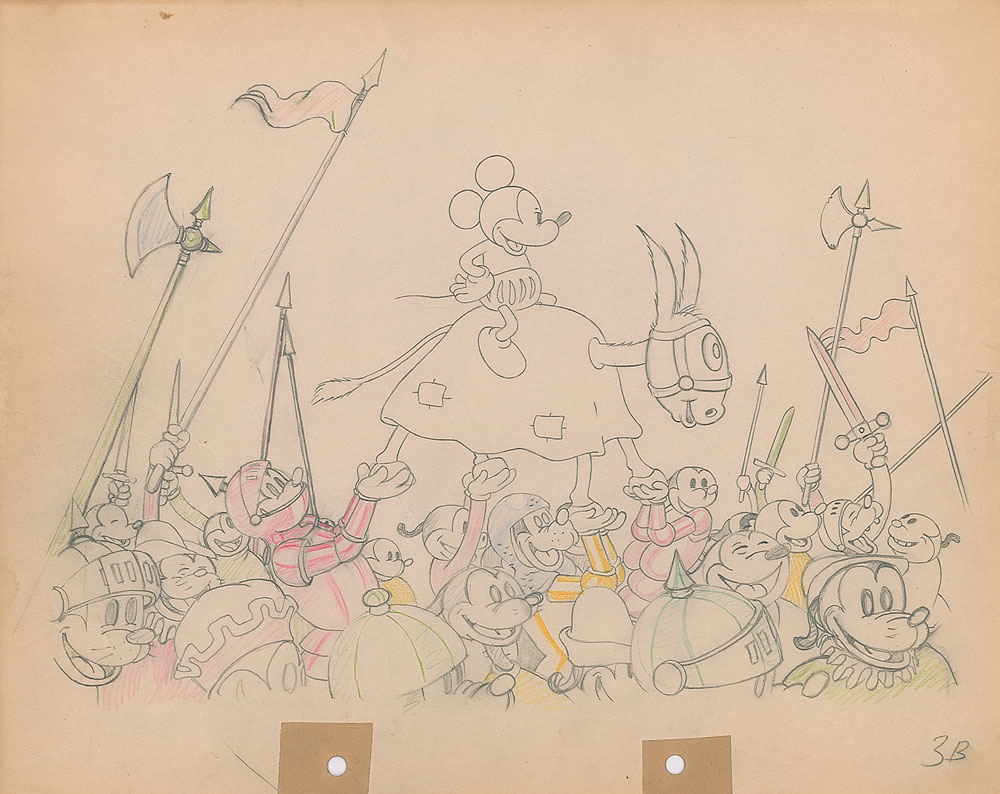
A vintage animation drawing shows wandering minstrel Mickey Mouse, having won the hand of Princess Minnie, being carried aloft on his donkey at the victorious conclusion of Walt Disney's "Ye Olden Days" (1933). The prince who Mickey must defeat in combat is Goofy, then still called Dippy Dawg. Silly Symphonies were produced in color starting in 1932 with "Flowers and Trees," but Mickey Mouse was popular enough that his cartoons could remain in black and white until 1935 with "The Band Concert." Still, that doesn't mean a little color couldn't be added to an animation drawing every now and then.
A production cel from the animated short "Squatter's Rights" (1946) signed by Walt Disney depicts a wintry scene that did not actually appear on screen, at least not in this manner. The characters Mickey Mouse and Chip did not appear together in the actual shot. The non-production background is meant to show off the two character cels to best advantage, but it has nothing to do with the action of the movie.
Signed production cel from "Squatter's Rights" (1946) on a non-production background
Walt Disney Productions
Walt Disney AbeBooks Listing Accessed January 17, 2020
Note: I am unable to locate the movie still that corresponds to the cel of Chip—or is it Dale?—in this animated short. Does it indeed come from "Squatter's Rights" or is it possibly from some other production?
The production cel is still available for sale at the time of this posting.
So many purported Walt Disney autographs were actually signed by his personnel that it's refreshing to see an autograph penned by Disney himself when he was away visiting his family in Ireland, far from the usual studio set of secretaries and animators. Of course, it's all the better that there is a drawing included of the world's most beloved mouse.
Note: Readers in possession of their own autograph albums this breathtaking, or nearly so, might want to make other readers envious by sending a few heartbreakingly beautiful scans to Attempted Bloggery. My readers can take it. Quick Links to the Attempted Bloggery Archives:
.jpeg)


.jpg)


.jpg)