Showing posts with label Victor De Pauw. Show all posts

Saturday, February 7, 2026

Peter Arno: The Fireman's Farewell

In a 1939 New Yorker cartoon, Peter Arno's firefighter bids farewell to a befuddled homeowner:

"Well, if you ever need us again just give us a ring."
Peter Arno
Original art
The New Yorker,
 June 17, 1939, p. 18

The cartoon reads left to right, foreground to background. The firefighter is the most prominent and the most illuminated figure. He is leaving the scene, but he leans back into the cartoon panel with a raised arm. You can't miss him. The poor, portly homeowner in his robe is seen next seemingly trying to lean back out of the frame. There is no place for him to go. The smoldering ruins of the home are behind him. The firemen have left behind great reflecting puddles of water in the middle ground. The birdcage is a fine comic detail which may or may not be noticed later. Anyone whose eyes linger over an Arno drawing can expect to be rewarded.

The original art, framed and matted, was sold yesterday at Heritage Auctions. It was the useful practice of Barbara Nicholls of the Nicholls Gallery in the 1970s and 1980s to write the caption on the matte in a calligraphic hand. No doubt Irvin Greif, Jr., purchased the artwork from her. Her ink has faded over the years more than Arno's.
"Well, if you ever need us again just give us a ring."
Peter Arno
Framed original art
The New Yorker,
 June 17, 1939, p. 18

On the back of the artwork, The New Yorker's founding editor Harold Ross approved the drawing with his customary R. 
Verso with Ross's R


Bidding opened at $1,250 some three weeks before the sale with no reserve. The first bid appeared quickly, proof, if any were needed, that Arno's star continues to shine bright in the firmament of New Yorker cartoonists.
Peter Arno
Heritage Auctions Mainstream Illustration listing of February 6, 2026


Peter Arno
Heritage Auctions Mainstream Illustration item description

The work sold for $5,000 plus a 25% buyer's premium of $1,250. In other words, the final buyer's premium was the same as the amount of the opening bid.


Here's how it appeared in the magazine:
"Well, if you ever need us again just give us a ring."
Peter Arno
The New Yorker, June 17, 1939, p. 18

"Well, if you ever need us again just give us a ring."
Peter Arno
Original art
The New Yorker,
 June 17, 1939, p. 18


With a cartoon by Peter Arno and a spot drawing by Victor de Pauw


* * *


On the page opposite, Victor de Pauw's spot drawing of a railway station is as unassuming as Arno's cartoon is bold.
Spot drawing of a railway station
Victor de Pauw
The New Yorker, June 17, 1939, p. 19


05196

Sunday, September 22, 2024

Charles Addams: Cobblers on Strike

Charles Addams's New Yorker cartoon from the issue of July 21, 1962 has no caption, but there are still quite a few words to take in. The key word is right in the middle of the factory wall so you won't miss it. 

Charles Addams
Original cartoon art
The New Yorker, July 21, 1962, p. 31

Charles Addams's signature

"For Marten Loewengart
with all best
Chas Addams"

Detail with strikebreakers

J. Whatman drawing board verso


The New Yorker stamp


The original art was sold yesterday in Palm Beach.

Charles Addams
AGOPB (Auction Gallery of Palm Beaches) listing of September 21, 2024

Charles Addams
AGOPB item description


Charles Addams
The New Yorker, July 21, 1962, p. 31

Charles Addams
Original cartoon art
The New Yorker, July 21, 1962, p. 31


With a spot drawing by Victor de Pauw and a cartoon by Charles Addams


Victor de Pauw
Spot drawing
The New Yorker, July 21, 1962, p. 30

I identified the artist on September 6, 2024.


Note:  In his 1964 wedding announcement, the Times described the drawing's recipient, Marten Loewengart, as a tanning company officer. So it may really have been the shoe subject matter that interested him in this cartoon.


I am eager to fill this blog with images of original art by Charles Addams. Please let me know what you have. After all, Halloween is coming.


Victor de Pauw's superb spot work has been noted here previously. I would be happy to hear from anyone with additional relevant material on this artist.


04753

Thursday, September 29, 2022

Helen E. Hokinson: Radio Days

These days the news is relentless. Many of us use our televisions,  computers, and mobile phones to keep ourselves updated throughout the day.


During World War II, Americans had an urgent need to keep up with the news as well. Moving images of war were available in the cinemas through newsreels. Detailed print articles abounded in a wide variety of newspapers. But for the latest breaking news, there was nothing as immediate as radio. Commentators over the air waves like Gabriel Heatter became familiar names even before the war:

"Gabriel Heatter sounded an ominous note as I rounded a curve."
George Price
The New Yorker, July 6, 1940, p. 21


Weekly magazines like The New Yorker were an excellent source of news too. They could analyze the events of the week in great depth while providing perspective and thoughtful writing. The New Yorker in particular, with its talented stable of artists, could also take a step back and comment on how we consumed the various news media, as with the George Price drawing above.


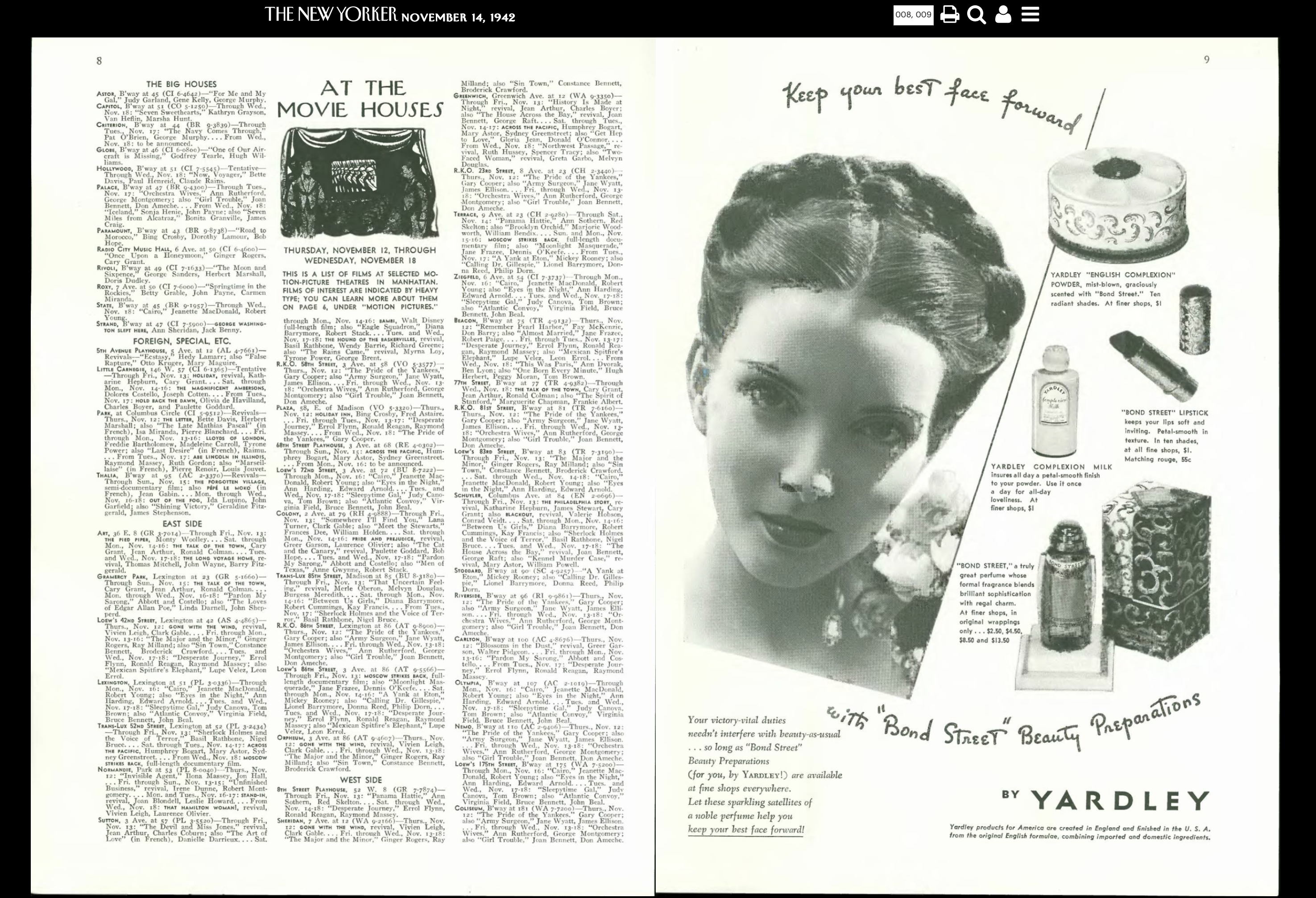
The issue of November 14, 1942, is another case in point. A spot drawing in the movie listings highlights the experience of watching newsreels:

Spot drawing
Victor de Pauw
The New Yorker, November 14, 1942, p. 8


While Saul Steinberg offers a humorous insight into newsstand behavior:

Saul Steinberg
The New Yorker, November 14, 1942, p. 11


"There's good news tonight." The familiar voice of Gabriel Heatter, again, brought news of World War II to American families sitting by the radio. Before the war, George Price may have had him sounding "an ominous note," but Heatter's wartime broadcast was known for its hope and optimism. That brought him popularity, although it brought him some jibes as well. Helen E. Hokinson's cartoon in the issue shows how her matrons related to the radio personality as if he were a personal acquaintance:

"Gabriel Heatter was every bit as surprised as I was."
Helen E. Hokinson
The New Yorker, November 14, 1942, p. 13


With V-E Day and Germany's surrender, Hokinson has occasion to return once again to the famous broadcaster. Her original cartoon art for The New Yorker was sold at auction just yesterday:

"Isn't it all wonderful! I'm so happy for Gabriel Heatter."
Helen E. Hokinson
Original art
The New Yorker, 
May 5, 1945, p. 19


The paper has significant foxing.

"Isn't it all wonderful! I'm so happy for Gabriel Heatter."
Helen E. Hokinson
Framed original art
The New Yorker, 
May 5, 1945, p. 19


Helen E. Hokinson's signature

Typed caption


Helen E. Hokinson
Hill Auction Gallery listing accessed September 27, 2022 after the first absentee bid was placed


The hammer price:


"Isn't it all wonderful! I'm so happy for Gabriel Heatter."
Helen E. Hokinson
Framed original art
The New Yorker, May 5, 1945, p. 19
A spot drawing and a cartoon by Helen E. Hokinson
V-E Day (May 8, 1945) commentary by Gabriel Heatter


An illustration by Ludwig Bemelmans and a cartoon by George Price


A spot drawing by Victor de Pauw and an advertisement for Yardley


An advertisement for B. Altman, the famous banner by Rea Irvin, and a cartoon by Saul Steinberg


A spot drawing by Susanne Suba and a cartoon by Helen E. Hokinson


Note:  It's hard for me to look at original art by Helen E. Hokinson and not want to write a little something about it. It's especially great when the art tells a story. Feel free to send images of your original Hokinson art to share, perhaps, with the world.

And, while we're at it, I don't mind original art by Ludwig Bemelmans either:


Now, about those spots...

I can't make out the signature on the twins playing piano four hands spot illustration. Can any reader make it out?


Susanne Suba's spot is an interesting example of social realism not typical of the magazine. Feel free to send examples of her original art.
Victor de Pauw is one of my favorite spot illustrators. I'd love to see more of his work too.


04092

Friday, January 7, 2022

The New Yorker Advertises in Stage, April 1938

"People who like the theatre can't help but like The New Yorker." So advertised the magazine in the April 1938 issue of Stage: The Magazine of After Dark. The ad featured a collage of nine theatre pages from The New Yorker, all illustrated by Alfred Frueh. Evidently the magazine was making a play for new readers who were fans of the theatre, rather than fans of flawless grammar. Frueh's drawings cover the Broadway plays "On Borrowed Time," "Our Town," Julius Caesar," "Of Mice and Men," and "A Doll's House," among others.

"People who like the theatre can't help but like The New Yorker."
Alfred Frueh

The magazine cover features a photograph of actress Helen Hayes:
Helen Hayes touring as Portia in "The Merchant of Venice"
Stage:  The Magazine of After Dark, April 1938
Photo by Vandamm

The truth is, readers of Stage were already familiar with a number of contributors to the New Yorker, many of them artists. Illustrator Victor de Pauw contributed cartoons and spot drawings to The New Yorker. A full-width spot drawing for Stage on the contents page could easily be taken for a New Yorker spot.
Contents
Spot drawing by Victor de Pauw


Ludwig Bemelmans illustrates a Frank Sullivan piece the year after the artist's work first appeared in The New Yorker and the year before his first Madeline book was published.
First putting suet on his Saratoga lawn for a tame flock of spring harbingers, Frank Sullivan takes a junket to Broadway, and casts a weather-eye on the current drama.
Ludwig Bemelmans

Detail showing the remainder of the far right side of the Bemelmans drawing


Christina Malman caricatures actress Beatrice Lillie.

"Till the Weather Breaks" by Beatrice Lillie
Caricature  of Beatrice Lillie by Christina Malman


Why , I can remember when a dog could go to sleep all day in the middle of Main Street and nothing come along to disturb him.
—Thornton Wilder, "Our Town"


The streets of Grover's Corners still look pretty tranquil in Adolf Dehn's illustration of the Stage Manager's story, condensed. New Yorker readers occasionally got to see Dehn's work, but never in color.
"Our Town"
Adolf Dehn


Meanwhile Abe Birnbaum illustrates the jazz scene.
The old Onyx Club
"Oh, Say Can You Swing" by Paul Douglas
Illustration by Abe Birnbaum


Ruth Woodbury Sedgwick's column is named for the privilege of sitting in the center seats of the seventh row. One hopes George Price's absurd cartoon takes place many rows back.
"He's a dramatic critic, and sees a point in keeping it a secret."
George Price


Music writer Marcia Davenport, who also contributed to The New Yorker, offers the second part of a profile of conductor Leopold Stokowski. Otto Soglow's accompanying cartoon anticipates the iconic handshake between Stokowski and Mickey Mouse that was to occur two years later in Walt Disney's "Fantasia" (1940). The maestro is even shown in silhouette, as both he and Mickey are in the movie. Did Davenport have advance knowledge of the handshake?
"Hi-ya, Leo."
Otto Soglow


from "Fantasia" (1940)


Note:  This all started when master collagist Stephen Kroninger sent me a scan of the New Yorker theatre advertisement from his magazine collection. After that, one thing just led to another. My thanks to Stephen for all the work he put in. This is his forty-sixth contribution here. He should know better by now.


03848