Charles M. Schulz began his Peanuts comic strip in 1950 and in 1952 published the first of what would come to be many collections. It was simply named Peanuts. A copy of a later printing of the first edition is signed by Schulz and includes an original drawing of the character Schroeder in profile accompanied by a trio of hand-drawn musical notes. It's evident that Schulz's rendering of Schroeder evolved quite a bit from the time he drew the cover illustration. This splendid volume is offered by Raptis Rare Books of Palm Beach for $4,000. There is still plenty of time for some lucky music or comics lover to get it before Beethoven's birthday.
The original artwork for Chuck Jones's 1976 Warner Brothers Christmas card was sold on October 20 by Heritage Auctions.
Chuck Jones's signature
"Deck The Halls With Boston Charlie" is a decidedly lame take on Walt Kelly's brilliant "Deck Us All With Boston Charlie" carol from his Pogo comic strip, as it reverts back in part to the correct lyrics we all know. Nevertheless, Bugs Bunny and Daffy Duck are in fine form at the piano, or at least Bugs is, in their musical roles from "Bugs and Daffy's Carnival of the Animals," a 1976 TV special featuring the music of Camille Saint-Saëns.
Songs of the Pogo is a songbook and album (1956) which includes the number "Deck Us All With Boston Charlie." The classic Christmas carol amended with wildly inventive lyrics returned to the strip in different versions over the years.
Chuck Jones Heritage Auctions listing of October 20, 2025
Signed in Boston, one Carolyne's copy of The Musicans by Sempé—in full that's cartoonist Jean-Jacques Sempé—was dated in 1980, the year of publication. It's hard to believe that it's been forty-five years since the publication of this wonderful book of drawings on the subject of people who make music.
Sempé dedicated the book to this Carolyne with a drawing: a still life of a flower sitting in a vase sitting on a grand piano.
The book was priced at $250 by Lakeside Bookshop of Bradford, New Hamshire. While certainly not bargain-basement cheap, it was considerably less expensive than some comparable items on the European market.
The book quickly sold, more or less on the day it was listed.
Jean-Jacques Sempé Abe Books listing sold November 12, 2025
Edward Koren's drawing in Anne and Sergio's copy of Are You Happy?, his 1978 cartoon collection, fills the inside cover and the facing front free endpaper. It depicts a couple playing a duet for violin and piano. They make such beautiful music together. How could they not be happy?
Edward Koren AbeBooks listing accessed December 26, 2023
The first Peanuts Sunday strip was drawn by Charles M. Schulz early in 1952. Six years later, the original art seen here was produced:
Peanuts, February 16, 1958 Charles M. Schulz Original art
The characters in the February 16, 1958 strip are Lucy, Schroeder, and Snoopy. Snoopy and Schroeder play a duet for violin and piano with Snoopy standing on the piano. As they play, the beagle breaks into his happy dance. Schulz produced any number of great strips. This one is a masterpiece.
Peanuts, February 16, 1958 Charles M. Schulz Original art
The original art was sold at Heritage Auctions on August 4. I stopped by about a day before the sale to check on it. The online bidding was spirited, but the one could dream this superb comic strip was almost within reach.
Charles M. Schulz Heritage Auction listing accessed April 2, 2024 one day before the auction
The New Yorker Cartoon Caption Contest #941 appeared in the issue of April 21, 2025. A piano is drinking too much wine at a bar. The bartender speaks to two men in business attire. My entry appears below. The drawing is by Feggo, a.k.a. Felipe Galindo.
"Before I serve him again, I want to hear some scales."
These captions weren't in tune:
"At least he isn't playing." "His orchestra left him." "He doesn't need to stay sober. He's a player piano." "He's hammered."
May 3, 2025 Update: The Finalists
May 9, 2025 Update: I voted for the caption from Danvers.
There's another lot in Doyle's recent Stephen Sondheim sale that caught my attention. It contained eight caricatures from the composer's estate. The songwriter kept many framed likenesses of himself. Some are original art and some are reproductions.
Martin Kreloff
Naturally one of the original works caught my eye right away, an original mock-New Yorker cover.The unsigned caricature here is, alas, not a good likeness. The rhyming dictionary may well have been one of Sondheim's tools, but he could hardly have relied on it enough to merit its inclusion front and center. This seems to detract from his accomplishment, which countless other musical composers with countless other rhyming dictionaries could hardly approach. The chess board on which the master writes music has gotten the dark and light squares all wrong, the graphic equivalent of a lyric that doesn't quite scan. I suppose this was something made as a personal gift and never actually submitted to the magazine, but anything's possible. The presence of the frame, at least, suggests That Sondheim himself was pleased with it, as he must have been pleased with all these pieces.
Trog (Wally Fawkes)
John Minnion
The lyrics in the Squigs picture are from "Anyone Can Whistle," "A Little Night Music," "Company," "Sweeney Todd," "Marry Me a Little", "Into the Woods," and "Sunday in the Park with George." There may be other shows represented as well.
These days the news is relentless. Many of us use our televisions, computers, and mobile phones to keep ourselves updated throughout the day.
During World War II, Americans had an urgent need to keep up with the news as well. Moving images of war were available in the cinemas through newsreels. Detailed print articles abounded in a wide variety of newspapers. But for the latest breaking news, there was nothing as immediate as radio. Commentators over the air waves like Gabriel Heatter became familiar names even before the war:
"Gabriel Heatter sounded an ominous note as I rounded a curve." George Price The New Yorker, July 6, 1940, p. 21
Weekly magazines like The New Yorker were an excellent source of news too. They could analyze the events of the week in great depth while providing perspective and thoughtful writing. The New Yorker in particular, with its talented stable of artists, could also take a step back and comment on how we consumed the various news media, as with the George Price drawing above.
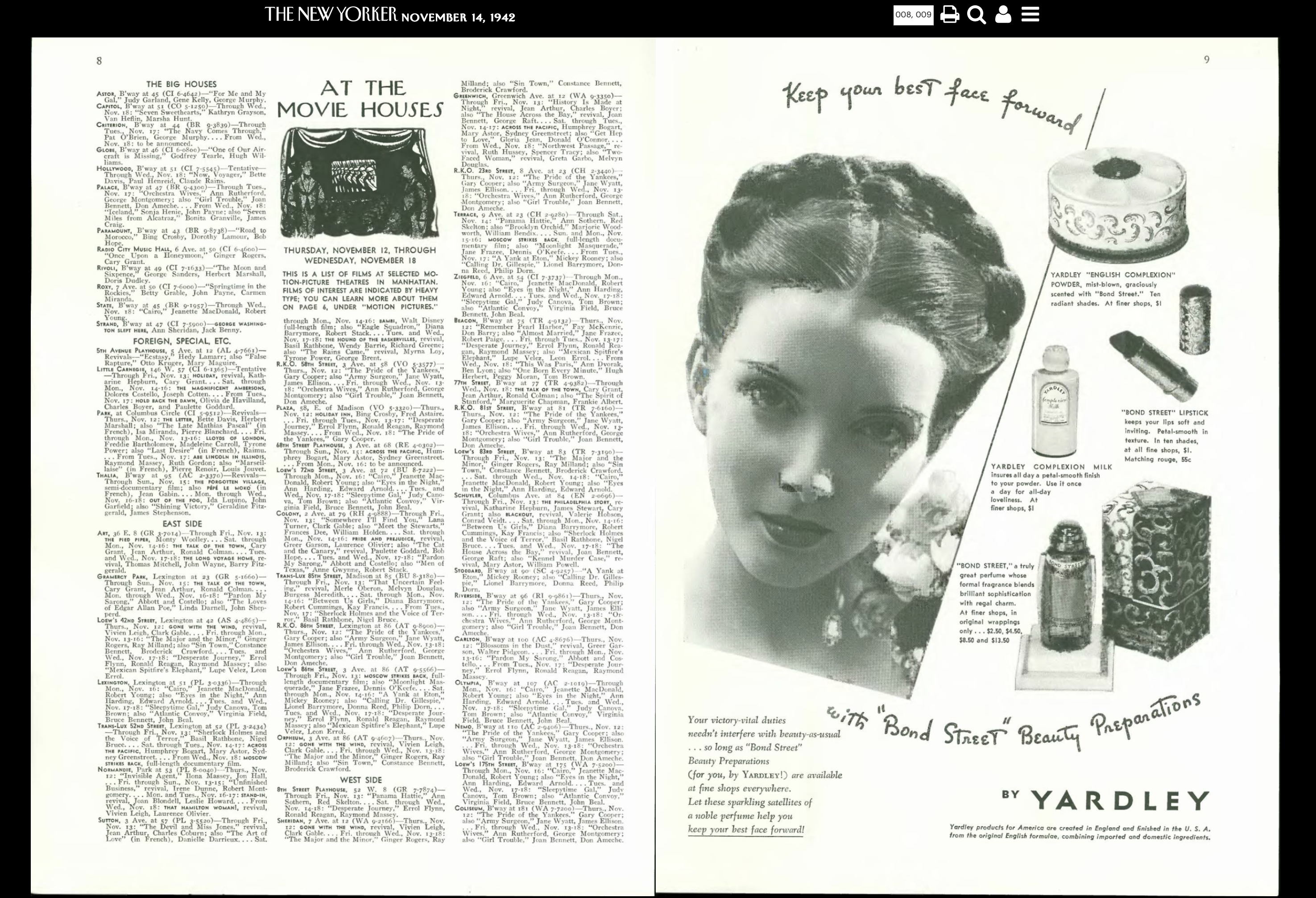
The issue of November 14, 1942, is another case in point. A spot drawing in the movie listings highlights the experience of watching newsreels:
Spot drawing Victor de Pauw The New Yorker, November 14, 1942, p. 8
While Saul Steinberg offers a humorous insight into newsstand behavior:
Saul Steinberg The New Yorker, November 14, 1942, p. 11
"There's good news tonight." The familiar voice of Gabriel Heatter, again, brought news of World War II to American families sitting by the radio. Before the war, George Price may have had him sounding "an ominous note," but Heatter's wartime broadcast was known for its hope and optimism. That brought him popularity, although it brought him some jibes as well. Helen E. Hokinson's cartoon in the issue shows how her matrons related to the radio personality as if he were a personal acquaintance:
"Gabriel Heatter was every bit as surprised as I was." Helen E. Hokinson The New Yorker, November 14, 1942, p. 13
With V-E Day and Germany's surrender, Hokinson has occasion to return once again to the famous broadcaster. Her original cartoon art for The New Yorker was sold at auction just yesterday:
"Isn't it all wonderful! I'm so happy for Gabriel Heatter." Helen E. Hokinson Original art The New Yorker, May 5, 1945, p. 19
The paper has significant foxing.
"Isn't it all wonderful! I'm so happy for Gabriel Heatter." Helen E. Hokinson Framed original art The New Yorker, May 5, 1945, p. 19
Helen E. Hokinson's signature
Typed caption
Helen E. Hokinson Hill Auction Gallery listing accessed September 27, 2022 after the first absentee bid was placed
Note: It's hard for me to look at original art by Helen E. Hokinson and not want to write a little something about it. It's especially great when the art tells a story. Feel free to send images of your original Hokinson art to share, perhaps, with the world.
And, while we're at it, I don't mind original art by Ludwig Bemelmans either:
Now, about those spots...
I can't make out the signature on the twins playing piano four hands spot illustration. Can any reader make it out?
Susanne Suba's spot is an interesting example of social realism not typical of the magazine. Feel free to send examples of her original art.
Victor de Pauw is one of my favorite spot illustrators. I'd love to see more of his work too.


.jpeg)
.jpeg)
.jpeg)


.jpeg)
.jpeg)