Showing posts with label attorney. Show all posts

Saturday, November 11, 2023

Peter Arno: In the Opinion of the Court

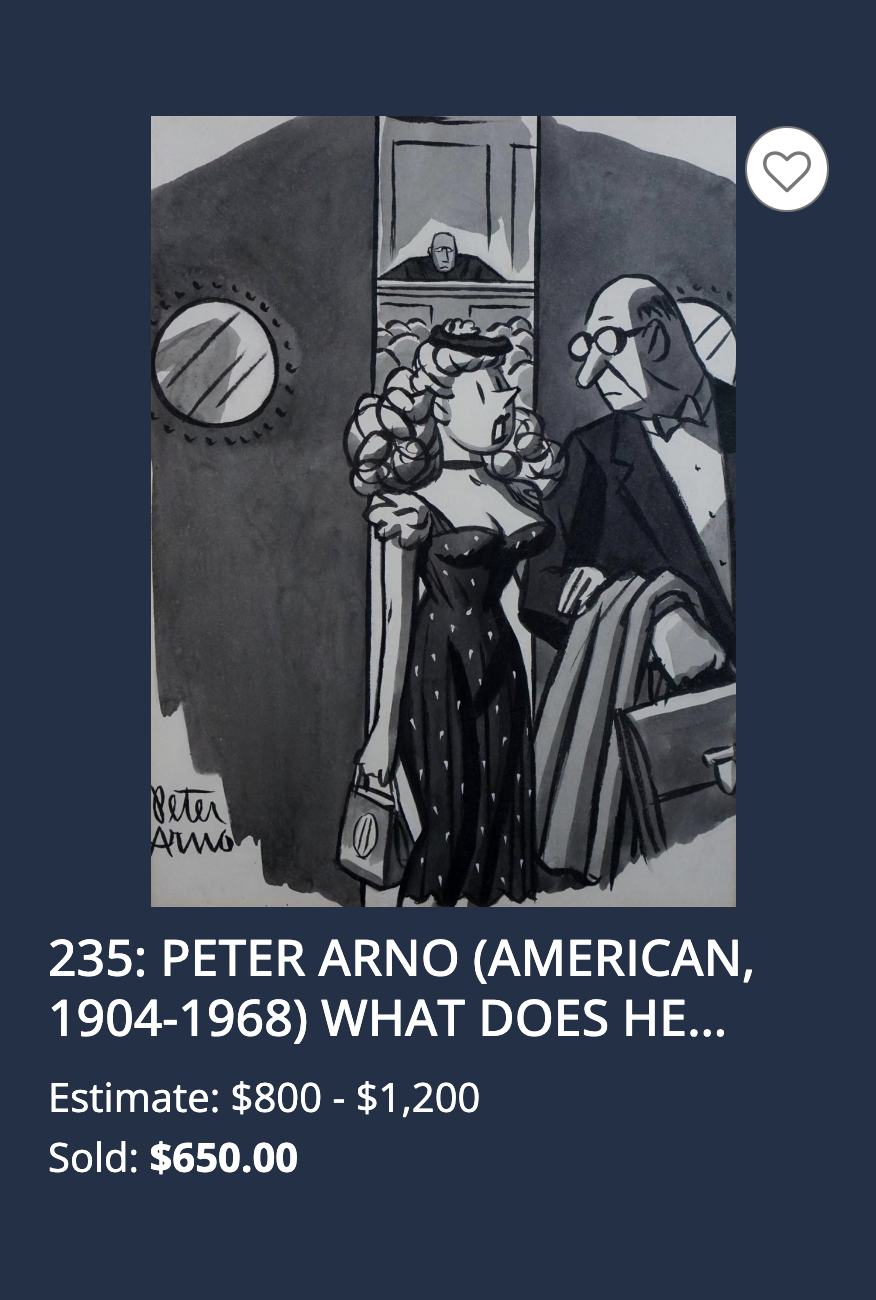
Peter Arno's 1954 New Yorker cartoon gets quite a bit of mileage out of one word.
"What does he mean, 'ilk'?"
Peter Arno
Original art
The New Yorker, November 6, 1954, p. 34


We can call this cartoon from seven decades ago sexist, even stereotypical, but I don't think we can call it unfunny. Arno's blonde bombshell has a wonderful earnestness as she tries to understand what is being said of her.


The artist is such an accomplished storyteller. It takes just an instant for us to understand the setting. We take in the impassive judge, the crowded courtroom, and the sexpot exiting the premises with her lawyer. The doors serve as a framing device for the speaker, and the space between the two is just narrow enough to push her into the foreground, as if she weren't three-dimensional enough. The negative space behind her black dress is white.


The light source is on the left. The speaker is highlighted with just a thin line of shadow. Her legs are visible through the dress; Arno just can't help himself. Far more shadow falls on the attorney because he is the less important figure. His expression is muted and we can't see his eyes, but his head is turned toward the speaker, bringing our eyes back to her. His hands are twice the size of his petit client's and his waist is at least three times as wide as hers. Cartoonists wield such awesome power.

"What does he mean, 'ilk'?"
Peter Arno
Original art
The New Yorker, November 6, 1954, p. 34

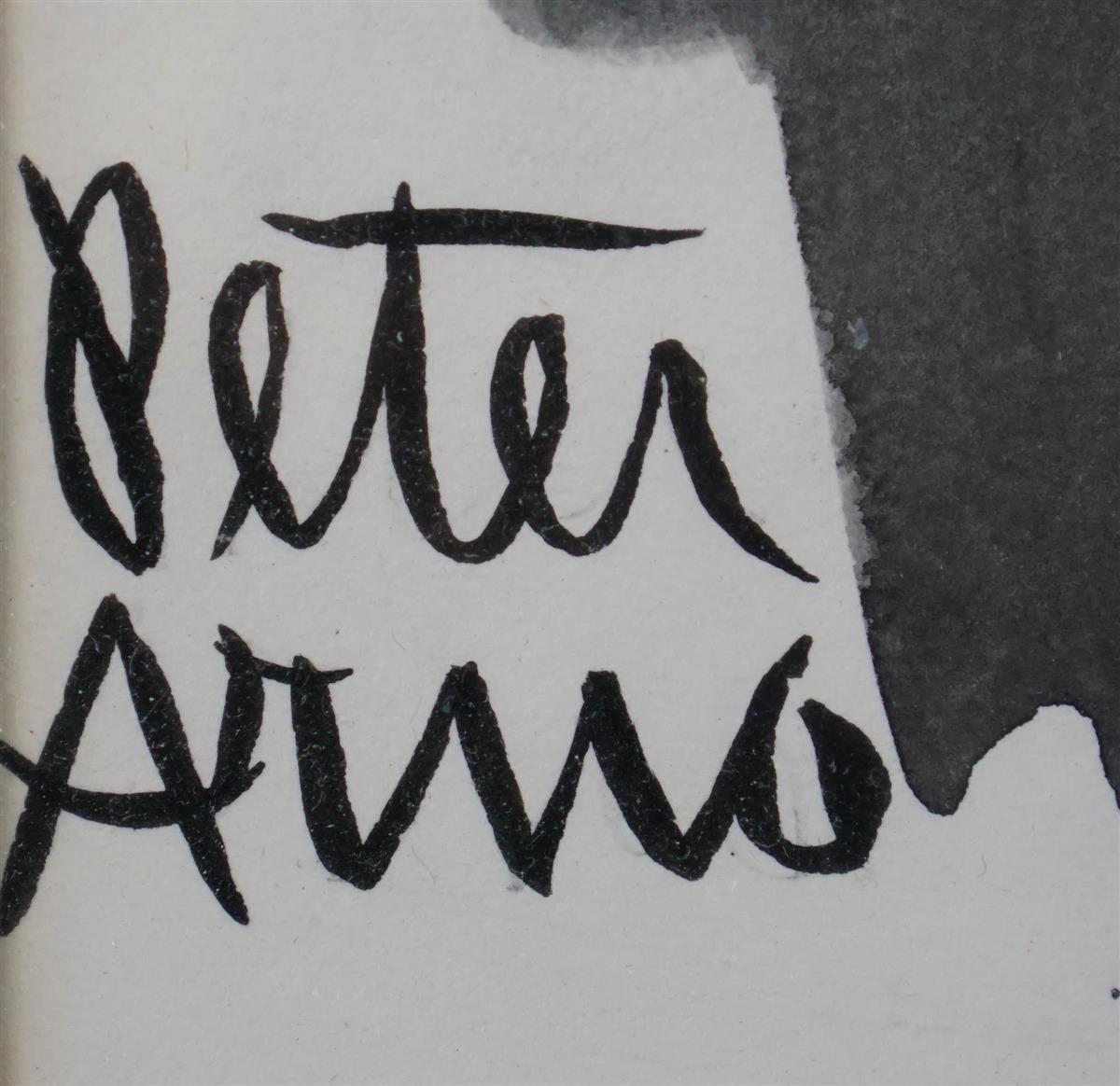
Peter Arno's signature


Peter Arno
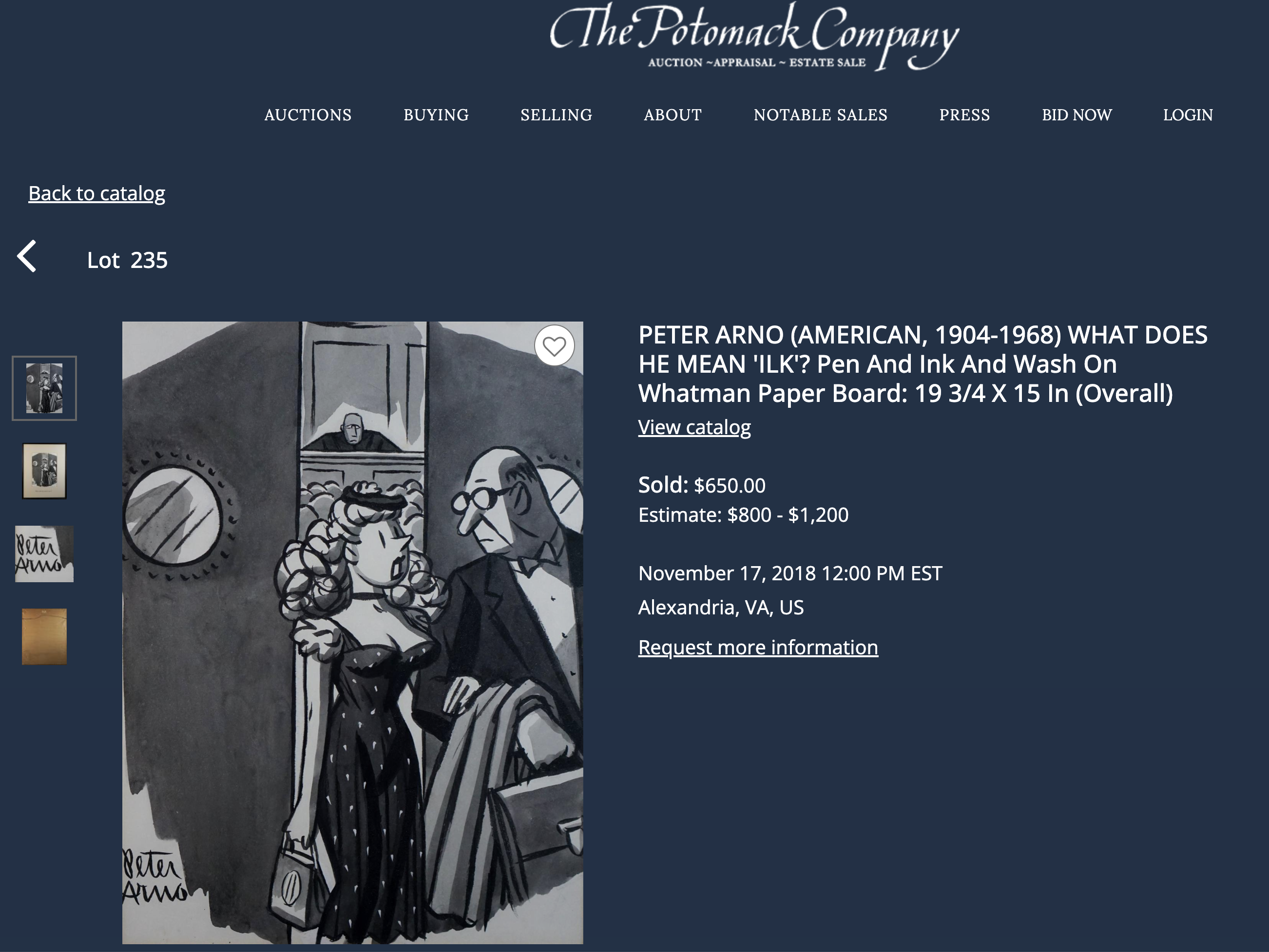
The Potomack Company listing for November 17, 2018


Peter Arno
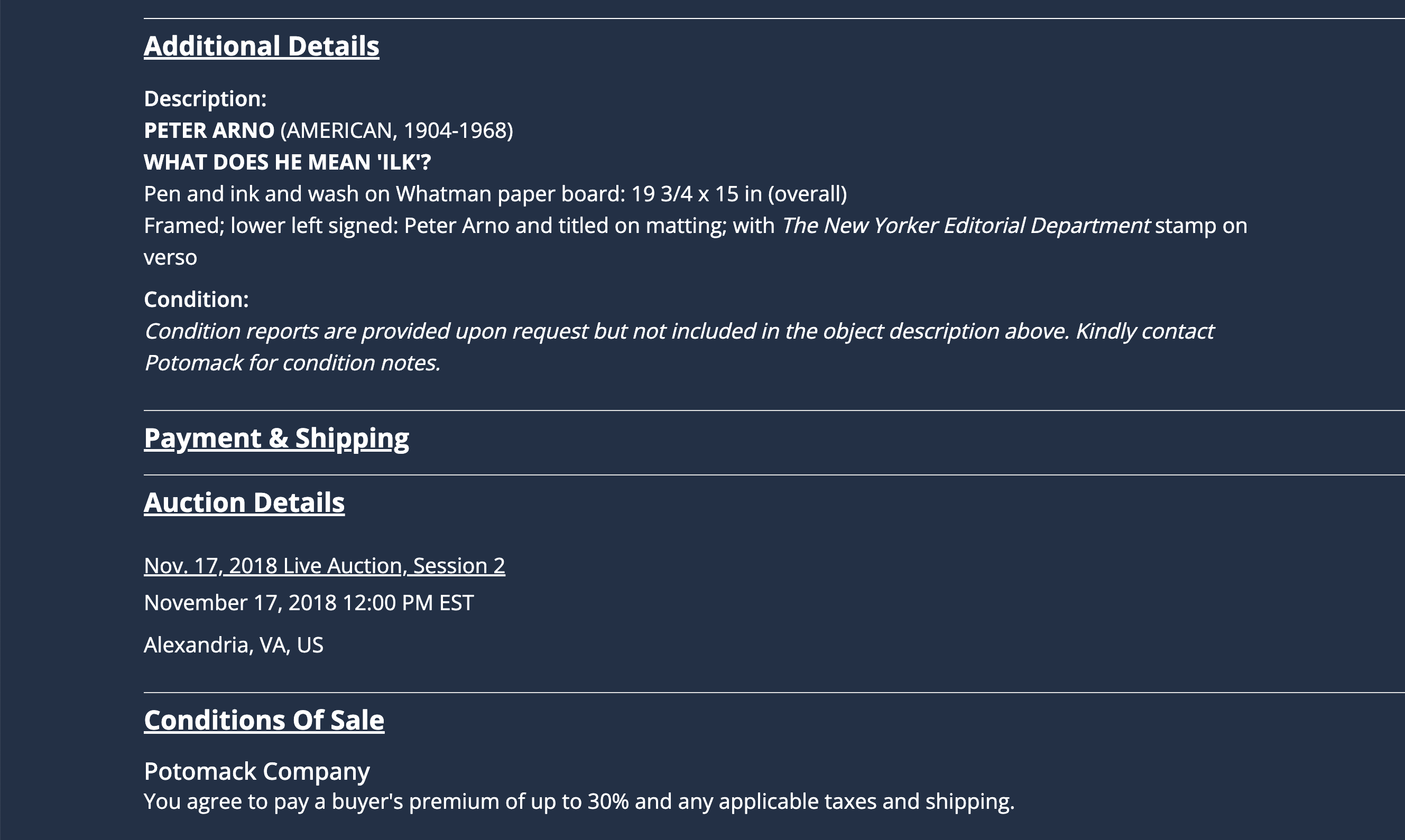
The Potomack Company item description

Sold!


Here's what New Yorker readers saw:
"What does he mean, 'ilk'?"
Peter Arno
The New Yorker, November 6, 1954, p. 34

"What does he mean, 'ilk'?"
Peter Arno
Original art
The New Yorker, November 6, 1954, p. 34

A cartoon by Peter Arno and a spot drawing by James Thurber


James Thurber
Spot drawing


Note:  Ladies and gentlemen of the jury, my client, this blog, is in need of an ongoing supply of original art by Peter Arno.

Small world! I've already commented on the spot drawing by James Thurber here.


04499

Wednesday, February 27, 2019

The Cartoon Collections Caption Contest #12

Exhibit A: The Cartoon Collections Caption Contest #12 with a drawing by Mick Stevens. My entries follow, if it please the court.

"My client pleads not guilty to any copycat crime."
"My client is no more guilty than I am."
"Mr. Zelig wishes to represent himself."
"My client wishes to represent himself."
"My client pleads not guilty to identity theft."

"My client pleads not guilty to anything but good taste."
"Not guilty, plaid and simple."
"Not guilty by reason of inanity."


March 6, 2019 Update:  The Winner


Quick Links to the Attempted Bloggery Archives:


Mick Stevens

Sunday, August 13, 2017

Mischa Richter: In the Court of Public Opinion

Never mind the courts! A cartoon by Mischa Richter from 1995 mocks the fact that legal cases are "tried" in the court of public opinion on the afternoon talk shows. "The Sally Jessy Raphael Show," later simply "Sally," aired from 1983 to 2002. Note that the artist misspelled the talk show host's middle name as Jesse in his hand-written caption.

"Your case has been turned down by Oprah, but we're
appealing to Sally Jessy Raphael."

Mischa Richter, original art
The New Yorker, January 16, 1995, page 77


eBay Listing Ended October 19, 2016

eBay Item Description

eBay Bid History
As is often the case, it is the last bid that wins it.


"Your case has been turned down by Oprah, but we're
appealing to Sally Jessy Raphael."

Mischa Richter, original art
The New Yorker, January 16, 1995, page 77


http://archives.newyorker.com/?i=1995-01-16#folio=076


Sally Jessy Raphael, 1995
Greg Louganis, Part 1
"America's Heroes Fighting for Life"


Note:  Attempted Bloggery is always looking for original cartoon art by Mischa Richter and other New Yorker artists. Do you have something awesome to share here?


Quick Links to the Attempted Bloggery Archives:

Mischa Richter
02274

Wednesday, June 1, 2016

Peter Arno: Where There's a Will..., Part 3

In 1942, Peter Arno confronted an interesting problem. He had either come up with or been assigned a gag cartoon for the New Yorker that involved the reading of a will to disappointed relatives. He had already handled this scenario in 1939. At least some of his readers and editors would be familiar with the previous cartoon. How was he to handle this?

Peter Arno, The New Yorker, December 2, 1939, page 23

Peter Arno, The New Yorker,  May 16, 1942, page 14


Arno chose to make the new cartoon distinctly different. Aside from removing the dog which is the object of the 1939 gag, there are quite a few ways he made the 1942 drawing into something quite new and unique:

1. He expanded the panel size from about two-thirds of a page to a full page.

2. He reversed the general layout, putting the family on the left and the lawyer on the right.

3. He changed the setting from a sunlit drawing room to a dark study with each of the faces starkly illuminated.

4. He minimized the mourning garb.

5. He changed the reaction of the family from anger and loathing to shock and surprise.

6. He changed the perspective from two-point to one-point, and therefore drew more of the faces in profile.

7. He changed the decor from art deco to neoclassical.

8. He gave the attorney a briefcase, a pair of spectacles, and a nice head of hair.

In summary, Arno had many tools at his disposal, and in this case he used a variety of them to make two similar gag cartoon concepts look and feel completely different.


Note:  What makes a cartoon work? I've discussed composition here only a few times, but Peter Arno really brings it out in me. Click on the aqua link to see the relevant posts.

Does the will really say that? You bet it does.

Am I running out of Arno posts? Probably. When will they end? I'm not sure. I've been saying a week or two more for about six weeks now. Is there anything you can do to help? Why, yes. This blog is in desperate need of more Arno:  correspondence, photos, original art. Check your attic. People who frequent classy places like Harry's Bar or 21 might want to sneak a few high-res photos of the art. But please don't get yourself thrown out or anything. I'm not worth it.

01873

Tuesday, May 31, 2016

Peter Arno: Where There's a Will..., Part 2

The reading of the will was featured in an exceptional Peter Arno New Yorker cartoon from 1939. The original artwork was sold in 2013 by a small auction house. Appearances suggest the listing did not trouble to reproduce the long caption aside from the difficult-to-read handwriting in the photographs. The artwork sold for about one-third its estimate.
"First then:  the bulk of my estate, excepting certain specific
bequests as hereinafter noted, I leave to my true friend and
companion, one of God's noblest creatures..."
Peter Arno, Original art, The New Yorker, December 2, 1939, page 23

Note how the dark colors of mourning are contrasted with the white of the dog. The clever use of two-point perspective allows two sets of lines to lead our eyes to the dog, one from the attorney's chair and feet aligned with the aisle and the other joining the mourner's feet in the front row. If that's not enough, the mourners' eyes are all directed at the same spot.

The art is nicely framed, but a more legible caption would be welcome:

"First then:  the bulk of my estate, excepting certain specific bequests as hereinafter
noted, I leave to my true friend and companion, one of God's noblest creatures..."

Peter Arno, Framed original art, The New Yorker, December 2, 1939, page 23

Detail

Detail


Locati Auctions, October 21, 2013, Lot 1013162


"First then:  the bulk of my estate, excepting certain specific bequests as hereinafter
noted, I leave to my true friend and companion, one of God's noblest creatures..."

Peter Arno, The New Yorker, December 2, 1939, page 23


Note:  On Sunday, this blog's brief excursion into the reading of the will began with cartoon variations by the late Frank Modell, 1917-2016. In his obituary, the Times writes, "Mr. Modell took pleasure in mocking mortality in his work."

This blog offers a lot more about Peter Arno and about original New Yorker cartoon art. Ask for it by name.

01872

Monday, May 30, 2016

Peter Arno: Where There's a Will...

The reading of the will to stunned relatives is a time-honored cartoon trope. Peter Arno does not disappoint with the drawing published in the New Yorker on May 16, 1942. Being able to see his original artwork offers insights into the process of creating the cartoon, but there is a serious problem in the image provided by Bill Hood & Sons, which sold the work in 2008. They have gotten the aspect ratio wrong. The photograph, which should be rectangular in portrait orientation like the full page of a magazine, is instead distorted into a square.

At least we can read the original caption written across the top. "Well, what do you know? You're [sic] dear grandfather seems to have left everything to me!" Grandfather is not a great choice here, given the different ages of the family members. The published caption is a bit tighter and uses a rich uncle instead:  "My goodness! Your dear old uncle seems to have left everything to me."

Arno was a master at composing and lighting his scenes. This scene is read from left to right. The lines of site, the family members' arms, and the curtain tie-backs all direct our gaze to the lawyer on the right. The lamps and especially the curtains frame his head. This scene is set in a dark study with two unlit lamps. The light source is from the right behind the attorney and it starkly illuminates all the family members. Paradoxically, the attorney's face is illuminated from the left.

"Well, what do you know? Your dear grandfather
seems to have left everything to me."
Published as "My goodness! Your dear old uncle seems to have left everything to me."
Peter Arno
Original art
The New Yorker, May 16, 1942, page 14

Peter Arno's signature

Bill Hood & Sons Art & Antique Auctions, March 26, 2008, Lot 2211


"My goodness! Your dear old uncle seems to have left everything to me."
Peter Arno
The New Yorker, May 16, 1942, page 14

May 14, 2018 Update:  The original art is being offered on eBay for a Buy It Now price of $5,950, more than double the 2008 auction price of $2,300 even assuming a hefty 25% buyer's premium. We can now see the original art undistorted.
"Well, what do you know? Your dear grandfather seems to have left everything to me."
Published as "My goodness! Your dear old uncle seems to have left everything to me."
Peter Arno
Original art
The New Yorker, May 16, 1942, page 14

Preliminary caption in Peter Arno's hand

Peter Arno's signature

"Well, what do you know? Your dear grandfather seems to have left everything to me."
Published as "My goodness! Your dear old uncle seems to have left everything to me."
Peter Arno
Original art
The New Yorker, May 16, 1942, page 14

Tucson Museum of Art exhibition label

Peter Arno
eBay Listing Retrieved May 14, 2018


Peter Arno
eBay Item Description Retrieved May 14, 2018


Note:  Yesterday, the reading of the will took place in a series of cartoon variations by the late Frank Modell, 1917-2016.

My earlier blog posts about Peter Arno are just a click away. I have, at most, one or two weeks left of blog posts on this great artist, but I would be delighted to incorporate more Arno material from readers. Correspondence, photos, and of course original artwork are fair game.

Works of original New Yorker cartoon art may be found here as well. It's a specialty of the house.

01871

Wednesday, April 18, 2012

Eichmann in the Dock

Ronald Searle made these sketches of Adolf Eichmann on trial in April of 1961 in the Court Room in Jerusalem. These sketches were made on the printed cover of the indictment. Searle was covering the trial for Life magazine.


Sale B290212 Lot 246
Ronald SEARLE (1920-2011)
Adolf Eichmann on trial 
pen and ink on paper cover of 'The Indictment' printed for the Government Press Office, Jerusalem 
signed and inscribed 'The Court Room, Jerusalem, April 1961' 
26.5 x 20.5cm (visible) 

Provenance: Magdalene Street Gallery, Cambridge, with label verso 

Other Notes: After the Second World War, Eichmann changed his name and eventually made his way to Argentina. His whereabouts were later discovered by the Israeli authorites who captured him in 1960, and took him to Israel where he was put on trial in 1961, and found guilty of war crimes, chiefly his large involvement in the Holocaust, was hanged in 1962 and his ashes scattered at sea. Searle was covering the trial for Life magazine. 
Estimate £3,000-4,000

Sold for 2,800 GBP on February 29, 2012.
http://auctions.cheffins.co.uk/asp/fullcatalogue.asp?salelot=B290212++246+&refno=+++79781&image=0

May 12, 2012 Update:  This sketch is currently offered for sale by London art dealer Chris Beetles in his exhibition Ronald Searle Remembered, May 22 - June 9, 2012 for 6,500 GBP. The auction house Cheffins charged a 23.4% buyer's premium above the 2,800 GBP hammer price. Assuming then that the full cost of this lot at auction was 3,455 GBP and that an art gallery would be exempted from any additional VAT charges, that would make the dealer's markup 88% above cost.

Ronald Searle Remembered exhibition sale price, May 22 - June 9, 2012, Chris Beetles Gallery

Ronald Searle, Adolf Eichmann on Trial, Chris Beetles Gallery

Note:  My most recent blog post about Ronald Searle includes Searle art along with that of three other New Yorker artists and can be found here.


0308