Showing posts with label composition. Show all posts

Friday, November 10, 2023

Peter Arno's Floor Show

Peter Arno (1904-1968) came of age in the Prohibition Era, frequenting nightclubs and speakeasies. His 1953 New Yorker cartoon sold on Tuesday at Doyle New York seems to evoke an earlier time.

"I'm sorry, sir. You just missed the floor show."
Peter Arno
Original art
The New Yorker, February 21, 1953, p. 30


The foreground is lit from the entranceway causing the shadows to diverge on the sidewalk. This directs our gaze to both the main figures whom we are meant to see first. The central light source allows the front of both the men's faces to be lit. The patron's trousers and the doorman's have different pressing and tailoring indicating their different social classes. Likewise, the patron's shoes are the more tapered and elegant; he wears a fedora and a long coat while the doorman wears a cap and a uniform.

The drawing is read from left to right, and also from foreground to background. The curve of the canopy leads our eyes back to the paddy wagon, the visual punch line. The smiles on the showgirls' faces are all the same in the promotion on the left and then the frowns are identical in the police van on the right. The showgirls themselves are not distinguishable from one another in either case. On the billboard, they are shown in their scanties with headpieces and high heels. In the van, we can certainly see their headpieces and heels. Are they wearing anything else? Arno may be concealing the evidence.

Verso of the Whatman drawing board

Peter Arno
Doyle listing accessed October 31, 2023

Peter Arno
Doyle item description


Bidding opened at $600 with an estimate of $1,200 to $1,800.


Sold! The hammer price was $3,500.


The two Arnos from the Doyle sale, buyer's premium included:


Here's how the drawing first appeared in The New Yorker:
"I'm sorry, sir. You just missed the floor show."
Peter Arno
The New Yorker, February 21, 1953, p. 30


"I'm sorry, sir. You just missed the floor show."
Peter Arno
Original art
The New Yorker, February 21, 1953, p. 30

A cartoon by Peter Arno and a drawing by St. Clair McKelway to accompany his personal history


Note:  There's always room here for one more post with original Peter Arno art. If you've got any lying about, please do share it. Showgirls optional.


Is it still okay to say paddy wagon? It probably shouldn't be. But then I can't write black maria without thinking of Charles Addams. Police van is absolutely correct, but it's a little drab.


I know I shouldn't use the term showgirls either, but at least I'm certain Arno would have approved.


04498


Tuesday, July 27, 2021

Blog Post No. 3700: Peter Arno's Changing Points of VIew

Four years ago, when I surveyed the original Peter Arno artwork that came from the estate of New Yorker cartoonist Frank Modell, I was unable to say much about one of the gag cartoons because it came to the market lacking its caption:

Recently I came across Arno's cartoon of April 30, 1932 on the blog A New Yorker State of Mind and then everything fell into place. Modell evidently had been holding on to preliminary art for a New Yorker gag that Arno totally reworked before publication:
"Trapshooting? I thought you said crapshooting!"
Peter Arno
The New Yorker, April 30, 1932, page 14


I doubt we'll learn whether Modell himself knew exactly what he had here, or for that matter whether he knew the intended caption. The composition of the preliminary art has much going for it, particularly that the shooting party is seen head on, and not from the rear. Yet Arno felt compelled to rework the entire composition. Why expend so much effort on this "turnaround," as his biographer Michael Maslin called it when I brought these drawings to his attention? Is this sort of wordplay worth all the effort?

I'm not sure I have the answer. The preliminary art definitely shows the driver nervously realizing his error when the entire party is just heading out, while the published version stages the critical moment when the shooters are—possibly—in the act of arriving at some gambling venue. The suggestion that they may be about to enter the wrong place might give the driver's mistake more immediacy and make it funnier, whatever one's opinion of this brand of wordplay. But is that truly all that's going on? In the finished art, Arno has also softened the exaggerated, cartoonish reaction of the driver into something slightly more understated.

All cartoonists, of course, are obliged to make some changes to their compositions, but in my ten years of chronicling the cartoon art form here, I have yet to come across anyone with Arno's facility for reimagining his drawings from other points of view. Two examples from the blog archives are worth bringing up again in this regard. Also from Modell's collection is a rough of an Arno gag from 1930:
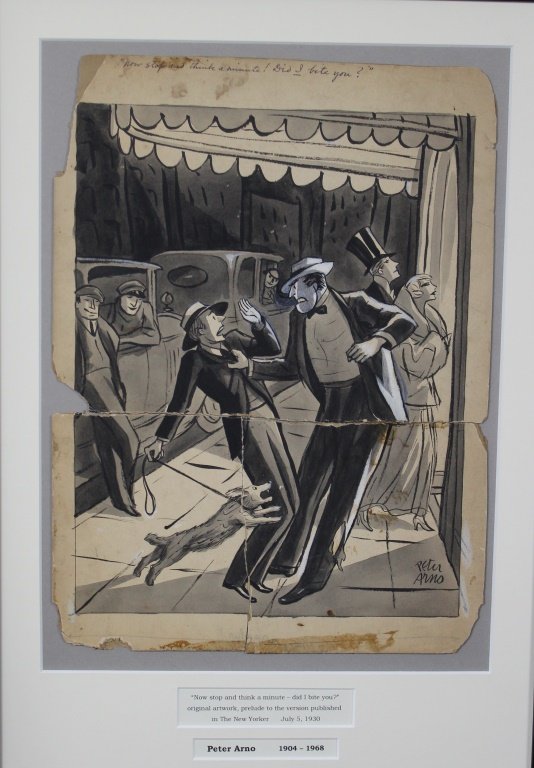
"Now stop and think a minute—did I bite you?"
Peter Arno
Preliminary art
 The New Yorker, July 5, 1930


It's all right, but Arno certainly wasn't satisfied with it. For his final version of the gag, he lowers the vantage point to the ground and gives us a more dramatic view, the view of spectators looking up at a prize fight. Now we are down at the eye level of the attacking dog. We are so low we can look up into the inside of the awning above. In the rough version, the top hat of the man entering the lobby rises over the other figures, but in the published version it is merely at shoulder level and thereby less significant. Furthermore, Arno draws as if through a wide angle lens here; one wonders whether his camera aided him in such adept compositional transformations. From here, it is just a matter of adding some dramatic lighting and of rendering the belligerent man more solidly from behind and in a more threatening, angular pose. 
"Now stop and think a minute—did I bite you?"
Peter Arno
The New Yorker, July 5, 1930, page 14


Here's one more example, a different kind of "turnaround." In the preliminary version of his cartoon, Arno's reluctant scoutmaster is too awkward by half. 
"You're making a great mistake, Miss Loesch. We scoutmasters
are not entrusted with military secrets."
Peter Arno
Preliminary art
The New Yorker, July 27, 1940, page 18


The final image "reads" better from left to right. The scoutmaster's legs are now at least both doing the same thing; he is still awkward, but less so, as he fails to take advantage of his opportunity. Perhaps the scoutmaster wasn't prepared.
"You're making a grave mistake, Miss Loesch. We scoutmasters
are not entrusted with military secrets."
Peter Arno
The New Yorker, July 27, 1940, page 18


Cartoon by Peter Arno and a spot drawing by an unknown artist


Cartoon by Peter Arno and a spot drawing, apparently by Helen E. Hokinson


Cartoon by Peter Arno and an illustration by Ludwig Bemelmans


Note:  There are doubtless many cartoonists who are capable of changing point of view on the journey between rough and finish, but I haven't found too many who handle it as fluidly as Peter Arno. Readers with further examples of changing perspectives by Arno or indeed by other New Yorker cartoonists are encouraged to submit them here.

I am grateful to A New Yorker State of Mind for giving Arno's would-be trapshooters such a high profile here.

I am grateful as well to Michael Maslin, the author of Peter Arno:  The Mad, Mad World of The New Yorker's Greatest Cartoonist. Numerous copies are available online, so don't ask to borrow mine. And if you aren't reading his blog Ink Spill, then you just can't know everything going on in the world of New Yorker cartoonists.

My post about Frank Modell's original Arno art may be seen here. For what it's worth, I consider it my best effort.

This blog's original scoutmaster post may be found here. For pity's sake, don't let this happen to you.


The Attempted Bloggery Centennial Posts
 💯

Blog Post No. 100
Blog Post No. 200:  A Shaggy Dog Story


Artist unknown


Helen E. Hokinson


Ludwig Bemelmans


03700

Thursday, October 29, 2020

W. Heath Robinson: And That's the Last I Saw of Her

W. Heath Robinson's illustration to the story of "The Woodcutter and His Three Sons" appeared in Liliane M. C. Clompet's Once Upon a Time. An airborne witch departs from the woodcutter's wife who is left standing by a well. The strong diagonal composition is defined by a sight line between the two faces which runs parallel to the line of the broomstick. The double uprights alongside the well point directly upward to the witch, while the pail directs the eye gently back toward the standing woman. This final book of Robinson's career was published in 1944, the year of his death.


https://www.chrisbeetles.com/artwork/8518/and-that-s-the-last-i-saw-of-her


03426

Saturday, March 16, 2019

George Price: Pizza Springs Eternal

In a deft work of original New Yorker cartoon art from 1986, George Price (1901-1995) delivers the goods—and the pizza! The caption, which was not written by Price, describes the pizza very specifically in the negative, or by what it is not, and then expands upon that with soaring language that is almost religious. It's hard not to be charmed.
"It's a no-pepperoni pizza—a message of hope for all mankind."
George Price
Original art
The New Yorker, July 14, 1986, page 35


Price was a master of interiors, so it's always worth taking a look at how he sets the scene. The vantage point is high—at eye level with the man—and way over to the right directly above the edge of the carpet, which therefore appears to run vertically. The couch is flush with the rear wall but the chairs are arranged catty-corner, thereby encircling the speaker convincingly and grounding him in the room.

Those who were taught never to compose images with light fixtures directly behind people's heads lest they appear to be emanating from them will note that Price violates this rule with apparent impunity. Price also populates his interiors with extraneous bric-a-brac which serves to define the taste of the inhabitants. The pillow and the figurine are especially outrageous examples of home decor, but rather than distracting they somehow add to the richness of the narrative.
"It's a no-pepperoni pizza—a message of hope for all mankind."
George Price
Framed and matted original art
The New Yorker, July 14, 1986, page 35

The family pictures are drawn with humor and little apparent concern that they might prove distracting.
Detail of portraits, pizza, and pillow
Both chairs direct the eye to the speaker.
The caption is pencilled by hand: "It's a no-pepperoni pizza—a message of hope for all mankind."

The front of the dress has been reworked by the artist with correction fluid.
Detail


The wife's blank expression focuses our attention on the husband:
Detail
The hat and coat tell us instantly that the husband has just come in.
Detail

It's sadly rare for an eBay seller to know how to research New Yorker cartoons, but this one clearly does.


The art found a bidder the first time it was offered at auction.
George Price
eBay Listing Ended January 22, 2019


George Price
eBay Item Description

eBay Bid History
One early bid


"It's a no-pepperoni pizza—a message of hope for all mankind."
George Price
Original art
The New Yorker, July 14, 1986, page 35
Spot illustration by Joseph D'Addetta
and cartoon by George Price


The spot is reminiscent of Italian pietra dura design:
Spot drawing by Joseph D'Addetta


Note:  This blog can always use more original art by George Price. Your scans or photos can provide a message of hope for all mankind.


Quick Links to the Attempted Bloggery Archives:

George Price


Original New Yorker Cartoon Art

Pizza

St. Patrick's Day

Attempted Bloggery's Index with Extra Cheese


02865

Thursday, March 14, 2019

George Price: A Dinner Invitation

Original art to one of George Price's 1979 New Yorker cartoons shows him in his element, depicting a working class couple at home fielding a dinner invitation from another couple. It may seem wrong for the husband to criticize that other couple—presumably in similar economic circumstances to his own—for economizing on meals, but his description of the dinner that awaits him and his wife makes his case hands down.

With George Price, it's all about line. This particular composition is all line and no shading. The long-married couple sit leaning slightly away from each other creating some slight tension, yet they regard each other attentively. The home furnishings reflect not 1979 but previous decades when they last decorated. The communication technology on view, the newspaper and rotary dial telephone, are not out of date but they would have been current in previous decades as well.
"Before you go accepting a dinner invitation, remember their dollar-stretcher gumbo with potato balls."
George Price
Large detail of framed original art
The New Yorker, May 28, 1979, page 43

Kudos to the eBay seller who wants you to know he did his homework on this one:

For the record, George Price did not write his own captions.
Caption
Correction fluid shows Price's meticulous attention to getting his contours just right.
Detail

George Price's signature is as angular as his drawing.

Detail with feet

Detail of wife

Detail of husband


"Before you go accepting a dinner invitation, remember their dollar-stretcher gumbo with potato balls."
George Price
Framed original art
The New Yorker, May 28, 1979, page 43

George Price
eBay Listing Ended January 31, 2019


George Price
eBay Item Description


George Price
eBay Bid History

One bid


"Before you go accepting a dinner invitation, remember their dollar-stretcher gumbo with potato balls."
George Price
Framed original art
The New Yorker, May 28, 1979, page 43

Cartoons by Dana Fradon and George Price


Quick Links to the Attempted Bloggery Archives:

George Price

Original New Yorker Cartoon Art

St. Patrick's Day

Attempted Bloggery's Uninvited Index


02863