Showing posts with label Leonard Dove. Show all posts

Saturday, June 5, 2021

J. D. Salinger Signed New Yorker Short Stories

An eBay listing from a year ago included two copies of The New Yorker containing short stories by J. D. Salinger, each signed by the author. The stories, "Just Before the War with the Eskimos" (June 5, 1948) and "Pretty Mouth and Green My Eyes" (July 14, 1951), were both later collected in Nine Stories (1953).The magazines come from the 2008 Princeton estate sale of Nobel Prize-winning physicist Murray Gell-Mann.
Magazine covers by Leonard Dove, Arthur Getz, and Robert Vickery

Salinger signed both magazines "with best wishes[,]/J. D. Salinger" above the story title. 


It's an apparent coincidence that the title page of each story is decorated with a spot drawing by Abe Birnbaum.

Too bad the eBay seller wasn't a better photographer.


J. D. Salinger
eBay Listing Ended June 19, 2020


J. D. Salinger
eBay Item Description

J. D. Salinger
eBay Bid History
Only one bid in the final two minutes


0000

Wednesday, April 21, 2021

Leonard Dove: Hyperbole at the Internal Revenue Service

To commemorate tax season, Dick Buchanan writes with another superb scan from his cartoon clip files. Who among us hasn't been tempted to resort to a little hyperbole when dealing with the Internal Revenue Service? To anyone who may have been audited or otherwise pestered by the IRS, Leonard Dove's beleaguered taxpayer from a 1961 Look magazine cartoon surely evokes empathy. The man's language is understandably hyperbolic, but whether he is aware of his own exaggerated rhetoric is not clear from the drawing, which depicts him as simply earnest and overwhelmed.
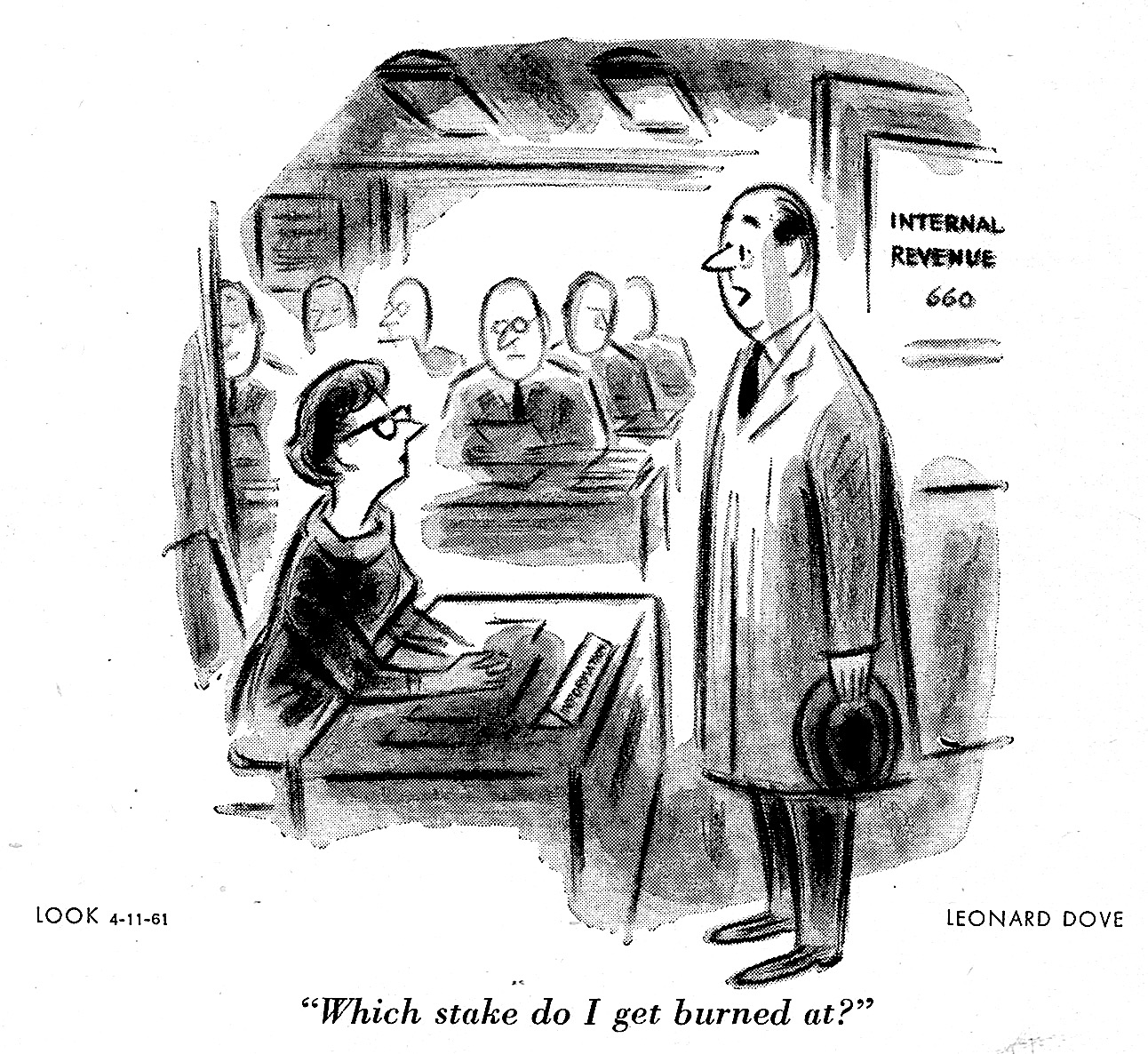
"Which stake do I get burned at?"
Leonard Dove
Look, April 11, 1961, page 122
Scan by Dick Buchanan


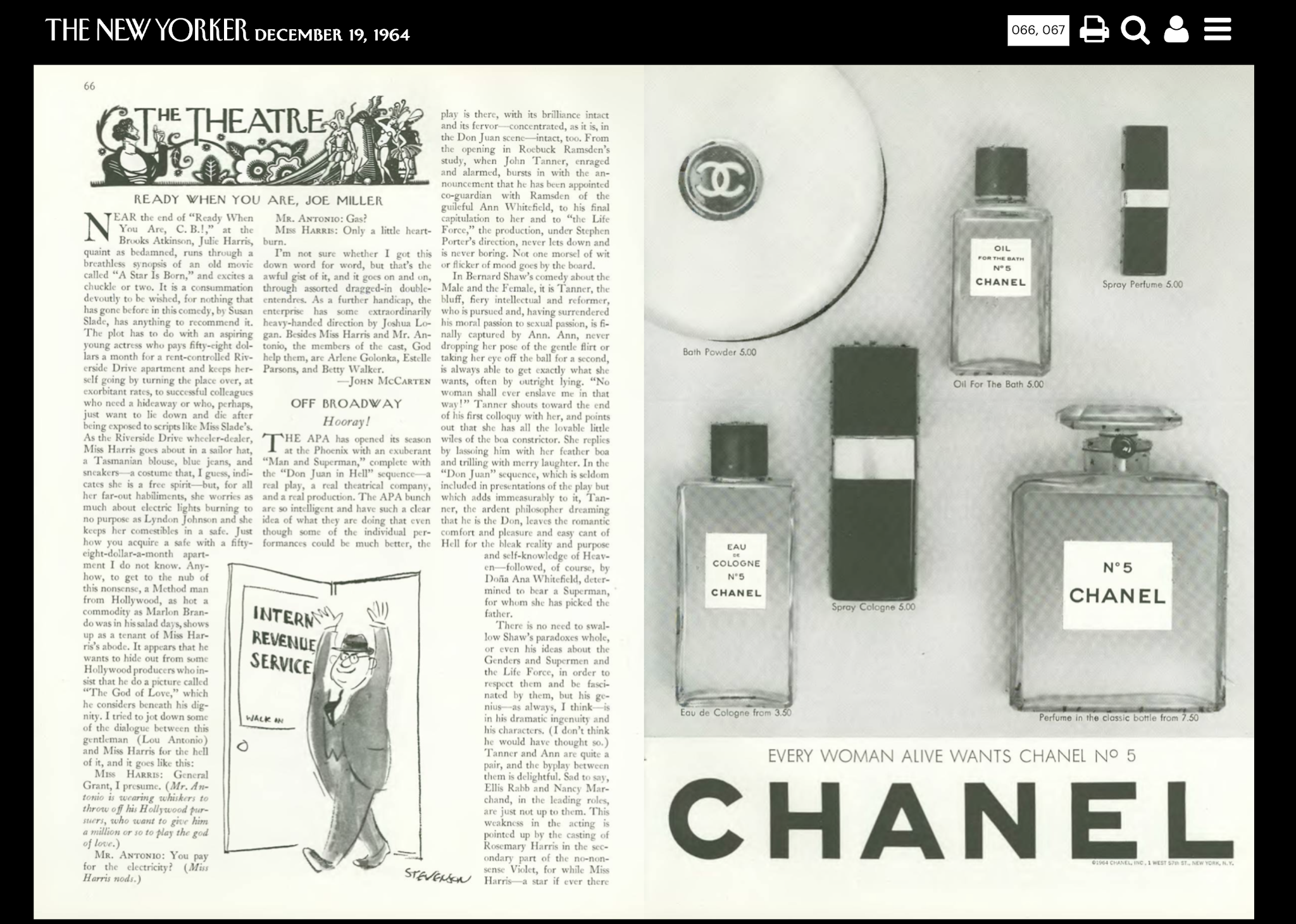
Dove, of course, was a New Yorker regular, which means this cartoon may very well have been rejected by the venerable magazine before it was shopped around and picked up by Look. Four years later, though, The New Yorker too would have its chance to play around with hyberbole in the setting of an IRS office. Amazingly, cartoonist James Stevenson manages to pull it off with a simple, wordless gag. The wry smile shown by Stevenson's taxpayer, in contrast to Dove's, indicates this man is very well aware of his own clowning around. Stevenson's cartoon appeared almost four years after Dove's and is memorable, a New Yorker classic. 
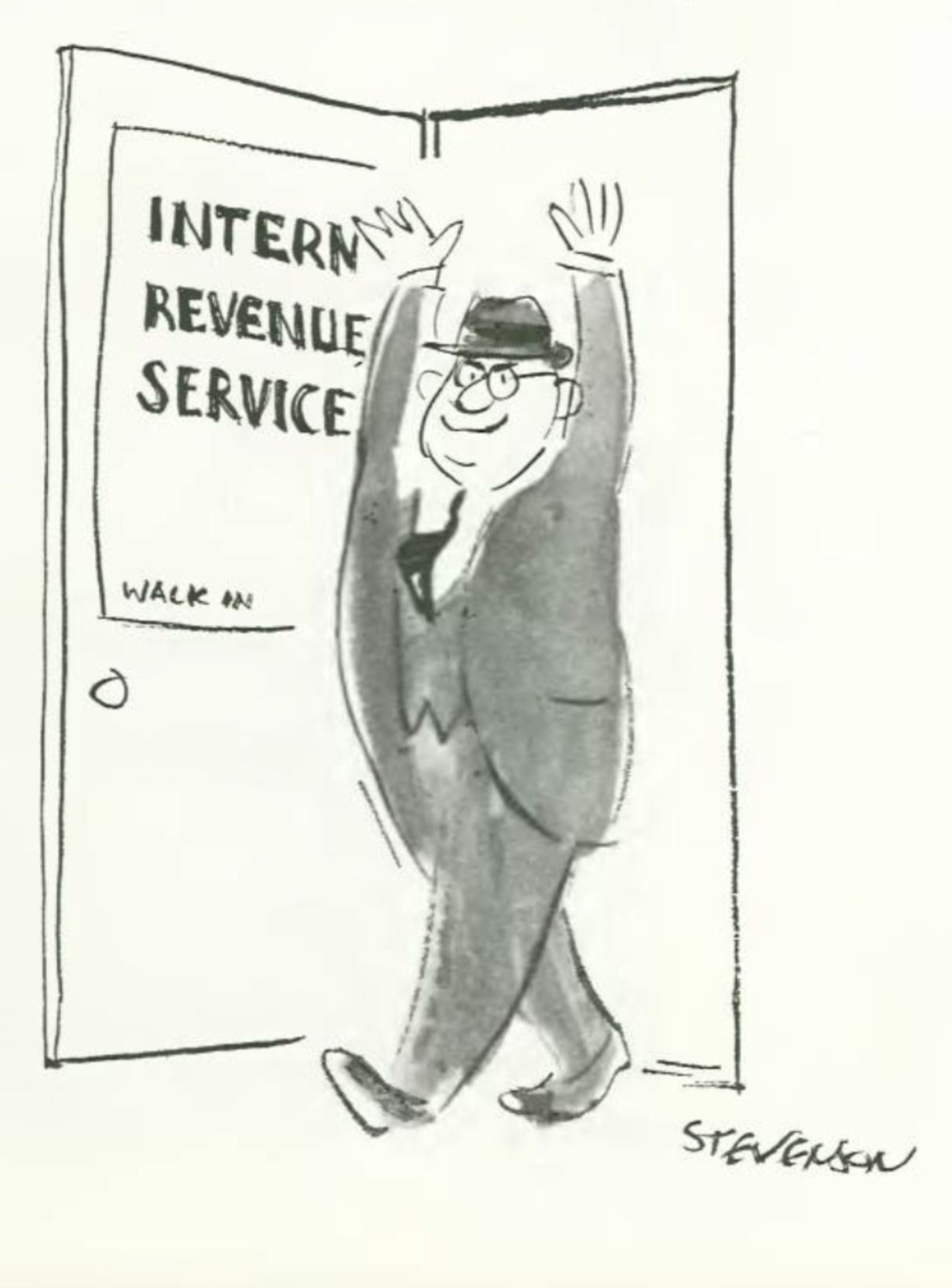
James Stevenson
The New Yorker, December 19, 1964, page 66


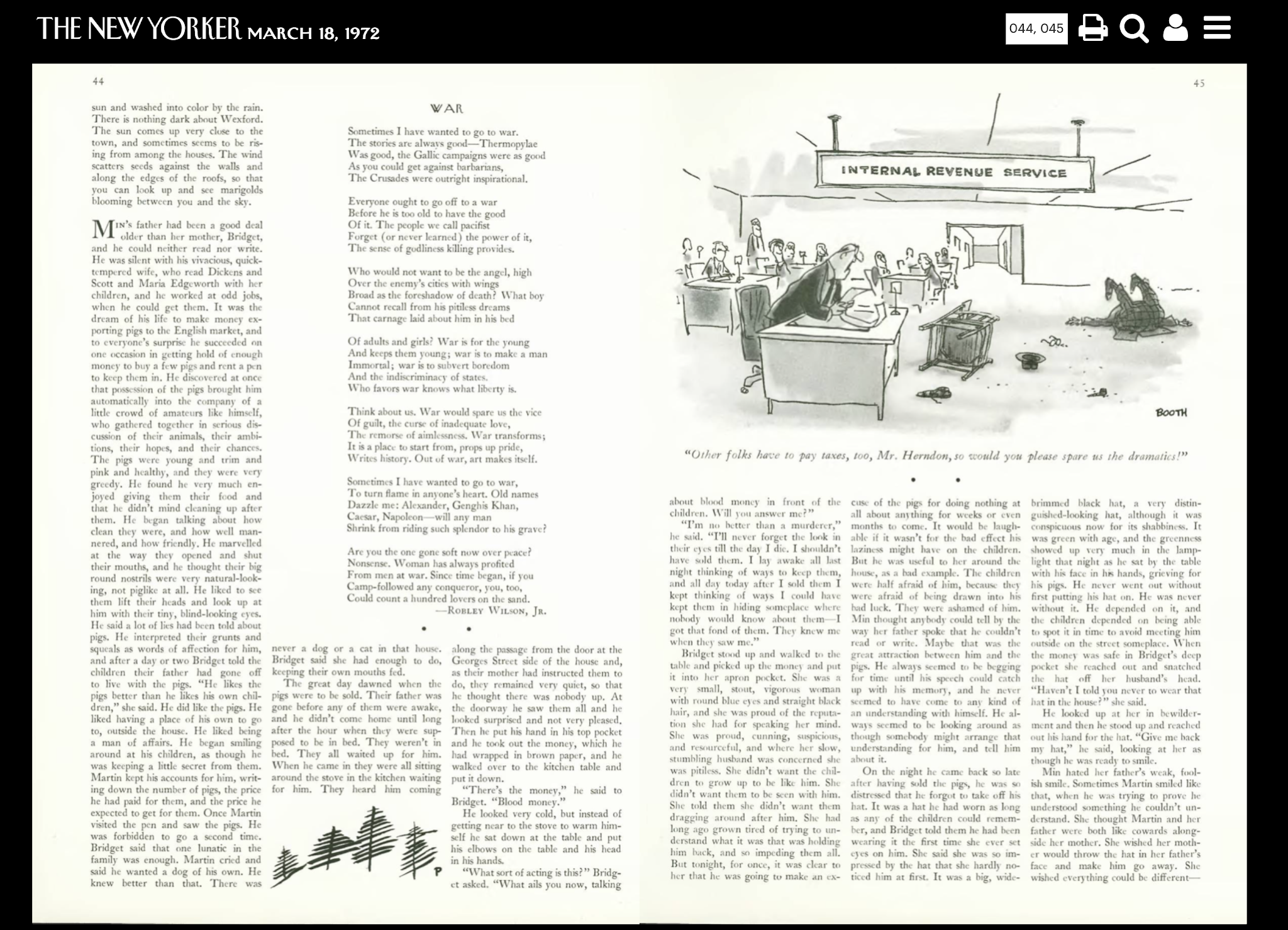
Is there room for another great cartoon on this topic? (Would I ask if there weren't?) You might think James Stevenson gets the last word, wordlessly, on the subject of exaggerated reactions to the tax collector, but his character's mimicking of a holdup victim does not quite end our story. In a cartoon dating from the 1972 tax season, cartoonist George Booth takes the taxpayer's overreaction up a notch into the realm of pure slapstick. As with Stevenson, the hyperbole is physical, not verbal; it is the flustered taxman who is left to refute the taxpayer's antics with some commonsense talk.
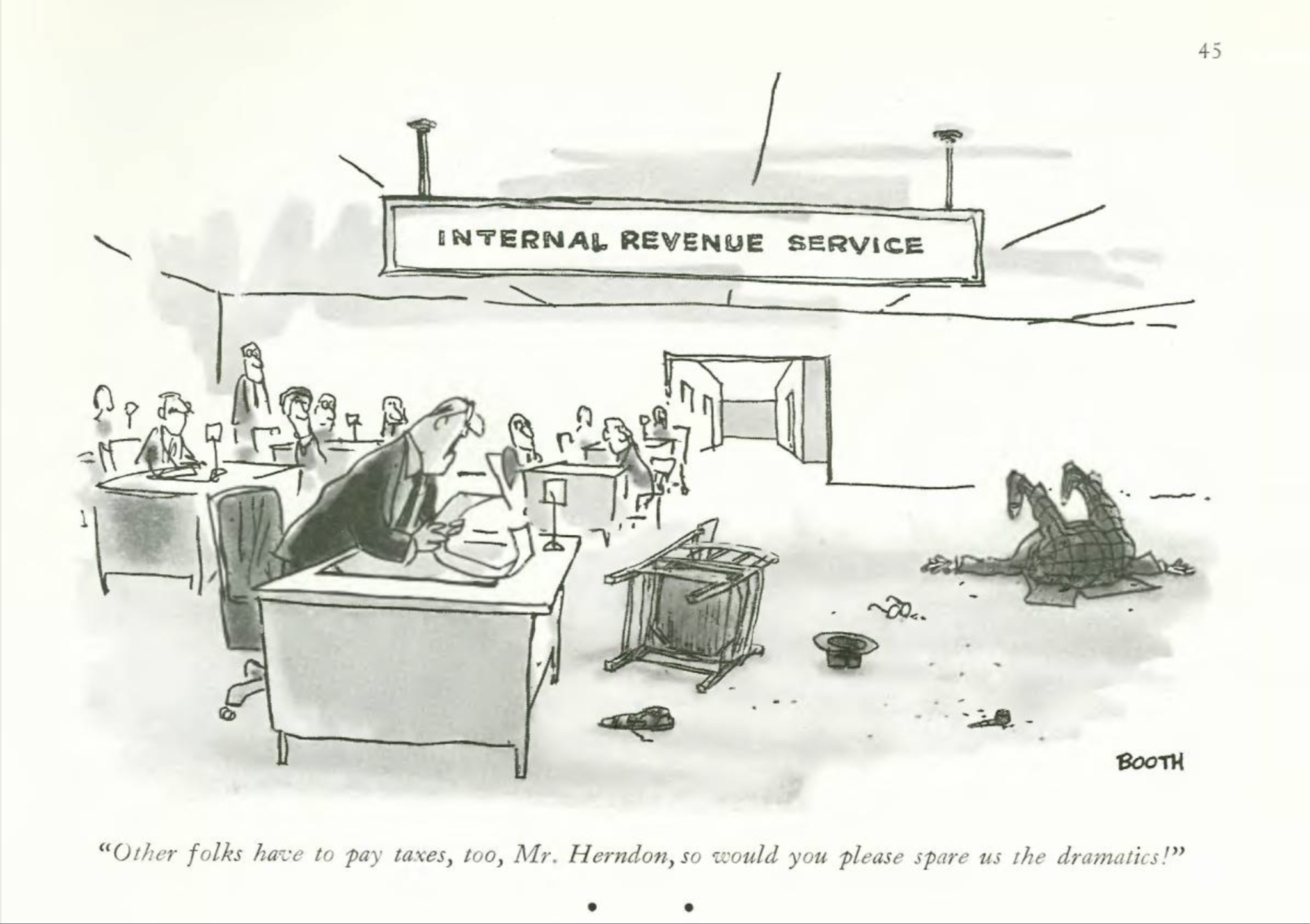
"Other folks have to pay taxes, too, Mr. Herndon, so would you please spare us the dramatics!"
George Booth
The New Yorker, March 18, 1972, page 45


Cartoon by James Stevenson. Ad by Chanel.
https://archives.newyorker.com/newyorker/1964-12-19/flipbook/066/


Spot drawing by P and cartoon by George Booth


Note:  My thanks to Dick Buchanan for his  beautiful scan of the Leonard Dove gag from his matchless cartoon clip files. Dick, you may recall, contributes regularly to Mike Lynch Cartoons, most recently a post entitled "From the Dick Buchanan Files: Certified Vintage Gag Cartoons 1940 - 1961." Dick is the only one I trust to certify gag cartoons as vintage. He also represents me at audits. This is Dick's 61st contribution to Attempted Bloggery, a record unlikely to be broken ever, or at least until tomorrow.

I'll jump at any excuse to highlight the work of Leonard Dove, James Stevenson, George Booth, and the like. Feel free to send such excuses in my direction.

Surely there must be other cartoon examples out there of hyperbolic reactions to a tax audit. I mean, is there really any other kind of reaction? Please let me know if you are aware of similar taxing cartoons that fit the bill.

By the way, who might be P, the spot artist from 1972? Anybody?


03603

Saturday, August 29, 2020

Helen E. Hokinson: Portrait of Hendrik Willem van Loon

Hendrik Willem Van Loon was a bestselling author who illustrated his own popular histories, most notably The Story of Mankind in 1921. He was the subject of not one but two New Yorker Profiles, in 1926 and 1943. The latter profile was published over the course of three issues, creating the need for three distinct illustrated portraits of the subject to appear at the head of each installment. It seems likely that Helen E. Hokinson's illustration of van Loon, pronounced "van Loan" from the Dutch, was intended to accompany one of the segments of this three-part article. Her original artwork of van Loon in black tie is currently listed by James Cummins Bookseller.

Helen E. Hokinson
AbeBooks listing retrieved May 2, 2019


A younger and thinner van Loon was depicted with a cigarette holder in the Profiles illustration of June 19, 1926. The article is by Waldo Frank.
Section header by Rea Irvin, cartoon by I. Klein, and a Profiles illustration
https://archives.newyorker.com/newyorker/1926-06-19/flipbook/018/

Helen Hokinson's artwork did not appear in any of the three sections of van Loon's 1943 Profile by Richard O. Boyer. The first part appeared in the March 20, 1943 issue with an illustration that does not try to hide van Loon's double chin, collar size 17 ½". Was having a cartoon on the facing page a consolation prize for Hokinson?
Profiles illustration by Will Cotton, cartoon by Helen E. Hokinson
https://archives.newyorker.com/newyorker/1943-03-20/flipbook/024/

The March 27 issue has a Profile illustration by Abe Birnbaum that unflinchingly portrays van Loon's corpulence—he weighed 290 pounds—and his continued smoking. In the end, was Hokinson's portrait too flattering for The New Yorker's editors?
Profiles illustration by Abe Birnbaum, cartoon by Leonard Dove

 For the third installment, Miguel Covarrubias depicts van Loon with ambidexterity in his dual capacities as writer and artist. "He once drew a picture of himself confronting the world; of the two, van Loon was the larger and more impressive" writes Richard O. Boyer. Once again Hokinson's cartoon appears on the facing page. Just a coincidence?
Profiles illustration by Miguel Covarrubias, cartoon by Helen E. Hokinson


Note:  At the time of this posting, Helen E. Hokinson's portrait of Hendrik Willem van Loon is still available from James Cummins Bookseller.

I have not been able to identify the illustrators of the 1926 Profile or of the March 30, 1943 Profile, so I would appreciate some assistance with this. I have assumed the Hokinson portrait was never published anywhere; please tell me if I'm wrong about this.


August 31, 2020 Update:  Tom Bloom has identified the signature on the March 30, 1943 Profiles illustration as Will Cotton's. It seems very plausible, even obvious, once pointed out. Thanks, Tom.


Quick Links to the Attempted Bloggery Archives:

03365

Sunday, May 24, 2020

Tall, Dark...and Handsome?

In yesterday's post, readers may recall, I got on my high horse and very matter-of-factly stated that the copy in a 1949 Alemite ad by Peter Arno featuring a fortune-teller should read "tall, dark, and handsome" rather than just "tall, dark." At least that's what sounded right to my ear. In the light of a new day, it still does.
You'll meet a tall, dark man on "A"-Day!
Peter Arno
Alemite advertisement
The Saturday Evening Post, December 17, 1949


Yet I will always entertain other opinions, and what opinion could be more authoritative on this blog than that of the New Yorker editors who okayed a vintage New Yorker cartoon? Specifically it is the cartoon by Leonard Dove from the issue of January 11, 1941 that brings us into the parlor of another fortune-teller, this one reading tarot cards rather than gazing into a crystal ball:

"But I've already met a tall, dark man."
Leonard Dove
The New Yorker, January 11, 1941, page 13


That's interesting in that it's very similar in both setting and wording to the Arno ad of 1949 and it treats "tall, dark man"—without the addition of "handsome"—as an established cliché. Next thing you know, the movie "Tall, Dark, and Handsome" was released on January 24, 1941, less than two weeks after the publication date of this issue of the New Yorker. That movie may well have enshrined the expression "tall, dark, and handsome" in the language for keeps.
"Tall, Dark and Handsome" movie poster, 1941


Except that, come 1949, it didn't affect the caption, as it were, of Arno's Alemite ad. Of course, we don't even know whether Arno wrote the final copy himself. It's possible the words "and handsome" were left off deliberately to keep the ad's large-type words short and punchy. But it's also possible that Arno created the ad with Dove's cartoon in front of him, or at least in his thoughts. (It could also be that he remembered the expression as he'd heard it before 1941.) All of which might go a long way to explaining the apparent similarities between the Dove cartoon and the Arno ad, but alas it is only speculation. So that's where things will have to stand, at least for now.


Cartoons by Richard Taylor and Leonard Dove


July 3, 2020 Update:  The Facebook group Vintage Panel and Gag Cartoons has proven quite useful once again. A Playboy cartoon by Erich Sokol published in February of 1972 provides further evidence for the common usage of tall dark—no comma needed, apparently, for the Playboy reader—without handsome. So now we have examples of this trope from 1941, 1949, and 1972 which agree with each other…and not with me. It is high time that I admit I was wrong.
"But I don't want to meet a tall dark man. How about a tall blonde woman?"
Erich Sokol

Playboy, February 1972
Scan by George Topham Hayes
Enhanced by Larry Miller III 


November 5, 2023 Update:  A cartoon from the 1970's by Barney Tobey favors the rule of three, but it avoids the word handsome.
"You will meet a tall, dark, attractive Reagan man."
Barney Tobey
The New Yorker, December 22, 1975, p. 35

Image added November 5, 2023

Cartoons by Lee Lorenz and Barney Tobey


Note:
  All right, I'll get off my high horse now. Readers are asked to submit evidence of how good-looking men were described, whether as "tall, dark" or "tall, dark, and handsome," in the 1940s and later. Opinions are welcome as well.


Sound the fanfare. This is my one-hundred thirtieth post about Peter Arno, a subject who never fails to fascinate me. Readers are invited to keep me going by submitting original Arno art, letters, published rarities, or memorabilia for discussion on the blog. Help me to get back on my high horse.

On the other hand, this is only the sixth post here to mention Leonard Dove. One could argue that I am more in need of material about him to balance things out a bit on the blog.


Quick Links to the Attempted Bloggery Archives:

Peter Arno

Leonard Dove


Movies

Advertising

Attempted Bloggery's Tall, Dark Index


03268

Friday, December 7, 2018

Barbara Shermund: Just Talking...

An example of original cartoon art created by Barbara Shermund for the New Yorker in 1930 is presented in an ad by art dealers Carlson and Stevenson. The stock market crash happened a year earlier, but you'd never know it from the drawing. The three women are fashionably turned out and not coincidentally represent the sort of young, educated demographic which the magazine was actively courting. Cigarette smoking was taken to be a sign of women's independence and sophistication; our trio is accompanied by three distinct plumes of smoke which run more or less parallel to the curtains off to the right.

"Oh, she talked a lot, but she didn't give anything."
Barbara Shermund
Original art
The New Yorker, October 4, 1930, page 33


The composition is based on the three women's heads forming a triangle with the speaker at the apex. The women on either side lean in toward her; all together they can be seen as forming the outline of a diamond. The lines of the center chair lead the eye back up to the speaker as do the legs of the woman on the right and the right-hand edge of the table.

The caption is better balanced with the simple addition of "a lot." The central dash has been replaced in the published cartoon with a less-obtrusive comma. Sometimes it takes a little work to make a drawing appear to be effortless.


The San Francisco Fall Antiques Show 2015 Catalogue, page 121


Cartoons by Leonard Dove
and Barbara Shermund

https://archives.newyorker.com/?i=1930-10-04#folio=032


Quick Links to the Attempted Bloggery Archives:

 02761

Wednesday, July 11, 2018

Leonard Dove: Schadenfreude at White Sulphur Springs

Leonard Dove's placidly acerbic cartoon appearing in the April 12, 1928 issue of Life is from so early in his career that his mature style is nowhere to be recognized. To our sensibilities, the cartoon is determinedly old-fashioned. It offers us the stock figures of the "well-fed clergyman" and his "wife (reading newspaper)," all the fussy attention to hatching and cross-hatching, and the two lines of not-so-snappy dialogue culminating in a tepid punch line. You see, it simply isn't enough to have a grand old time relaxing in White Sulphur Springs, West Virginia. For true happiness, the people who stayed behind in New York need to be made miserable as well.

At White Sulphus Springs
Leonard Dove
Life, April 12, 1928, page 14
Scan by Dick Buchanan


Note:  My thanks to Dick Buchanan for his milestone thirtieth blog contribution here, a rare and beautiful scan fresh out of the legendary Dick Buchanan Cartoon Clip Files. Dick contributes regularly to Mike Lynch Cartoons, most recently a crowd-pleasing post entitled "Dick Buchanan: Some Favorite Magazine Gag Cartoons 1940-60s."


Quick Links to the Attempted Bloggery Archives:


Leonard Dove


Dick Buchanan

Attempted Bloggery's All-Weather Index


02602

Saturday, May 13, 2017

Claude: "Honey, I'm Home."

Sometimes eBay sellers are at their best when they offer a bit of unsolicited home decorating advice. For example, an eight-panel original New Yorker cartoon from the late summer of 1950 by Claude Smith depicts a husband coming home from work and greeting his wife at a lakeside summer home. The seller advises that this piece, which is on two sheets, "would look great framed in a vacation cottage on a lake!" To this there is really nothing to add except "or anywhere else."

Leonard Dove, The New Yorker, September 2, 2017

Claude Smith, original art, sheet one of twoThe New Yorker, September 2, 2017, pages 18-19

Claude Smith, original art, sheet two of twoThe New Yorker, September 2, 2017, pages 18-19

Claude Smith, The New Yorker, September 2, 2017, pages 18-19

Verso, sheet one of two

Claude Smith
eBay Listing Ended October 27, 2016 with Best Offer of $90

Claude Smith
eBay Item Description

Reduced from $175 to $135, then purchased with a best offer of $90
Claude Smith, original art, sheet one of twoThe New Yorker, September 2, 2017, pages 18-19
Claude Smith, original art, sheet two of twoThe New Yorker, September 2, 2017, pages 18-19
Sequential drawing by Claude Smith
The New Yorker,
 September 2, 1950, pages 18-19

Note:  The present work is now framed but it has not been relocated to a vacation cottage on a lake.


Attempted Bloggery's quick links:

Attempted Bloggery's Summery Index

02186