Harold Ross, as managing editor of Stars and Stripes for the American Expeditionary Force, had been commended by General Pershing and by the French government for conceiving a plan whereby 3,567 children left orphaned by the First World War were adopted by American soldiers serving in Europe. In 1920 Ross, now stateside and editor of The American Legion, urged the nation's more than nine thousand American Legion posts to readopt these same orphans brought home by American soldiers, apparently through financial contributions to their welfare. Ross's publication supplied the copy of this article to newspapers around the country. Ross would later take on the editorship of Judge and then, in 1925, found his own weekly newsmagazine, The New Yorker.
Showing posts with label WW I. Show all posts
Showing posts with label WW I. Show all posts
Sunday, March 28, 2021


Saturday, March 27, 2021
Harold Ross and Jane Grant Wed
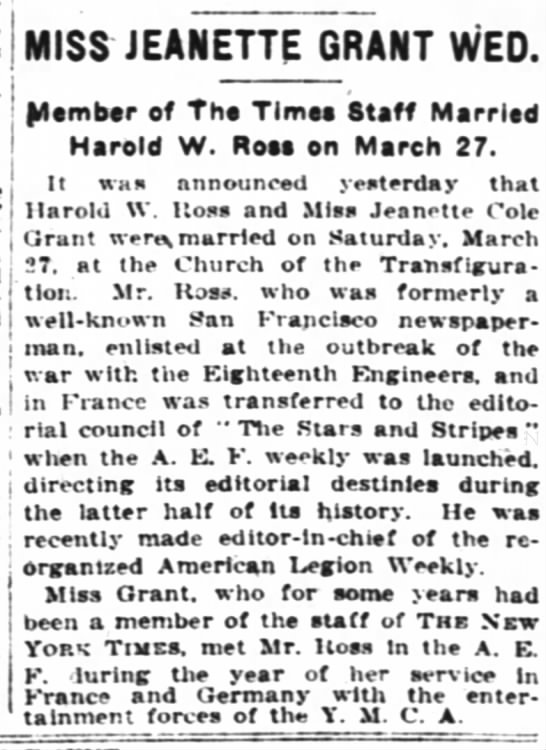
One hundred one years ago today New York Times reporter Jane Grant and American Legion Weekly editor-in-chief Harold Ross were married. The Times dutifully covered the nuptials of its first full-fledged female reporter after the announcement was made on April 12. Ross was then known for his work during the Great War on Stars and Stripes, which he had been assigned to from its founding, eventually becoming managing editor. In France, Alexander Woollcott had introduced the couple.
 |
 |
Together Ross and Grant would go on to establish The New Yorker in 1925 with the financial backing of Raoul Fleischmann. Ross, of course, served as the magazine's editor while Grant worked at bringing investors and talent, notably Janet Flanner, on board. The magazine became a success but the marriage did not. The couple were divorced in 1929. Grant would publish her memoir Ross, The New Yorker and Me in 1968.
03577
Wednesday, June 28, 2017
Ray Rohn: A Portrait of a Serviceman
The late Marge Schrader would go to thrift stores and yard sales, bringing home books by the hundreds. She would read them and then donate most of them to a worthy cause, but one that she chose to keep was Dere Mable: Love Letters of a Rookie by E. Streeter. This is the author's first book and it was published in 1918. (In 1949, Edward Streeter was to write Father of the Bride.) Recently, Marge Schrader's grandson was looking through the book when a sheet fell out of it with an original World War I era drawing by Ray Rohn. Rohn, you may recall, illustrated a single New Yorker cover, that of March 28, 1925, the magazine's sixth issue. Here's what I had to say about it in 2015:
Everyone knows women and cats sell magazines. Ray Rohn's New Yorker cover has both. It is very theatrical, which seems appropriate for a new magazine that covers so much of the stage. Like the cover of the magazine's third issue, a fashionable young woman carries a cigarette holder and the cigarette smoke is a prominent design element. Ray Rohn never did a second cover.
Ooh, I ended on a real downer there. Today I might add that the rendering of the female figure and the cigarette smoke seem to be influenced by the art nouveau style of Alphonse Mucha. I might also add that the smoking here shows that the fledgling magazine was embracing women's equality. Like men, women had the right to vote, to smoke, and to drink hooch in speakeasies.
Note: My 2015 reading of the New Yorker's sixth issue with the cover by Ray Rohn may be found here. Rohn was a major illustrator of his day, yet there are only a few works by him available on the internet today. Write if you have more artwork of his to add.
I know nothing of Girard's military insignia, but I'd love to hear from anyone who does know of such things.
 Ray Rohn, The New Yorker, March 28, 1925
The sketch found in the book is a portrait of a serviceman named Girard, evidently dating from the first World War. He appears to be a pleasant, good-natured man despite the intrusion of the war. He is shown in a three-quarter, left-facing view with a light source on the left.
|
 |
| Ray Rohn, Girard, c. 1916-1918 |
Here's the book that has kept the drawing protected:
 |
| Edward Streeter, Dere Mable: Love Letters of a Rookie, New York: Frederick A. Stokes Co., 1918. Cover illustration by Bill Breck |
 |
| Title Page Dere Mable: Love Letters of a Rookie, New York: Frederick A. Stokes Co.,1918 |
Note: My 2015 reading of the New Yorker's sixth issue with the cover by Ray Rohn may be found here. Rohn was a major illustrator of his day, yet there are only a few works by him available on the internet today. Write if you have more artwork of his to add.
I know nothing of Girard's military insignia, but I'd love to hear from anyone who does know of such things.
Quick Links to the Attempted Bloggery Archives:
02227
Tuesday, July 2, 2013
James Montgomery Flagg's "I Want You" Poster
James Montgomery Flagg's most popular and enduring work by far is the "I Want You for U.S. Army" recruiting poster from 1917. The artist himself served as the model for Uncle Sam.

Note: Does anyone know what became of the original artwork for this iconic poster? Just asking.
Catch more Flagg illustrations here or by clicking on the label below.
 |
James Montgomery Flagg, "I Want You for U.S. Army" Poster, 1917
Heritage Auctions, December 11, 2012 |
 |
James Montgomery Flagg, "I Want You for U.S. Army" Poster, 1917
Heritage Auctions, December 11, 2012 |
|
James Montgomery Flagg, "I Want You for U.S. Army" Poster, 1917
Heritage Auctions, December 11, 2012 |
Note: Does anyone know what became of the original artwork for this iconic poster? Just asking.
Catch more Flagg illustrations here or by clicking on the label below.
0795
Wednesday, June 6, 2012
Liza Donnelly and the War on Women
When I see a cartoon like Liza Donnelly's "Mommy, what did you do in the War on Women?" I am first lost in admiration for the simple yet effective idea. Then, a moment later, I ask myself, "Now why didn't The New Yorker take this one?"
This cartoon accompanied a column by Ms. Donnelly written in April on Forbes.com. Not every cartoonist has such a public venue for displaying timely cartoons presumably passed up by The New Yorker, but she does, and it allows us to see the consistently high quality of her output and to muse on The New Yorker's editorial decisions.
Since I am unable to get into the head of the cartoon editor, let me just note that the magazine often shies away from overtly political commentary in its cartoons, and that this little gem may well fall into the category of "too political." It is, I think, precisely the right approach to politics for a New Yorker cartoon, as it shows the effect of the national discourse on our everyday lives. The phrase "War on Women" is admittedly partisan, as aptly as some may feel it describes what is taking place in today's ongoing attacks on women's reproductive rights, and perhaps it is not editorially acceptable. But it is used in common speech. The gag certainly can't work without it.
Ms. Donnelly's cartoon stands on its own, but it also makes a pretty direct reference to this classic British recruitment poster by Savile Lumeley published during the first World War. This image no doubt prompted many guilt-ridden young men to enlist so they would be able to save face before their as yet unborn children--if they survived to have them, that is.

This cartoon accompanied a column by Ms. Donnelly written in April on Forbes.com. Not every cartoonist has such a public venue for displaying timely cartoons presumably passed up by The New Yorker, but she does, and it allows us to see the consistently high quality of her output and to muse on The New Yorker's editorial decisions.
 |
| Liza Donnelly, "Mommy, what did you do in the War on Women?" Social Media and Generational Shift In The War on Women, Forbeswoman, Forbes.com, April 23, 2012 |
Ms. Donnelly's cartoon stands on its own, but it also makes a pretty direct reference to this classic British recruitment poster by Savile Lumeley published during the first World War. This image no doubt prompted many guilt-ridden young men to enlist so they would be able to save face before their as yet unborn children--if they survived to have them, that is.
 |
| Savile Lumely, Daddy, what did YOU do in the Great War? 1915 |
Today more people may remember the 1966 Blake Edwards screen comedy which shamelessly distorted the classic poster's main idea, apparently into a series of lusty wartime shenanigans. The movie, incidentally, was set during the second, and not the first, World War.

"What Did You Do in the War, Daddy?" 1966 Film Poster
Liza Donnelly appeared at the Museum of Comic & Cartoon Art's Festival 2012 on April 28th where she produced a number of drawings for her fans. I missed her appearance, but when I came by the following day I was lucky enough to find this redraw of the War on Women cartoon waiting just for me.
On my blog, this is called a happy ending. I'm not sure what it's called on Fox News.
On my blog, this is called a happy ending. I'm not sure what it's called on Fox News.
 |
Liza Donnelly, "Mom--what did you do in the War on Women?" MoCCA Fest 2012
Scan added September 3, 2012
|
|
| Liza Donnelly, "Mommy, what did you do in the War on Women?" Social Media and Generational Shift In The War on Women, Forbeswoman, Forbes.com, April 23, 2012 |
 |
| Liza Donnelly, "Mom--what did you do in the War on Women?" MoCCA Fest 2012 |
0359
Thursday, January 19, 2012
Book Review: Fall of Giants by Ken Follett
 |
Fall of Giants (2010) by Ken Follett. |
As a young man, Ken Follett wrote the extremely memorable spy novel Eye of the Needle in 1978. He has since gone on to write the highly-praised historical novel Pillars of the Earth and its sequel World Without End.
Follett's writing has grown more ambitious over the years, and now he has written Fall of Giants, a book of nearly 1,000 pages which is only the first of three projected volumes called The Century Trilogy. Fall of Giants follows eight major characters across three continents during the cataclysmic events of World War I, no minor feat. Subsequent volumes will follow the same characters and their descendants through the 20th Century. It seems clear that the second volume will cover the second World War. Perhaps the third volume will be set during the Cold War.
My knowledge of the First World War consists of hazy memories from high school social studies. Follett has done his homework here--he actually uses a research company based in New York--and he's made the earthshaking events of the early 20th Century seem as palpable as today's headlines. It's hard for a contemporary reader to understand how civilized nations could have subjected millions to the carnage of the first World War. Follett deals with this problem rather well. He places his characters close to the key decision-makers, so we can see firsthand how so many nations were led to such a calamitous outcome.
Follett's writing is very simple and direct. I would not characterize it as literary. He goes to great lengths to describe his characters's motivation for every decision and action. The cruelty and deprivation of life under the Czar is depicted so well that the Russian Revolution, when it finally comes, seems totally plausible, even necessary. Slowly, the horrors of life under Lenin emerge as well. This elaborate work of fiction depicts a host of complex historical events from the assassination of the Archduke Ferdinand to the Great Depression in convincing, even compelling, detail. President Wilson, the Kaiser, and Lenin all make their appearances, but they never overshadow the characters we care about.
To be sure, getting so much historical detail in a book with only eight primary characters requires a fair number of contrivances and coincidences. Characters get reassigned from the battlefield to military intelligence and back again, as the story requires. Characters may travel from country to country, but wherever they go they keep running into each other.
As in World Without End, Follett has a fondness for highly intelligent, highly competent young men and women with modern ideals. These are the good guys, the ones who passionately want peace or women's suffrage or safer coal mines, and who we hope will succeed. There are also a number of nationalistic or aristocratic characters wedded to Old World ideals and eager for war to advance their interests. Follett explains their positions, but he doesn't share them.
0210
Subscribe to:
Posts (Atom)