Showing posts with label New Yorker cartoons. Show all posts

Tuesday, January 24, 2023

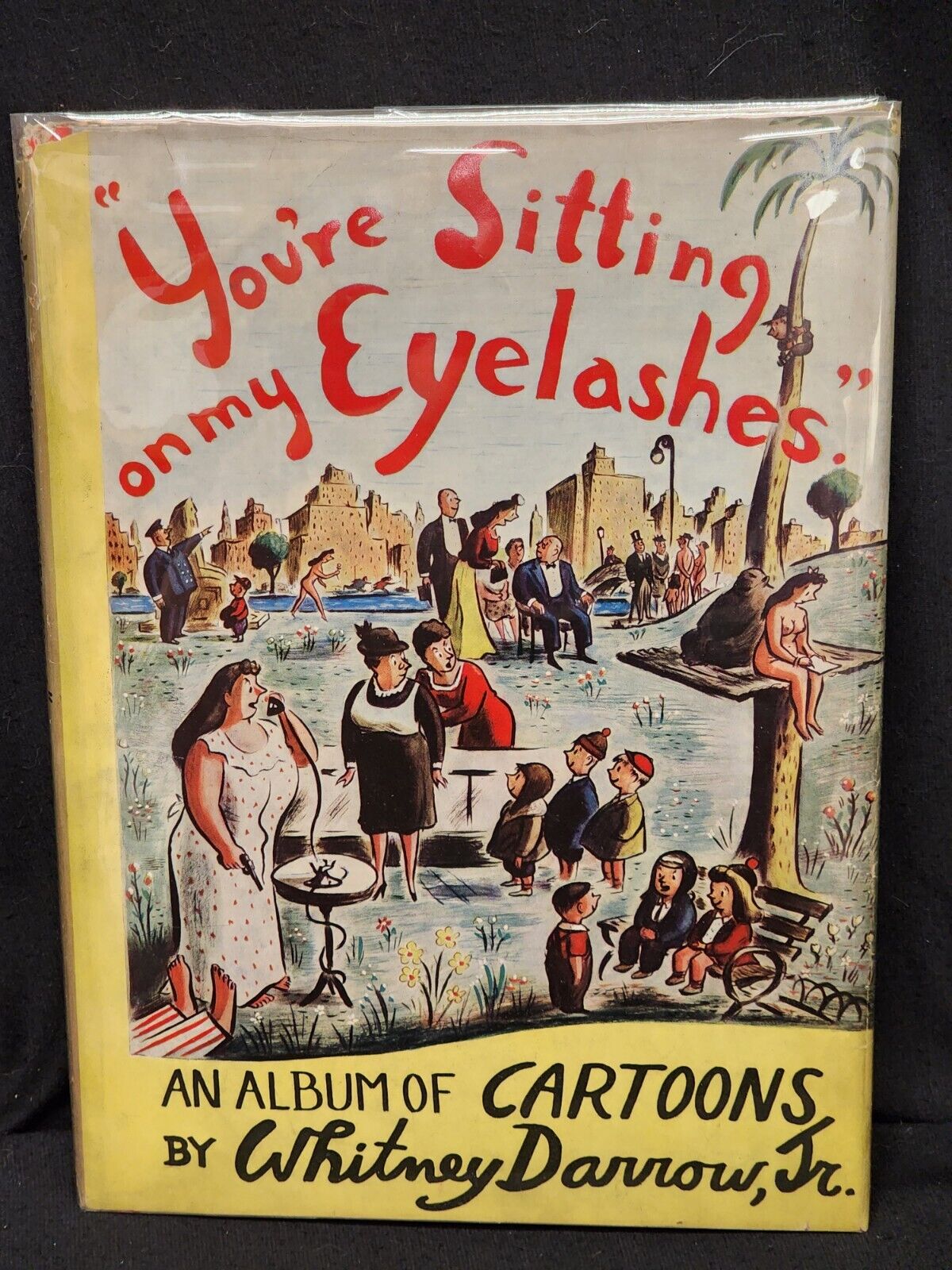
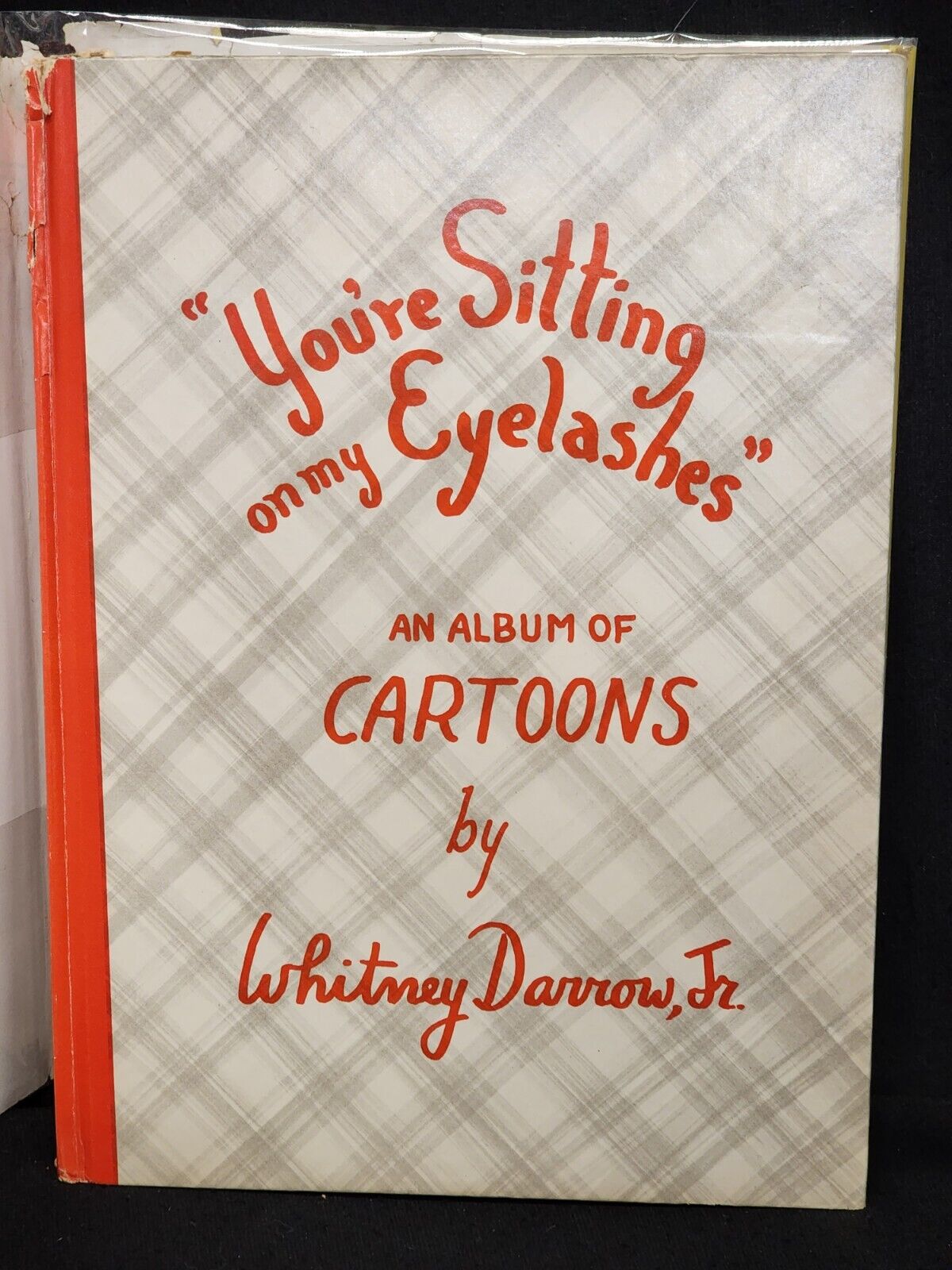
Isabel's Copy of "You're Sitting On My Eyelashes" by Whitney Darrow, Jr.

In 1943, Whitney Darrow, Jr., collected his New Yorker work of the prior decade in a collection called "You're Sitting On My Eyelashes." Isabel's copy, whatever her identity, has an original full-page sketch by the cartoonist. It is dated in November of the year of publication. His wife Middy gets in on the fun as well, inscribing the book underneath Darrow's printed drawing of a woman with "Love/ Middy Darrow, Jr." The book was just sold on eBay in November, a full eighty years after the drawing was made.




Additionally inscribed "Love/Middy Darrow, Jr."

"Mr. Jackson has contributed
most generously to Bundles for Britain."
* * *
". . . and, forsaking all others, keep thee only unto him, so long as
ye both shall live? . . . True or false?"

"As you know, Collins, this national-defense situation has left us a bit shorthanded. Can you ride a bicycle?"

"It's some radio survey, Ma'am. They                "Don't look now, but I think we're 
 want to know if you're happy."                            all set for the evening." 

Whitney Darrow, Jr.
eBay listing ended November 18, 2022

Whitney Darrow, Jr.
eBay item description

Whitney Darrow, Jr.
eBay bid history
Just one bid with five seconds to spare


Note:  At this point, I've shown enough of these Whitney Darrow books to make it clear to anybody that I'd like to keep doing this. Help a blogger out by sending your scans and photos of original book sketches by Darrow.


04209

Sunday, February 21, 2021

A Coffee Mug for Valentine's Day 2021

One of my Valentine's Day gifts this year is a cartoon mug, shown below with one of our cats slinking by behind it. On the side of the coffee mug is emblazoned a 2013 cartoon that I had never seen before from Rick London's website London's Times Cartoons. The idea is by London and the illustration is credited to Tom Kerr. 


I don't pretend to know what this cartoon should have to do with me, but apparently there's a popular conception that the cartoons that appear in a certain magazine are elitist and abstruse, requiring some sort of explication in order for the general public to be able to appreciate them. In the nearly ten years I've been writing this blog, which is often about New Yorker cartoons, it has been a very rare thing indeed for me to feel I had to explain any of them. But then, I don't feel the need to tell bedtime stories either.

https://www.pinterest.ch/pin/36239971974889748/


Note:  This mug was purchased from CafePress.com. The cat is from a shelter.


03543

Saturday, July 18, 2020

A Charles Addams Jungle Snake Cartoon Printing Plate

Joel Jacobus, devotee of cartoonist Charles Addams and cataloguer of divers Addamsiana, today adds to our knowledge of rarities so obscure that the creator of the Addams Family himself may never have seen them. Joel now reports the existence of a third copper printing plate bearing the reverse image of an Addams cartoon published in the New Yorker. Dating from the issue of October 16, 1948, the cartoon depicts a jungle scene with two Anglo men seated outside of a hut threatened by dangerous-looking tropical snakes. The man who is apparently the host, drink in hand, says to his squeamish guest, "Bothered me a bit too, at first, until I discovered they were real."
"Bothered me a bit too, at first, until I discovered they were real."
Charles Addams
Copper printing plate
The New Yorker, October 16, 1948, page 29

The plate was sold just last month on eBay—where else? Joel notes that "the plate is quite worn and was displayed in a printmaker's house in New York for years." Ever the scholar, he points out that the cartoon was reproduced in the classic 1950 Addams collection Monster Rally on page 69, where it was certainly printed with a different plate.

There has never been a real market for these printing plates, at least until very recently. It can't be an accident that three of the very few plates which survived and made their way to eBay were of Addams cartoons, each individually spared destruction in the printing plant by enterprising workers who were also, one assumes, fans. (There is, as we have had occasion to note, a surviving Barney Tobey cartoon printing plate as well.) That's all that's come to light so far after 95 years of New Yorker cartoons although, to be sure, such plates are no longer used in the process of printing the magazine.

Here's the rest of the eBay sale:


Charles Addams
eBay Listing Ended June 25, 2020


Charles Addams
eBay Item Description

Charles Addams
eBay Bid History
One bidder places two bids; the second is for insurance.


[End of eBay Listing]


"Bothered me a bit too, at first, until I discovered they were real."
Charles Addams

The New Yorker, October 16, 1948, page 29

The plate image is here flipped horizontally into the orientation of the cartoon.

A spot drawing of passenger ship terminal and a cartoon by Charles Addams


Note:  I would like to thank Joel Jacobus for bringing this eBay sale to my attention. He continues to provide us with many insights into these rare copper plates once used to print cartoon images in the New Yorker. There are no doubt other extant printing plates corresponding to published New Yorker cartoons. I would like to hear from anyone in possession of these. (I would also like to know whether readers can identify the artist of the passenger ship terminal spot drawing.)


"Bothered me a bit too, at first, until I discovered they were real."
Charles Addams
Copper printing plate
The New Yorker, October 16, 1948, page 29


Quick Links to the Attempted Bloggery 
Archives:


Charles Addams

Copper Printing Plates

Snakes


Joel Jacobus

Attempted Bloggery's Slithering Index


03323

Thursday, January 2, 2020

Lee Lorenz: Weight Watcher

For those of us who started off this new year resolving to eat better and stay fit, the New Yorker's former art editor Lee Lorenz has an important reality check. His message is conveyed in a lively color lithograph issued in a signed, limited edition of 300. The title might be Weight Watcher according to a notation on the verso. The date of publication should be 1989 or 1990 based on the issue date of the New Yorker cartoon on which it is based. This lithograph was probably printed by American Atelier for the Circle Fine Art Corporation of Chicago and New York City. I recall seeing it at the Circle Gallery around that time.
Lee Lorenz
Weight Watcher [?]
No. 143/300, c. 1989

The deckle edge suggests a paper stock of good quality.
Lee Lorenz
Weight Watcher [?]
No. 143/300, c. 1989


Grant Zahajko Auctions, LLC, which is to auction this print on January 9, 2020, states that the lithograph is "signed in unverified hand," as if handwriting this bad could belong to anyone other than Mr. Lorenz—or perhaps his physician.


Verso

Lee Lorenz
Grant Zahajko Auctions, LLC
January 9, 2020
Item Description Accessed January 1, 2019


Lee Lorenz
Grant Zahajko Auctions, LLC
January 9, 2020
Item Description Accessed January 1, 2019


The color lithograph is redrawn from a black and white 1989 New Yorker cartoon. At the time, Mr. Lorenz was the art editor of the magazine. He was later to be named the cartoon editor. 
Lee Lorenz
The New Yorker, February 20, 1989, page 42

Cartoons by Lee Lorenz and Jack Ziegler

Lee Lorenz
Weight Watcher [?]
No. 143/300, c. 1989
                                              

January 16, 2020 Update:  Sold!


Note:  Among its many purposes, this blog serves as an unofficial resource for information about New Yorker cartoonists. Over the years I have tried to preserve numerous examples of cartoon artist's signatures and handwriting. The auction house, which apparently obtained the artist's name from the pencil notation in an unknown hand on the verso, could very easily have verified the signature with a simple Google search. Is that asking too much of an auctioneer?

03125

Saturday, November 30, 2019

New Yorker Comics or Cartoons?

On the shelves of a popular independent bookstore I recently noted a sign reading New Yorker Comics. I won't mention the store's name, but it can be found downtown at 12th Street and Broadway in the city with which the New Yorker is principally concerned.

These days comics are extremely popular and with much good reason. But they are not synonymous with cartoons. Comics are sequential narrative art. They may appear as comic strips, comic books, graphic novels, or zines. Despite the name, comics do not have to be humorous.

Those clever drawings that appear in the New Yorker each week are called cartoons. The overwhelming majority of them are single-panel gags. A scant few may be sequential; these generally work up to a punch line or site gag in the final panel. These are still called cartoons.

There is, of course, bound to be some blurring of definitions. A few newspaper or online comics may be of the single-panel variety. The New Yorker does occasionally publish work in the form of a comic strip. But for the most part the New Yorker publishes cartoons and that's what they should be called.

That big white volume at the lower right in the second photo is The New Yorker Album of Drawings 1925-1975. Back in the days when I was introduced to the art form, the magazine made a point of referring to its cartoons as drawings and to its cartoonists as artists. The magazine, today wary of its former elitist reputation, has long abandoned that practice although I, perhaps stubbornly, have not. Regardless, for purposes of clarity, that section of a bookstore concerned with New Yorker cartoons should have signage indicating New Yorker Cartoons. There is nothing remotely useful about the term New Yorker Comics.

03095

Saturday, November 12, 2016

The New Yorker and the New President

On Wednesday November 9, the day after Election Day, The New Yorker's editor David Remnick wrote online of Donald Trump's election:

The election of Donald Trump to the Presidency is nothing less than a tragedy for the American republic, a tragedy for the Constitution, and a triumph for the forces, at home and abroad, of nativism, authoritarianism, misogyny, and racism. Trump’s shocking victory, his ascension to the Presidency, is a sickening event in the history of the United States and liberal democracy. On January 20, 2017, we will bid farewell to the first African-American President—a man of integrity, dignity, and generous spirit—and witness the inauguration of a con who did little to spurn endorsement by forces of xenophobia and white supremacy. It is impossible to react to this moment with anything less than revulsion and profound anxiety.
http://www.newyorker.com/news/news-desk/an-american-tragedy-2

That should give some idea of the challenges that the magazine will face in covering the Trump Presidency. The New Yorker's first post-election cover is by Bob Staake and it will be on newsstands Monday. With disarming simplicity, it seems to suggest something even more ominous than Trump's promise to build a wall on the Mexican border to keep out illegal immigrants. Presumably it also encapsulates the bleak and claustrophobic mood experienced by much of the magazine's readership as a solid field of red-state bricks obliterate the open blue-state sky:
Bob Staake, The New Yorker, November 21, 2016


Compare this with the shimmering, light-filled, open-air vision of hope depicted by Mr. Staake eight years ago when Barack Obama was elected to the Presidency.
Bob Staake, The New Yorker, November 17, 2008

The cartoons from the November 21 issue have yet to be released and they may not yet reflect the mood swing that accompanied the election outcome among a large part of the electorate. One can't envy the cartoonists their new task. This election has saddened and embittered many of the magazine's readers as they contemplate the many profound and unwanted changes coming to our nation, some of which may persist for decades. The New Yorker's writers will continue as always to chronicle the events that reshape this country for good or ill, but the cartoonists will have to find humor in them. It is impossible to predict what approaches the New Yorker's cartoonists will adopt in the Trump years and beyond, but it is perhaps helpful to ponder a darkly delightful 1982 Reagan-era cartoon by Charles Barsotti. Such subtlety isn't likely to register in the Trump era.
Charles Barsotti, Uninformed
The New Yorker,
September 13, 1982, page 38


Attempted Bloggery's essential links:

02017

Saturday, September 10, 2016

Bob Mankoff: New Yorker Cartoons Past, Present & Future

On Thursday evening, New Yorker cartoon editor Bob Mankoff came to the Museum of the City of New York to talk about—what else?—New Yorker cartoons. Afterwards the exhibition "Roz Chast: Cartoon Memoirs" was on view and Mr. Mankoff signed copies of his own memoir How About Never--Is Never Good for You?:  My Life in Cartoons which will soon be out in paperback.


"New Yorker Cartoons Past, Present & Future" with Bob Mankoff


http://www.mcny.org/event/bob-mankoff-new-yorker


Note:  Just a reminder:  Attempted Bloggery welcomes scans or photos of distinctive original art by Bob Mankoff or other New Yorker cartoonists past, present & maybe future.


Attempted Bloggery's quick links:

Robert Mankoff
The once and future Attempted Bloggery index

01959