Showing posts with label Garrett Price. Show all posts

Saturday, January 25, 2025

A Few First Steps Into "Drawn From The New Yorker: A Centennial Celebration"

The exhibition "Drawn From The New Yorker:  A Centennial Celebration" fills two floors of the Society of Illustrators, so there are two very good places to begin. To take in the show's material chronologically, a visitor can start at the bar on the third floor. As usual, a festive painting donated by Norman Rockwell welcomes all, as do a variety of libations.


A scrapbook kept by the magazine of published cartoons by Helen E. Hokinson is displayed under glass, on loan from The New Yorker's library. The page is open to her work from December 1926. Below that is the magazine's first cartoon issue from 1997 and the first album of drawings (1928). On the lowest level there are several smaller pony editions of the magazine published for America's overseas troops during World War II.

New Yorker cartoonist Liza Donnelly curated the show. She and her husband, New Yorker cartoonist Michael Maslin, loaned the exhibition a 1940s-era portrait of founding editor Harold Ross by magazine artist Garrett Price.

A photograph by Arnold Newman shows Ross and his wife Jane Grant who, along with Raoul Fleischmann, founded The New Yorker. (Fleischmann provided financing through his family's yeast and baking enterprises.)

A bold 1926 magazine header designed by Johan Bull for the Skyline section is also on loan from the collection of Maslin and Donnelly. They have not been able to determine if it was published.


Note:  These few photographs hardly begin to cover the delights of this exhibition. "Drawn From The New Yorker: A Centennial Celebration" is now on view at the Society of Illustrators. The full show may be seen in all its glory through March 12. The second floor gallery currently featuring more recent material will remain open through May 3.


04860

Friday, December 2, 2022

A Garrett Price Christmas Card Drawing

Cartoonist Garrett Price (1896-1979) started working for the Chicago Tribune in 1916 and for The New Yorker in 1925. He drew the comic strip White Boy from 1933 to 1936. In 1940, he moved east to Westport, Connecticut. 


A hand-drawn Christmas card of his currently listed on eBay features caricatures of fellow cartoonists at the Tribune. The biggest names of the era—John McCutcheon, Carey Orr, and Gaar Williams—are not to be found here. Those cartoonists labeled with only one name, or with a nickname, aren't easily identified. Gary Sheahan (1893-1978) is helpfully indicated by both first and last name. Today he has his work archived in the Chicago History Museum here. In 1942, he was to do a wraparound cover for The Line Book, published by the Tribune, fifteen years after The New Yorker's Peter Arno had that very honor.


The eBay seller of the Price drawing notes that it had been given to a fellow Tribune cartoonist, and that it bears evidence of having been kept in a scrapbook. It is dated by the seller to circa 1927, plausibly enough.


Garrett Price
eBay listing accessed February 12, 2022


Note:  I would appreciate hearing from anyone who can identify Walt, Gross, Lundy, Cagh, Cy, Milt, or Wag of the Chicago Tribune.


Additional art by Garrett Price, just Price to his fellow Chicago cartoonists, is welcome for future blog posts.


Here's that Line Book cover I mentioned by Gary Sheahan:

Gary Sheahan
The Line Book, 1942


04156

Sunday, November 20, 2022

Richard Taylor: A Revised Statuary of Morse

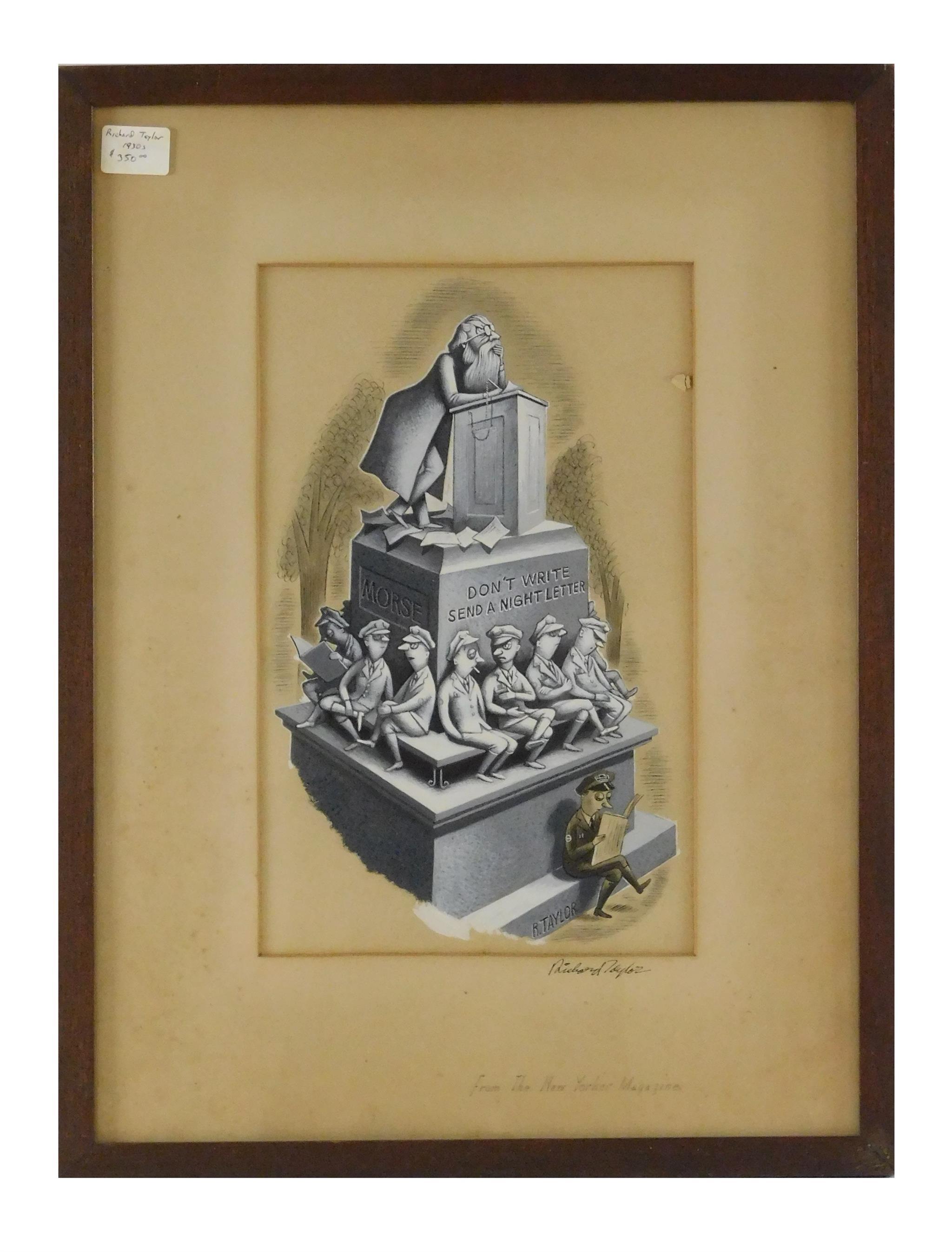
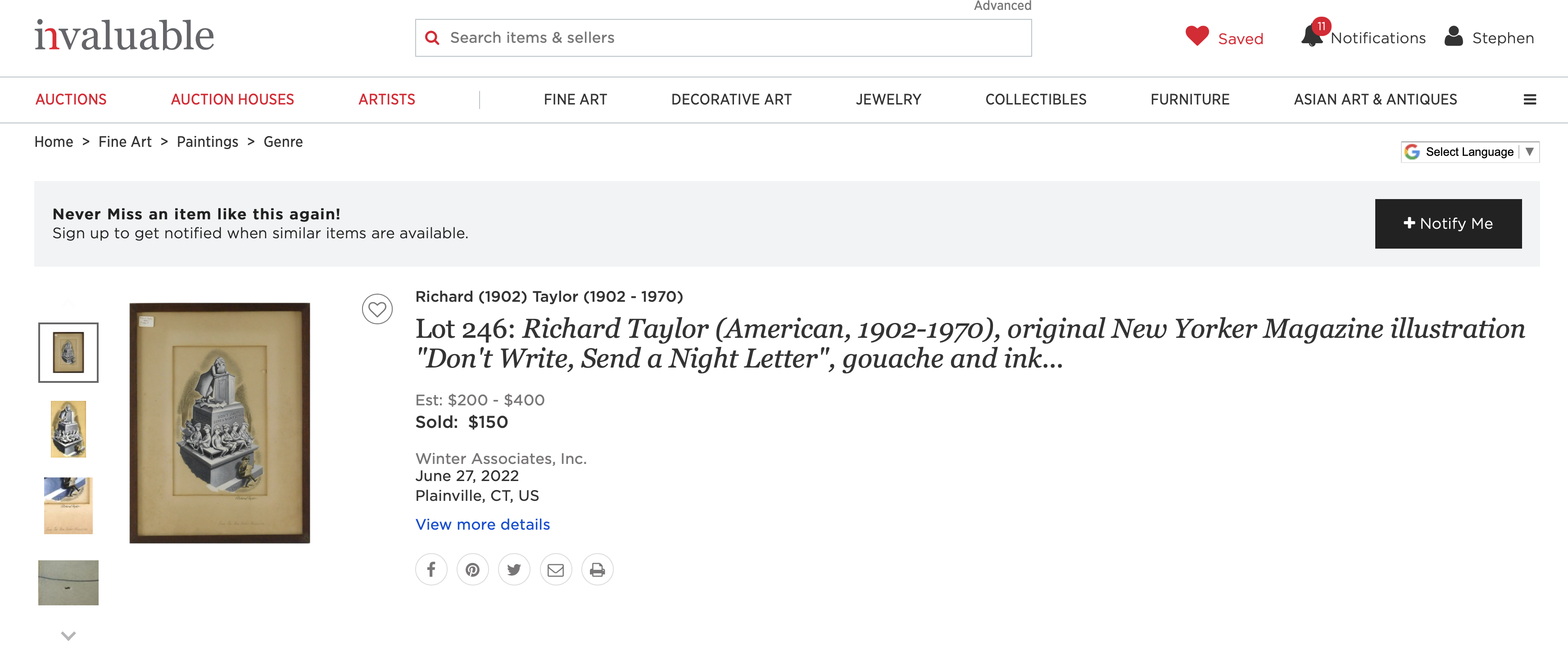
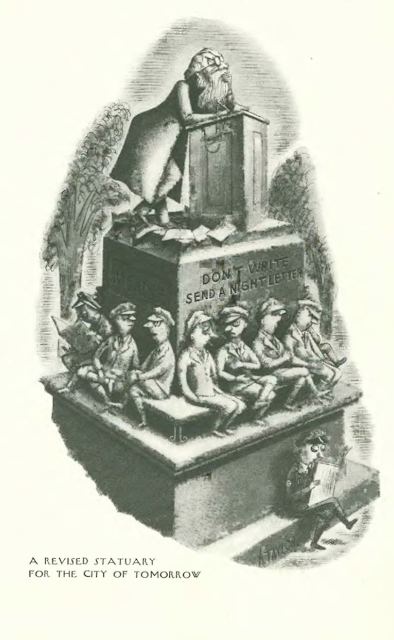
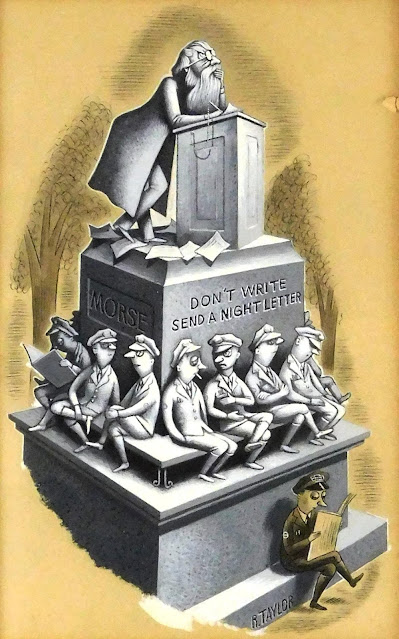
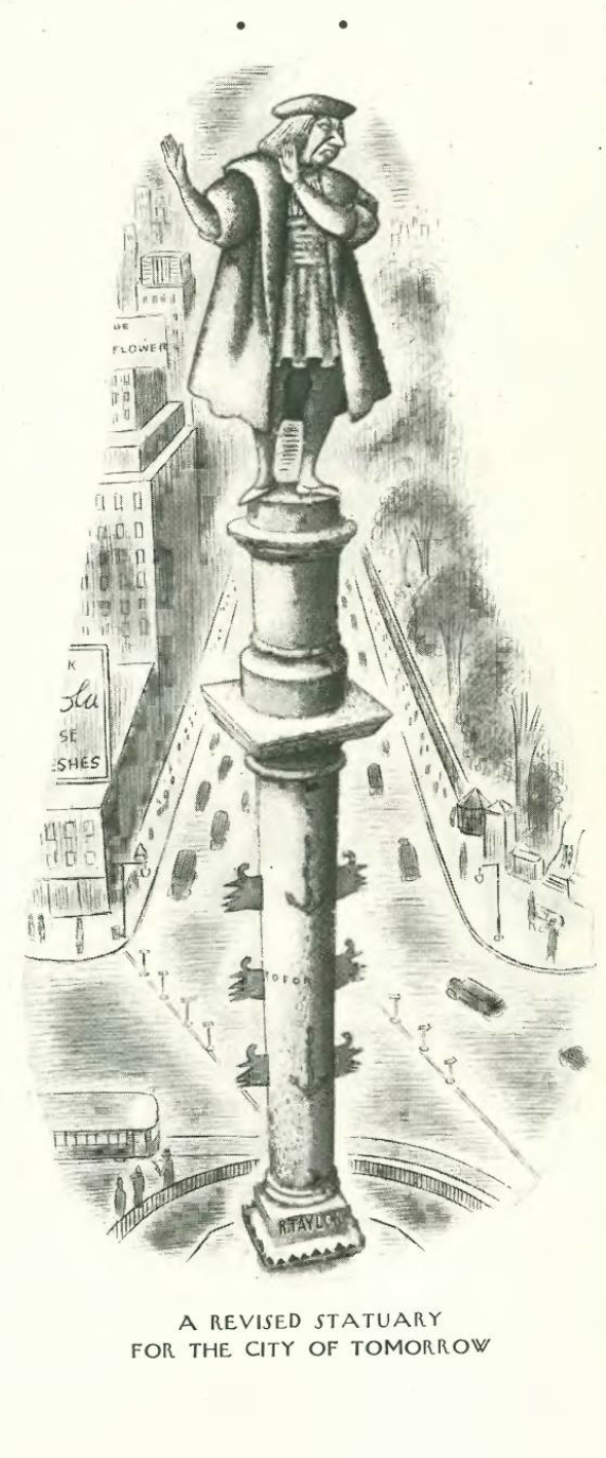
In 1938 and 1939, readers of The New Yorker were treated to a series of satirical statue designs by cartoonist Richard Taylor. Presented singly in the magazine, they went under the shared title A Revised Statuary for the City of Tomorrow. One of the originals from the set, Morse, was sold this past summer at Winter Associates, Inc., of Plainville, Connecticut. The frame has a price sticker of $350, and the work was given a presale estimate of $200 to $400. It is correctly dated to the 1930s.
A Revised Statuary for the City of Tomorrow: Morse
Richard Taylor
Framed original art
The New Yorker, August 27, 1945, p. 20


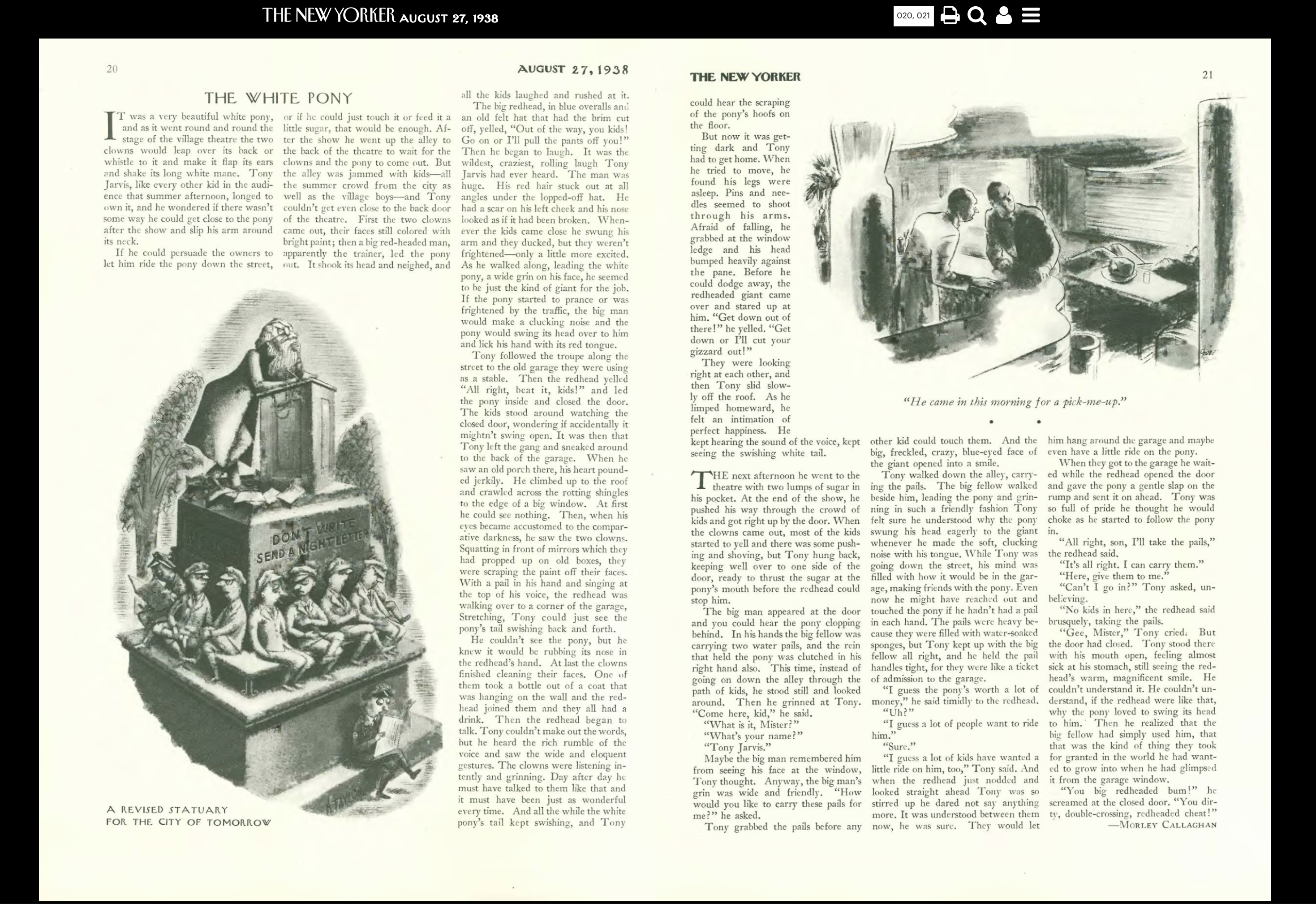
Some explanation might be in order today. Morse, the main figure of the public sculpture who is seen standing at his writing desk, is Samuel F. B. Morse, the painter and also the inventor of Morse Code. The monument's inscription Don't Write, Send a Night Letter refers to reduced rate telegrams sent overnight and delivered the following morning. These night letters had been popular, necessitating the many sculpted telegram messengers sitting on the statue's wraparound bench, but they were well in decline by the late 1930s; thus the lone living telegram messenger seen in the drawing. The telephone was making the telegram obsolete.
A Revised Statuary for the City of Tomorrow: Morse
Richard Taylor
Original art
The New Yorker, August 27, 1938, p. 20


Taylor drew his signature onto the base as if it were incised in the stone, but he signed the matte loosely with his full first name. Now the signed matte is aging faster than the artwork it is meant to protect, and the new owner may have to make a decision about whether it should be removed and replaced.


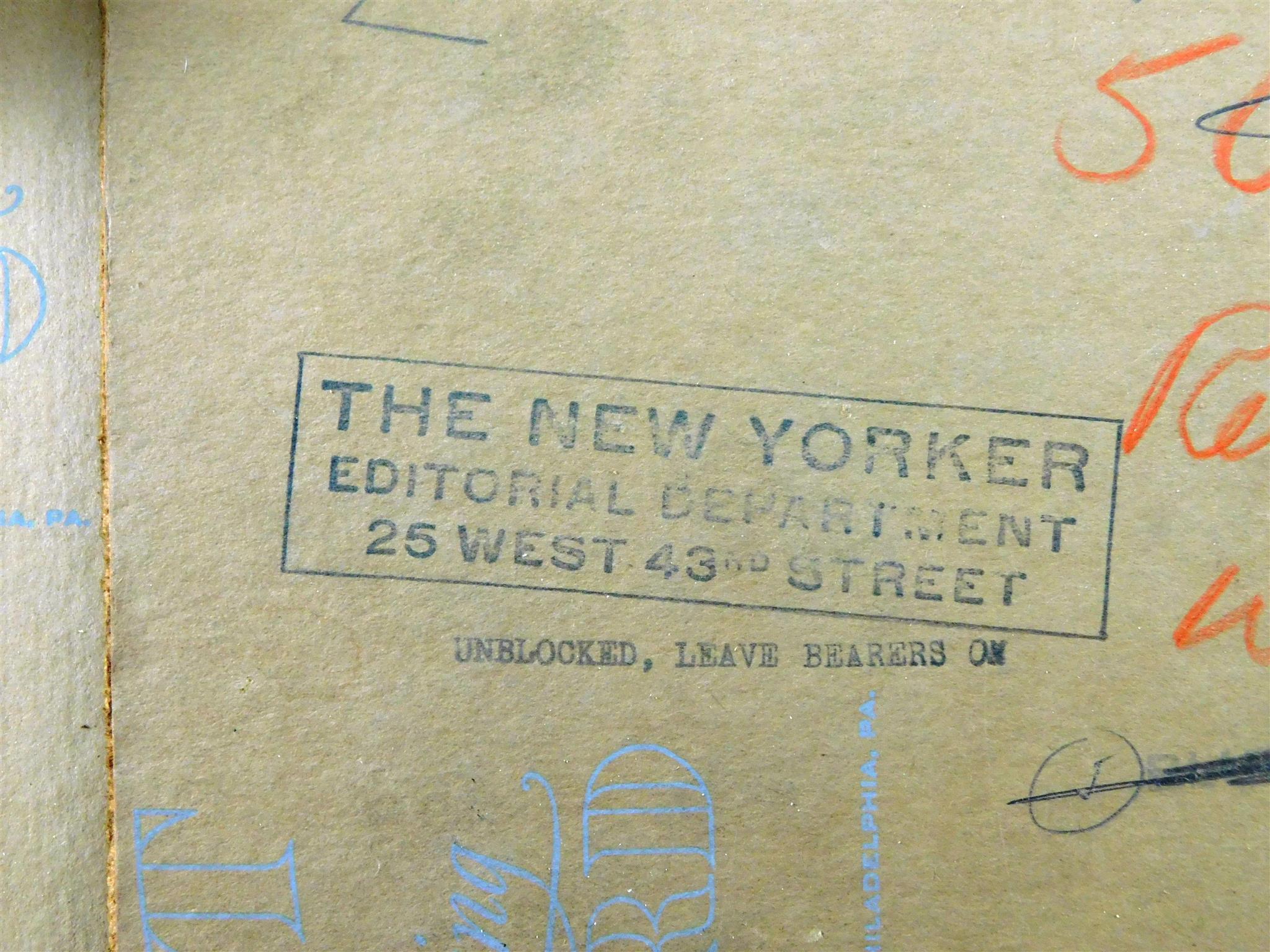
Verso


Richard Taylor
Winter Associates, Inc., June 27, 2022 sale


The $150 sale price does seem inexpensive for such a beautiful drawing, but then the gag itself may not have aged all that well for the modern reader who communicates by email and text message.


A Revised Statuary for the City of Tomorrow: Morse
Richard Taylor
Original art
The New Yorker, August 27, 1938, p. 20


Cartoons by Richard Taylor and Garrett Price


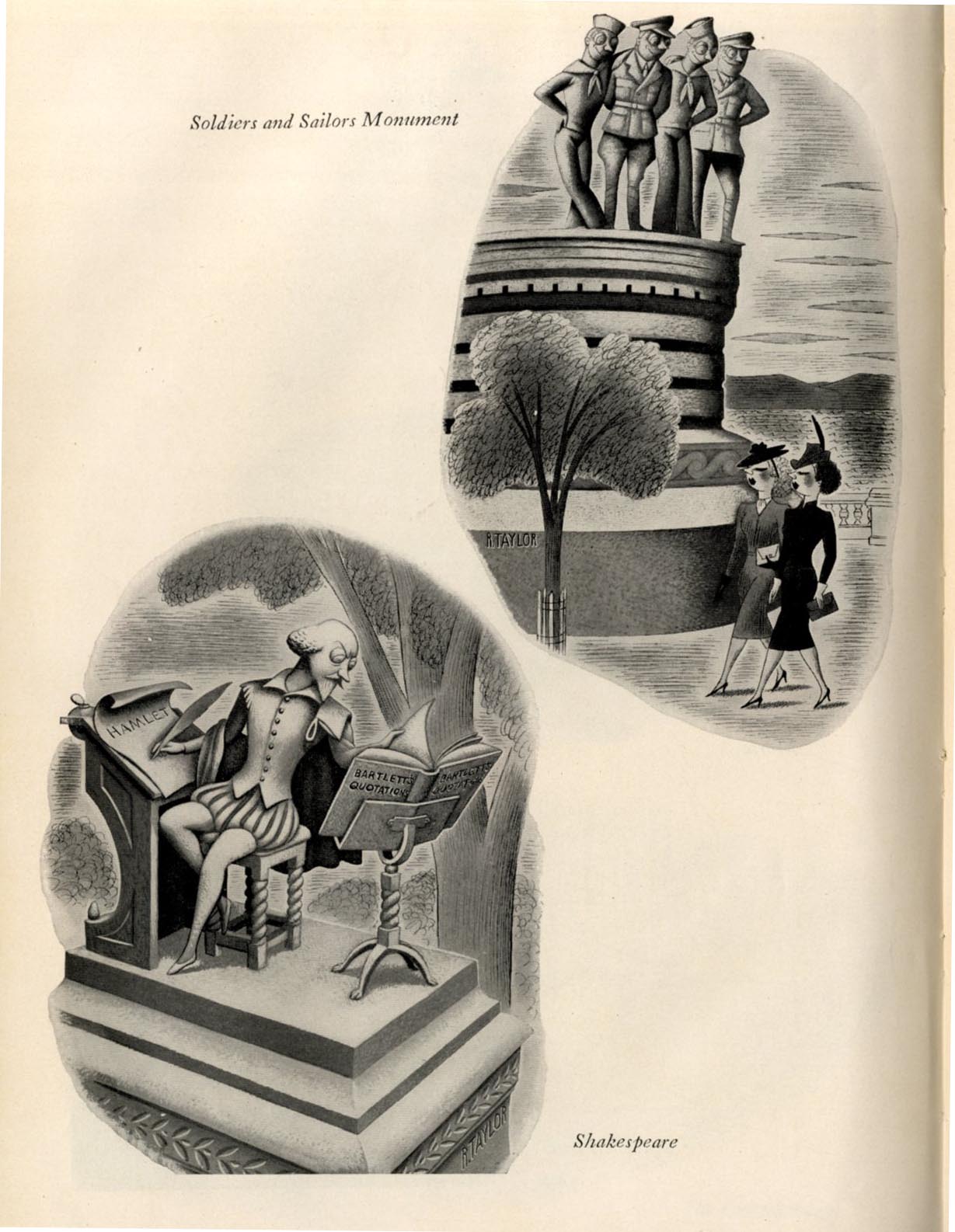
Most of the published Revised Statuary drawings, including Morse, were collected in The Better Taylors (1944).


https://www.fulltable.com/VTS/n/y/tt/b.htm


Then there are two others statues familiar to those who frequent Columbus Circle and Central Park:
A Revised Statuary for the City of Tomorrow: Columbus
Richard Taylor
The New Yorker, August 13, 1938, p. 21


A Revised Statuary for the City of Tomorrow: Cleopatra's Needle
Richard Taylor
The New Yorker, January 14, 1939, p. 27


A spot drawing by an unidentified artist [Tito?] and a cartoon by Richard Taylor


A spot drawing by Arthur Getz and a cartoon by Richard Taylor


Note: Having mentioned the book, I find it hard not to share a few images from a fine copy of The Better Taylors (1945 reprint edition from the World Publishing Company) currently listed on AbeBooks for $250, which is more, I'll just note, than the cost of the Taylor original seen above:


https://www.abebooks.com/servlet/BookDetailsPL?bi=30891484001&searchurl=an%3Dtaylor%2Brichard%26sortby%3D17%26tn%3Dbetter%2Btaylors%2Balbum%2Bcartoons&cm_sp=snippet-_-srp1-_-title2


And, finally, here are a few of the other images from The New Yorker's pages. Can anyone identify this spot artist possibly named Tito?
Spot drawing
Artist Unidentified [Tito?]


Spot drawing
Arthur Getz


04144

Friday, October 7, 2022

Blog Post No. 4100: The American Theatre's Carnival for Britain

On February 21, 1941, nearly ten months before Pearl Harbor, and thus nearly ten months before the United States was to enter the Second World War, Americans were actively supporting embattled Great Britain through the British War Relief Society. The American Theatre Wing organized a Carnival for Britain at Radio City Music Hall in support of the cause. The show went on at midnight on Friday, February 21, 1941, presumably after whatever evening performance had been previously scheduled. This allowed the stellar cast to converge after their other commitments.


The program included twenty-two performances, with well-known celebrities like Fred Allen, Gracie Allen, George Burns, Helen Hayes, Walter Huston, Boris Karloff, Danny Kaye, Ethel Merman, and Arthur Treacher. The show featured stage music by Irving Berlin and Cole Porter. There was classical music by Ravel and by von Weber. George Balanchine choreographed one of the pieces.


And there was quite a printed program. The example shown here is from eBay, currently between auctions. Peter Arno's cover brings civil defense into the theater quite literally. 


That cover foretells a wartime New Yorker cartoon Arno would later create for the issue of January 17, 1942:
"Of course, if they don't bomb Sutton Place, I'm going to look like a damn fool."
Peter Arno
The New Yorker, January 17, 1942, p. 14


The remarkable entertainment program featured many entertainers whose names remain familiar eighty years later:

“We shall not fail or falter; we shall not weaken or tire. Neither the sudden shock of battle, nor the long-drawn trials of vigilance and exertion will wear us down.”—Winston Churchill


Jo Mielzener,
who created the serious drawing of war planes over St. Paul's, below, was not a cartoonist by trade but a scenic designer. Of the artists listed in the program, the eBay seller has shown us Arno and Mielzener, of course, plus New Yorker stalwarts Perry Barlow and Richard Taylor, below. John Root's art might very well be here too. The other listed artists are quite outstanding and also should be worth seeing.

              "—on earth to men of good will!"
                              Jo Mielziner


Richard Taylor's
cartoon was reprinted from The New Yorker. It is not specifically a gag related to the war effort. That is, it was apparently intended to be about ordinary house movers, but in the context of this program it could be construed as relating to the clearing of museums during the blitz.

                                                                   "Why[,] Gogarty, you're blushing!"
                                                                    Richard Taylor
                                                                      Reprinted from The New Yorker, September 14, 1940


The apparently unsigned illustration Freedom of Speech may be the work of scenic designer John Root.
The Foreword by Rachel Crothers demonstrates the serious mission of the American Theatre Wing. "The one purpose of The Wing is to use the united power of the theatre to do its share of the grim work America has ahead of it—to help England stop the evil which is now stalking the earth—and to save civilization for all time."


New Yorker
cartoonist Perry Barlow is represented with a cartoon that is apparently not previously published.

                                 "But[,] dear! Isn't this the medal you won in a bowling tournament?"
                      Perry Barlow                         

Peter Arno
eBay listing ended September 11, 2022


Peter Arno
eBay item description


Image added February 14, 2023


Image added February 14, 2023


"Why, Gogarty, you're blushing!"
Richard Taylor
The New Yorker, September 14, 1940, p. 21

With cartoons by Garrett Price and Richard Taylor

We know from page 41 of the program that cartoonist Garrett Price's work is in the program too, but it may not be a cartoon originally from The New Yorker, and it almost certainly isn't from the same two-page spread as the Taylor drawing.
"Pardon me. Could you tell us how to get to West Linwood?"
Garrett Price
The New Yorker, September 14, 1940, p. 20


"Of course, if they don't bomb Sutton Place, I'm going to look like a damn fool."
Peter Arno
The New Yorker, January 17, 1942, p. 14


A cartoon by Peter Arno and a spot drawing by an unidentified artist

Spot drawing
Artist unidentified


Note:  The full program also has cartoons by Alain (Daniel Brustlein), Whitney Darrow, Jr., Richard Decker, Al Hirschfeld, Garrett Price, George Price, and William Steig. Tantalizingly, they are not seen in the eBay listing. If a reader can supply these missing images, I will add them to the post.


By the way, can anyone confirm that John Root made the Freedom of Speech drawing? Any luck identifying The New Yorker's spot artist?


The Attempted Bloggery Centennial Posts 💯
Blog Post No. 100
Blog Post No. 200:  A Shaggy Dog Story


04100