Showing posts with label William Shawn. Show all posts

Thursday, May 22, 2025

Bob Mankoff: If a Tree Falls in the Forest

An original cartoon by Bob Mankoff was sold at Wechsler's Tuesday alongside the gem by Michael Maslin we saw here in yesterday's post. 

"Dad, if a tree falls in the forest, and the media aren't there
to cover it, has the tree really fallen?"

Bob Mankoff
Original art


"Dad, if a tree falls in the forest, and the media aren't there
to cover it, has the tree really fallen?"

Bob Mankoff
Framed and glazed original art

Bob Mankoff's signature

The auction house states it is a drawing for The New Yorker. Maybe it is; that fussy use of the word media as a plural noun could certainly reflect the magazine's sensibility in, say, the era of editor William Shawn. Or not. But I wasn't able to locate the cartoon in the magazine's archives. Still, it could be hiding from me somewhere.
Bob Mankoff
Weschler's listing of May 20, 2025


Bob Mankoff
Weschler's item description


Note:  I'd like to hear from anyone who may know where this was published, if indeed it was. Collectors owning original art by Bob Mankoff who would like to share it here on the old blog should contact me before offering it to any new media. Media, singular.


04948

Friday, May 7, 2021

Paul Conrad: A Swipe at The New Yorker

On December 22, 1984, Bernhard Hugo Goetz shot and wounded four black teenagers on a New York City subway train, claiming they were attempting to rob him. The shooting made national news and Goetz became known as New York's "Subway Vigilante." Goetz initially had a lot of support from a public fed up with crime, but that support lessened as further details surrounding the shooting were learned.


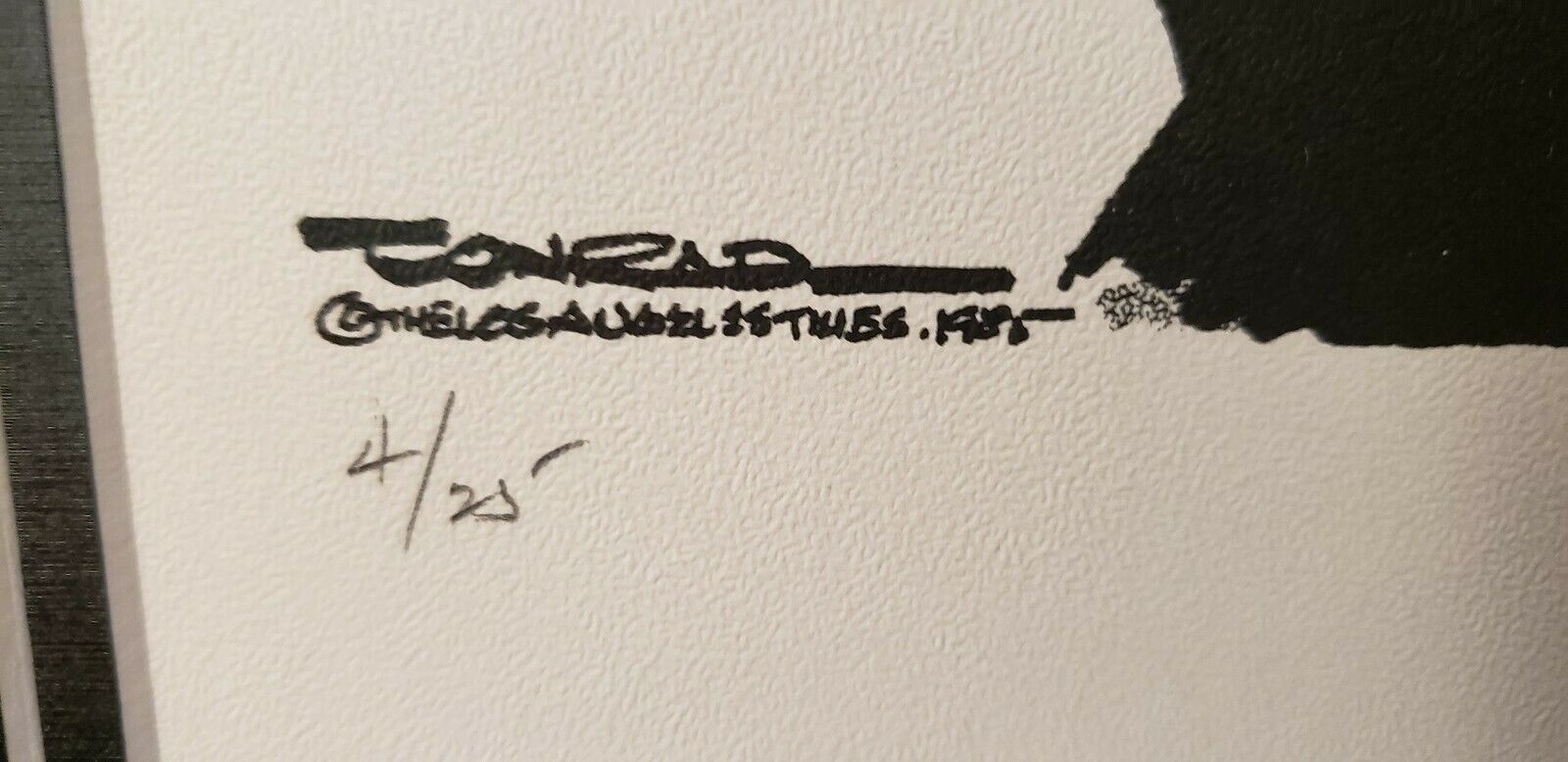
Paul Conrad, political cartoonist for the Los Angeles Times, responded to the story in 1985 with a cartoon showing The New Yorker's Eustace Tilley brandishing a handgun in a parody of the famous anniversary issue cover by Rea Irvin. Now Goetz was in no way representative of New York City's residents, nor was he emblematic of the liberal editors of The New Yorker, nor of its readers or staff writers. The magazine, in turn, is by no means a stand-in for the city on which it is focused. The magazine's editor, William Shawn, no doubt incensed, demanded a retraction. Conrad responded, so an eBay listing tells us, by releasing the cartoon as a limited edition print. Number 4 of 25, framed, was recently offered on the auction site for $1,000. It did not find a buyer, and was subsequently declared "no longer available."


No. 4/25

Paul Conrad's signature


Paul Conrad
eBay listing ended May 1, 2021

Paul Conrad
eBay item description


Note:  The story of this Paul Conrad print is derived exclusively from the eBay listing. I have not found any online sources to corroborate it. I would be pleased to hear from anyone who can confirm the history provided or add additional details.


03619

Sunday, January 27, 2019

Charles Addams: Here at The New Yorker Dust Jacket

A current eBay listing for the dust jacket—and only the dust jacket—to Brendan Gill's Here at The New Yorker (1975) provides a full if somewhat glare-laden image of the excellent wraparound cover illustration by Charles Addams. Thirty-six of the individuals who contributed preeminently to the magazine's success during its storied first half-century are framed in the arcades of an hermitage while the New Yorker's mascot Eustace Tilley walks by and surveys them through his monocle. Who are these monastic individuals abiding serenely in their cells yet united in their literary and artistic cause?
Charles Addams
Dust jacket to Here at The New Yorker (New York:  Random House, 1975) by Brendan Gill


Well, I'm glad you asked. I have added my own photo of the key to these figures on the front and back covers. Naturally, founding editor Harold Ross has a position of prominence on the front cover as does his successor William Shawn.
Key
Photo by docnad
This legendary grouping has a few evident quirks as befits a magazine staff which had many. First of all, among the thirty-six figures in the monastery there are only two women, Dorothy Parker and Katharine White, a number equal, oddly, to the number of inconspicuously-placed "unidentified wretches." Furthermore, there are only six artists—Peter Arno, James Thurber, Charles Addams, Saul Steinberg, George Price, and Whitney Darrow, Jr.—as  compared to twenty-nine writers and editors, among whom I will again include Thurber who was, if possible, an even greater figure in the writer's camp than in the cartoonist's. (Yes, E. B. White contributed one naive cover to the magazine, but aside from this curiosity his output was very non-naive words and words alone. James Geraghty was the magazine's art editor and could be counted, if one chose, on the artistic side of the equation, but he was not himself an artist.)

The inclusion of the first and second "unidentified wretch" in the lineup is a mystery. Is there some inside joke here? Isn't there a better use for these two spaces? The omission of Rea Irvin is surely inexcusable. He created the dandy Eustace Tilley who appeared on the very first cover, designed the masthead and many of the section headings, and served as the magazine's founding art supervisor. His profound influence on the New Yorker's look persists to this day. Addams includes his mascot on the cover, but not him.

If we were to be able to include Irvin, there would still be a "second unidentified wretch" to account for. Who should fill his space? This is far from an easy question. There was never any shortage of talent at the New Yorker. It seems obvious that among the artists William Steig surely deserves a place in the pantheon. But what of Otto Soglow and Gluyas Williams? What of Helen E. Hokinson and Barbara Shermund?

Among writers, John Cheever, John McPhee, and Janet Flanner immediately spring to mind. The are each certainly worthy of enshrinement on the monastery arcade. So the strange conceit of having a first and second "unidentified wretch" as placeholders when so many could justifiably be included defies explanation, unless it is to avoid having to make a difficult decision.

There are more worthwhile photos from the eBay seller. It's one hell of a nice dust jacket, and in this case you can judge the (missing) book by its cover.


Note:  In 2017 Michael Maslin wrote about this cover on Ink Spill here.


At press time, the dust jacket is still available for purchase here.


Quick Links to the Attempted Bloggery Archives:

Friday, June 22, 2018

Sunset Lookout: Arthur Getz "Killed" New Yorker Cover Art

Arthur Getz sold New Yorker editor William Shawn a stunning cover painting of a highway scenic overlook at sunset. The cars, seen from behind, are empty; the people have all gotten out to take in the spectacular view. The art was intended for use in January of 1962, but alas, it never saw publication. The tailfins on the cars make for a wonderful period detail, but they surely rendered the illustration obsolete within a few short years. Nevertheless Shawn, who was known to purchase more art than he could publish, kept the cover on hand for possible use throughout his tenure as editor. He was succeeded by Robert Gottlieb in 1987 and it was Gottlieb who officially "killed" the art and returned it to the artist.

Arthur Getz
Sunset Lookout
Killed New Yorker cover art, c. 1961-1962


Arthur Getz
Swann Galleries, Sale 2403, Illustration Art, Lot 236, January 28, 2016
Hammer Price

With Buyer's Premium


Note:  “The Art of Arthur Getz: City & Country” is currently on view at the Hotchkiss Library in Sharon, CT, but only through June 30. www.hotchkisslibrary.org


There's more time left to see “Covering New York: New Yorker Magazine Covers by Arthur Getz” now showing at the Moviehouse Studio Gallery located in the Moviehouse, Millerton, NY, through August 28.

02584

Thursday, June 21, 2018

"Tennis, Anyone?"—Arthur Getz "Killed" New Yorker Cover Art

"Killed" New Yorker cover art refers specifically to any cover purchased by the magazine but never published. Typically it is paid for, stored, and eventually returned to the artist unused.

A fine seasonal example by Arthur Getz is currently being exhibited at the Hotchkiss Library in Sharon, Connecticut. It takes a confident artist to place the foreground in shade. On a bright summer morning a young man sits outdoors reading on a chaise longue. He has brought with him two books, the Sunday paper, and an inviting pitcher of lemonade. He may think he has found the ideal way to enjoy a summer's day, but his friends show up with a different idea.


The cover, given the title "Tennis, Anyone?" by the artist, was purchased by the New Yorker's founding editor Harold Ross in 1950 or 1951, the year of his passing. For whatever reason, his successor William Shawn never ran it and the original illustration was returned to the artist in 1964. By this date, the car depicted was no longer a current model.

The artist describes the history of the piece in a notation on the back. Sarah Getz, Arthur's daughter, offers a personal perspective on the illustration. She writes, "Of course my dad loathed/never played/made fun of tennis, and much preferred reading peacefully in the shade. So I smile every time I look at this picture!"

Me too, Sarah, but for my own reasons. Happy summer!


Arthur Getz
"Tennis, Anyone?"
Killed New Yorker cover art, c. 1950-1951

Back of frame with the artist's notations


Note:  Thanks to Sarah Getz for providing these images.

This original killed New Yorker cover is currently on display in “The Art of Arthur Getz: City & Country” at the Hotchkiss Library in Sharon, CT, through June 30. www.hotchkisslibrary.org


A second show of original work by Arthur Getz is “Covering New York: New Yorker Magazine Covers by Arthur Getz” at the Moviehouse Studio Gallery located in the Moviehouse, Millerton, NY, through August 28.

02583

Thursday, November 2, 2017

Remembering James Thurber

American humorist James Thurber was born on December 8, 1894 and died on this date in 1961. Here are three obituaries dating from the days after his passing. The authors are writer Lewis Gannett, sportswriter Red Smith, and New Yorker editor William Shawn who turns over more than half the printed page to the reminiscences of Thurber's friend E. B. White.

"A case could be made for the statement that Thurber is the most widely known American artist in the world today."
Lewis Gannett,
  "James Thurber:  'Pre-Intentionalist'"
Herald Tribune Books, November 12, 1962, page 5

"Jim Thurber was the greatest humorist of his time and probably, as the obituary suggested, America's greatest since Mark Twain."
Red Smith, "Jim Thurber"
The New York Herald Tribune, [November] 1961

"Certainly there will never be an issue of The New Yorker of which Thurber is not a part."
William Shawn
and E. B. White, "James Thurber"
The New Yorker, November 11, 1961, page 247


Note:  If you've got original art by the great James Thurber, I'd love to see it.


Quick Links to the Attempted Bloggery Archives


02354

Thursday, May 4, 2017

New Yorker N-Grams

The Google Books Ngram Viewer allows for the quantitative display of specific names and phrases that have appeared in print and been scanned by Google Books in publications from prior to 2008. Now that Bob Mankoff has retired as cartoon editor at the New Yorker and Emma Allen has taken over, let's take a look at some n-grams reflecting the magazine's rich history, starting with those people like Mr. Mankoff and Ms. Allen who headed up the cartoon department.
The New Yorker's Art Editors and Cartoon Editors
Rea Irvin, who dominates this n-gram, came of age in the golden era of print. His overall book citations outweigh the later art editors. Note that James Geraghty and Françoise Mouly were never published artists and therefore may have fewer appearances in print than the others. Indeed, Mr. Geraghty published little if anything under his own name. (Emma Allen came on the scene too recently to appear in the n-gram, which only goes up to 2008.)


Next, let's look at the magazine's editors:
The New Yorker's Editors
Harold Ross, 1925-1951
William Shawn, 1952-1987
Robert Gottlieb, 1987-1992
Tina Brown, 1992-1998
David Remnick, 1998-

Founding editor Harold Ross's appearances in print were numerous and continued well after his death in 1951. Note that his successor William Shawn was the most publicity-averse of the magazine's editors.

 Up next are seven major cartoonists:
Seven Major Cartoonists:  Charles Addams, Peter Arno, Rea Irvin, Otto Soglow, William Steig, Saul Steinberg, and Gluyas Williams
Saul Steinberg's impressive numbers may reflect his acceptance by the fine arts community. (It seems doubtful that his results have been skewed by the financier Saul Steinberg.)

And what if we were to add one more major cartoonist?
Adding James Thurber as an eighth major cartoonist transforms the scale of the graph, apparently because of his outsized literary output.

On the other hand, there are no problems of scale when James Thurber is compared with his one-time New Yorker office-mate E. B. White. In 1929, the two co-authored Is Sex Necessary? (If you don't know the answer, you'll have to read the book.)
Coauthors of Is Sex Necessary?, 1929
Cartoonist and humorist James Thurber and essayist E. B. White are lock-step in their trajectories.


Now let's have some fun with this tool:
Five New Yorker Writers Named John


Father and son:
Editor William Shawn and his son, writer and actor Wallace Shawn


A married couple:
Husband and wife cartoonists Alan Dunn and Mary Petty peak in different decades.

Film critic Pauline Kael and staff writer Renata Adler, who famously criticized Kael in the New York Review of Books:
Film critic Pauline Kael and Pauline Kael critic Renata Adler

Authors who wrote about "The Last Days of The New Yorker."
The Pessimists
Gigi Mahon, author of The Last Days of The New Yorker1988
Renata Adler, author of Gone:  The Last Days of The New Yorker1999


Authors who brought alarming threats to public attention:
The Alarmists
John Hersey, author of Hiroshima, 1946
Rachel Carson, author of Silent Spring, 1962
Jonathan Schell, author of The Fate of the Earth, 1982


Four European favorite artists:
Four Major Postwar European Illustrators

Bob Mankoff's old home and his new home:
Cartoon editor Bob Mankoff's old and new homes in the magazine world


Note:  Go ahead. Make your own Google Ngrams here. Why should I have all the fun?


Quick Links to the Attempted Bloggery Archives:

Harold Ross

Rea Irvin

James Geraghty

Lee Lorenz


Bob Mankoff

Emma Allen

The New Yorker


02177

Monday, October 26, 2015

Charles Addams: Yes, The New Yorker

Once the [Addams F]amily appeared on television in 1964, New Yorker editor William Shawn banned them from the magazine, noting they were no longer appropriate for their sophisticated readership. The ban was lifted in 1987.

—Jen Carlsen
"Charles Addams's New York"


Uncle Fester from the Addams Family promotes the New Yorker in an ad which appeared in Women's Wear Daily in 1973. Cartoonist Charles Addams has drawn Fester's head and collar six times. The Addams Family uncle becomes progressively more cheerful with each drawing, while the copy describes the magazine's prowess in attracting advertising dollars in increasingly glowing terms. The ad, part of the "Yes, The New Yorker" campaign, is meant to solicit advertising in the magazine from the fashion industry. It makes use of a popular Addams Family character at a time when he and the other Addams Family characters were banned from appearing in the magazine's cartoons.
Charles Addams
Advertisement for The New Yorker from the "Yes, The New Yorker" campaign
Women's Wear Daily,
January 8, 1973, page 72
Scans courtesy of  David from Manhattan


Note:  Thanks to dedicated reader David from Manhattan for having the foresight to hold onto this page from Women's Wear Daily for forty-two years! He has kept the page horizontally folded and has scanned the two halves of the page separately. Anyone in possession of similar examples or—dare one hope?— access to the original art should get in touch. Remember, no new information is too trivial.

Charles Addams is well-represented in the blog archives. Yes, the blog archives.


01668