Showing posts with label Alexander Woollcott. Show all posts

Thursday, August 29, 2024

Alexander Woollcott's Copy of Private Lives by Noël Coward

"Private Lives," Noël Coward's "intimate comedy in three acts," was published in 1930. Coward inscribed a copy to drama critic Alexander Woollcott the following year and Woollcott, as the owner, added his signature in pencil as well.


Even Woollcott couldn't keep his books in pristine condition.

The first hardcover edition was priced at $1.75.

Is this how you would inscribe inscribe your book to an esteemed member of the Algonquin Round Table? Of course it is.
"For Ackie Wackie
from
Noly Poly
1931"

Title page

Noël Coward
AbeBooks listing accessed August 29, 2024

Noël Coward
AbeBooks item description


Note:  I read "Private Lives" in college from an under-inked Xerox copy that doesn't compare in any way to the extraordinary first edition shown above, except for the text. I have a special liking for books inscribed author to author, artist to artist, or, as you might imagine, cartoonist to cartoonist. Take your pick from your home library and send me photos of whatever you've got. I know just the blog for them.


04731

Friday, January 5, 2024

Florence Nash's Copy of Actorviews: Intimate Portraits by Ashton Stevens With Drawings by Gene Markey

Writer Steve Stoliar brightens my new year with news of his most recent acquisition:


It's a 1923 book called Actorviews, written by noted Chicago theatre critic Ashton Stevens. (Orson Welles said he based Jed Leland on Stevens, who was also George Stevens's uncle.) It was issued in a signed/limited edition of 210 and is also inscribed by Stevens. The book is signed to Florence Nash, a theatrical actress and poetess who is mentioned in Stevens's interview with Nora Bayes.

In addition to Stevens's inscription, there is a fairly accurate caricature of Stevens drawn by Gene Markey, who did the illustrations for the book. Since you blogged about Markey's drawing of Benchley and Woollcott, I knew you'd know who he is. He also did a famous caricature of a young Ben Hecht—and he was married to Joan Bennett, Hedy Lamarr,
and Myrna Loy, though not at the same time.

For me, Chicago in the '20s has the same sort of romantic image as New York in the '20s: Gangsters, speakeasies, Hecht, Lardner, Dreiser, all those newspapers, etc. This particular copy evokes so much of that time.

Picked it up for $25.

Actorviews
Title page

Limitation page
No. 89/210

"For Florence Nash,
My friend since she
was a baby poet,
my admiration ever.
Hers faithfully,
                               The Author"
and
"The Venerable Critic on a quiet
night in what he has nick-named
'The Windy City.'
To Flo-Flo—
                                         GM"


So did Stevens truly "nick-name" Chicago "The Windy City," as Markey suggests? It wasn't his coinage. Steve writes back, "I also checked earlier and saw that Stevens didn't invent 'The Windy City' but, to my surprise, he was well-known for having popularized the term." Aha!

Steve also provides some helpful Wikipedia links for those of us who aren't quite so up-to-date on 1923 Chicago-based literary celebrities:

https://en.wikipedia.org/wiki/Ashton_Stevens

https://en.wikipedia.org/wiki/Florence_Nash

https://en.wikipedia.org/wiki/Gene_Markey


Note:  I'm so grateful to Steve Stoliar for sharing this find here on Attempted Bloggery. I had no idea such a book was out there. This is Steve's eighth contribution to the blog if I'm counting correctly and his thirty-seventh if I'm not. Steve is the author of Raised Eyebrows: My Years Inside Groucho's House. If you don't have a nightstand, buy one and place this book on it.


04549

Tuesday, January 18, 2022

Sight Unseen: The First Issue of The New Yorker, February 21, 1925

On New Year's Day, I came across an AbeBooks listing for the very first issue of The New Yorker, dated February 21, 1925. I was immediately taken aback by the asking price, an absurdly low $4.39.

The New Yorker
AbeBooks
listing accessed January 1, 2021


Copies of the magazine's rare first issue currently listed on eBay are priced at $4,000 to $4,500, give or take a penny. There's no way a true copy could be selling for one one-thousandth of its market value, right? My best guess was that Discover Books of Toledo had mistakenly listed the 1953 reprint of the first issue.
Two current eBay listings of the first issue of The New Yorker, preceded by the 1953 reprint


The title of the AbeBooks listing was "The New Yorker, February 21, 1925 (Volume 1)." There was no accompanying photo. Listed authors were Ralph Barton, Marc Connelly, Rea Irvin, George S. Kaufman, Alice Duer Miller, Dorothy Parker, and Alexander Woollcott. Those were indeed the advisory editors listed on the first issue's masthead. The listing's specific details were all absolutely correct, but the price was too good to be true. Who was I not to take a shot at it? I placed my order sight unseen. Ten days later, the package was in my hands.


Here then are the contents:


The New Yorker Twenty-Fifth Anniversary Album 1925-1950 was published in 1951 and reissued in paperback in 1986, some sixty-one years after the first issue's publication. How a scuffed copy of this paperback edition was erroneously listed as a copy of the original 1925 magazine is beyond me, but it strikes me as more careless than malicious. The book has a $1.00 price pencilled on the half title; the $4.39 price I paid included postage. For what it's worth, I did not previously own a copy of the paperback.


03854

Tuesday, July 20, 2021

An Alexander Woollcott Signed Cover

There have been many creative attempts to combine postal covers with celebrity autographs. In 1933, decades before first day covers came into their own, collector H. M. Brehm persuaded noted New Yorker critic Alexander Woollcott to sign a postal cover with a 3-cent William Penn stamp and a Grand Central Annex postmark. Brehm then added an original illustration of Woollcott and a collaged photo over the address, quite possibly his own. At this point, one wonders why the postal cover was necessary in the first place.

Saturday, March 27, 2021

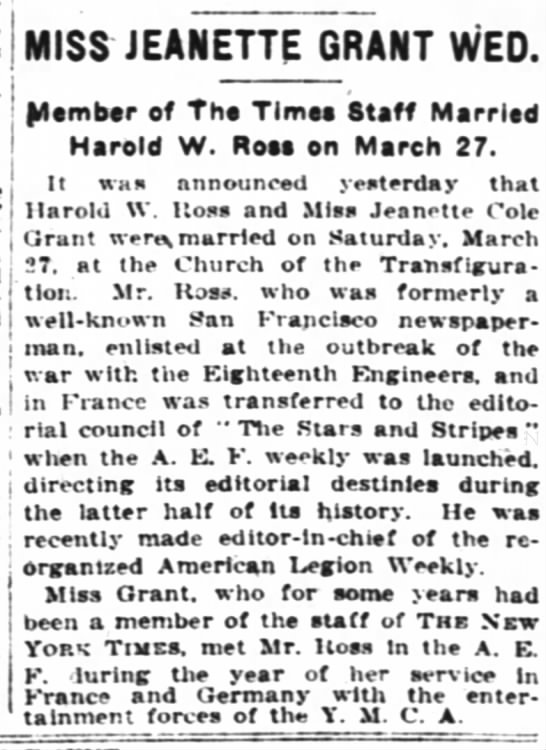
Harold Ross and Jane Grant Wed

One hundred one years ago today New York Times reporter Jane Grant and American Legion Weekly editor-in-chief Harold Ross were married. The Times dutifully covered the nuptials of its first full-fledged female reporter after the announcement was made on April 12. Ross was then known for his work during the Great War on Stars and Stripes, which he had been assigned to from its founding, eventually becoming managing editor. In France, Alexander Woollcott had introduced the couple.


Together Ross and Grant would go on to establish The New Yorker in 1925 with the financial backing of Raoul Fleischmann. Ross, of course, served as the magazine's editor while Grant worked at bringing investors and talent, notably Janet Flanner, on board. The magazine became a success but the marriage did not. The couple were divorced in 1929. Grant would publish her memoir Ross, The New Yorker and Me in 1968.


03577

Friday, January 1, 2021

Art Young: Portrait of Alexander Woollcott

Art Young's portrait of celebrated New Yorker writer Alexander Woollcott shows the critic and radio personality seated informally in his bathrobe. Woollcott is portrayed with his morning cup of coffee and a cigarette. The illustration is reproduced in Art Young: His Life and Times (1939). The original drawing was sold on eBay in 2019 for a best offer of $185.

Alexander Woollcott
Art Young

Art Young's signature

Art Young
eBay Listing Ended August 18, 2019


Art Young
eBay item description
Is this Art Young portrait the picture on Woollcott's wall?
Art Young
eBay bid history
Sold for best offer of $185


Best offer accepted:  $185


Note:  Additional images of original artwork by Art Young are sought for future posts on Attempted Bloggery.

03490

Sunday, May 31, 2020

The Bedside Tales: Armed Services Edition

Armed Services Edition No. 933 published in November of 1945 was a selection of short stories from The Bedside Tales (1945). It was issued six months after VE Day, a time when soldiers waiting to be demobilized might have had a fair amount of time for free reading.
The Bedside Tales:  Armed Services Edition (1945)


The book purports to be "an anthology of the finest modern writing" with a cover illustration and introduction by New Yorker cartoonist Peter Arno. The cover also bears the names of the collection's ostensibly most marketable writers in a vertical banner along the left side of Arno's art. Any author unfortunate enough to own a name longer than that of William Saroyan is listed by surname only—i.e., Bemelmans, Hemingway, and Woollcott—the minor indignity thus resolving a typesetter's major dilemma.

Yet it is Arno's name that is the most prominent on the cover, which gives an idea how essential both his cover art and his public persona were thought to be in selling at least the regular edition of the book (the Armed Services Edition wasn't actually offered for sale). The hybrid typography of the title could lead one to conjecture that Arno may have thought the collection was going to be titled simply Bedside Tales, the article The placed alongside his hand-drawn title as an afterthought. Perhaps, perhaps not, but to most buyers Arno's cover art alone must have seemed well worth the price of admission...with no disrespect meant to Ludwig, Ernest, or Alexander.


The Bedside Tales (1945)


The Bedside Tales:  Armed Services Edition
AbeBooks Listing Accessed May 30, 2020


The Bedside Tales
AbeBooks Listing Accessed May 30, 2020


Note:  At the time of this posting, both editions of The Bedside Tales seen here remain available for sale on AbeBooks.

This is my 135th post about Peter Arno. I could use some new material on him. Please send scans or photos of original art or other Arno rarities.


Quick Links to the Attempted Bloggery Archives:

Peter Arno


Ernest Hemingway

Alexander Woollcott

Attempted Bloggery's Bedside Index


03275

Saturday, December 1, 2018

James Thurber: Dear Harold

It seems an unforgivable lapse, but History for Sale somehow has just sold on eBay a two-page typed letter, signed, from literary and cartooning giant James Thurber without realizing the recipient is Harold Ross, the New Yorker's famous founding editor. The letter, dated January 20th (alas, there is no year), opens with "Dear Harold"—I had always assumed Thurber would just call him Ross. Thurber quotes a Mrs. Robert Sterling who refers to him as H. W. Ross. The letter reads, in part:

"Dear Harold,  
     This is a brief but moving bread-and-butter, rum-brandy-and-champagne letter, to begin with. I told you on the phone how much fun we had at your all-night party, but you probably forgot to tell Ariane, so you can show her this letter. It seems sad that we won't be able to keep you up till four o'clock for another year, but it will give us something to look forward to.
     I also mentioned on the phone how two friends of mine, Mr. and Mrs. Aristide Mian, of Nyack, discovered old Henri Mouquin living up there...
     If you want to have one of the boys interview Mouquin, at least for a Talk story, it could easily be arranged through Mrs. Mian...
     A few weeks ago, one Mrs. Robert Sterling, of Boulder, Colorado, wrote me a fan letter which was one of the most interesting I have gotten. She described herself as an old lady, but her mind is young and acute enough to have detected that I used the same device in 'The Catbird Seat' that I had used in the fable about the Unicorn. Nobody else but me had found this out. It really doesn't make any difference, however, or at least no more than the similarity between Hemingway and Ambrose Bierce which I read about in a piece called 'Is Hemingway the Lost Ambrose Bierce?' It was written by a man named H. W. Ross in some ponderous literary review or other. Fellow is a scholar...
     In case you didn't get the allusion, you are the last word in intellectual sophistication. I had always kind of thought it was Woollcott."

Ariane is Ross's third wife, Ariane Allen, whom he married in late 1940 when he was 48 and she was 25 (according to Kunkel). That would date this letter to 1941 or later, but probably not much later than the mid-1940s. 

"Talk" here refers to "The Talk of the Town" section of the magazine and Woollcott, of course, is critic Alexander Woollcott. 

Along the way, mention is also made of Gus Lobrano, the New Yorker's fiction editor. Henri Mouquin, may have been the owner of Mouquin's, in its day a well-known Manhattan speakeasy and restaurant, but he could not be the Henri Mouquin who died in 1933. (A. J. Liebling was to reminisce about the cafe in the December 8, 1956 issue of the magazine.)

The letter, priced uncommonly reasonably at $480, ended up going for even less when a Best Offer was accepted. One hopes the new owner realized the importance of this item; the seller obviously didn't.
James Thurber
TLS, January 20, 194?, page 1

James Thurber
TLS, January 20, 194?, page 2

James Thurber
eBay Listing Ended October 29, 2018


The wedding announcement of Harold Ross and Ariane Allen from the Times is not available in digital form.

The New York Times
November 11, 1940, page 21


Note:  I am unfamiliar with Harold Ross's "Is Hemingway the Lost Ambrose Bierce?" To what exactly is James Thurber referring?

I would like to hear from anyone who can pinpoint the year of this letter better than I can.

The letter was typed by Helen Thurber. 


Wednesday, February 15, 2017

The New Yorker Prospectus

THE NEW YORKER will be a reflection in word and picture of metropolitan life. It will be human. Its general tenor will be one of gaiety, wit and satire, but it will be more than a jester. It will be not what is commonly called sophisticated, in that it will assume a reasonable degree of enlightenment on the part of its readers. It will hate bunk.

So opens Harold Ross's 1924 prospectus for The New Yorker, which was to first hit newsstands this week in 1925. Note that Rea Irvin's famous magazine logo was already finalized and Irvin is listed among the fledgling magazine's ten advisory editors. The prospectus is most famous, though, for its concluding paragraph;

THE NEW YORKER will be the magazine which is not edited for the old lady in Dubuque. It will not be concerned in what she is thinking about. This is not meant in disrespect, but THE NEW YORKER is a magazine avowedly published for a metropolitan audience and thereby will escape an influence which hampers most national publications. It expects a considerable national circulation, but this will come from persons who have a metropolitan interest.

Would you invest in the New Yorker in 1924? Or might you be dissuaded by that talk of the old lady in Dubuque? Today, would you invest in a nice copy of the 1924 prospectus? One in very good condition was sold last year on eBay:

eBay Listing ended March 4, 2016


eBay Item Description


eBay Bid History
Two fairly lackluster bids


More readable scans of the prospectus are published on Magazine History:  A Collector's Blog.
http://magazinehistory.blogspot.com/2009/02/harold-ross-and-new-yorker.html


Note:  You're in luck! You now have enough information to spot the inside joke on my Twitter profile.


Quick Links to Attempted Bloggery's Archives
Harold Ross
Rea Irvin
The Old Lady in Dubuque

02101