Seventy-five years ago, New Yorker cartoonist Otto Soglow (1900-1975) illustrated Pepsi-Cola's calendar for the year 1945. In that year, like 2020, New Year's Day fell on a Wednesday. Unlike 2020, 1945 was not a leap year. So you can use this calendar in 2020, but only until February 29. After that, all the 2020 calendars should be deeply discounted.
Who doesn't love a good mystery? New Yorker cartoonist Whitney Darrow, Jr. (1909-1999), illustrates Pepsi-Cola's promotional calendar for 1943 with a cola-loving Mystery Fan. The image was reused as late as 1945 in newspaper advertising. A little escapist reading during wartime never hurt.
Mystery Fan Whitney Darrow, Jr. 1943 Pepsi-Cola calendar
In the 1940s as America entered the postwar period, Pepsi-Cola's advertising included radio jingles, skywriting, and a vigorous print campaign using a number of popular cartoonists. There was an extended series of print ads by New Yorker cartoonist Robert Day which echoed Pepsi's radio and skywriting promotions while also reflecting many of the extensive social and political changes taking place in the world. These ads appeared in Time, The New Yorker, and no doubt other publications. But first off, here are two examples of the jingle, which is referenced in more than one print ad:
"Pepsi-Cola Hits the Spot"
Radio ads from 1939 and 1950 with the jingle
American troops liberating a European village are greeted with the unlikely news that the populace is familiar with the Pepsi-Cola jingle.
"They want to know if we've got any Pepsi-Cola. Seems they heard the Pepsi-Cola jingle on the underground radio." Robert Day Pepsi-Cola advertisement 1944
The 1944 Presidential election pitted incumbent Democrat Franklin D. Roosevelt against Republican Thomas E. Dewey, both New Yorkers. The words to Pepsi's jingle may be spotted on a convention sign. Was either convention this unconventional?
"...It was his postwar plank of plenty of Pepsi-Cola for everybody, that touched off the demonstration." Robert Day Pepsi-Cola advertisement 1944
A 1945 wartime ad, no doubt meant for national consumption, suggests a midnight curfew in New York City. But Sam Roberts, writing in 1995 for the Times, noted, "The national curfew was midnight, but Mayor La Guardia insisted that New Yorkers be allowed to drink, legally, until 1 A.M."
"Have we time for a couple of Pepsis before the curfew?" Robert Day Pepsi-Cola advertisement 1945
Pepsi worked hard to get its name displayed in the air and the print ads reflect this major aspect of the soft drink's promotion. The source for this ad says it appeared in Ebony, which would date it to the end of 1945 or later. More concerning, the ad contains racial caricatures, yet it was deliberately marketed to the black community. That seems seriously misguided at best.
"That means mission successful—ice the Pepsi-Cola." Robert Day Pepsi-Cola advertisement Ebony, 1945 or later
The postwar housing shortage was serious, but perhaps it could have a cola-infused bright side. The bishop's crook lamppost leaves no doubt that we are looking at New York City. (It's visible in the ceiling prices and curfew drawings above as well.) Pepsi was based in Long Island City.
"What do we care if we have to move in with four or five other families[?] Look how convenient it is." Robert Day Pepsi-Cola advertisement Time, June 3, 1946, page 37
"Many cities vied for the honor of hosting the UN Headquarters site, prior to the selection of New York City. The selection of the East River site came after over a year of protracted study and consideration of many sites in the United States."
"Then it was my turn, and since my repertoire was completely exhausted, the only genuinely American song I could think of was 'Pepsi-Cola Hits the Spot!' which they applauded as loudly as the others, although they said such a wine was unknown in Kazakstan, and inquired from what grape it was made." Robert Day Pepsi-Cola advertisement Text from W. L. White, Report on the Russians, Harcourt, Brace and Company, page 211.
"...she's jet propelled—does 604 an hour and writes Pepsi-Cola in eight foreign languages." Robert Day Pepsi-Cola advertisement Time, October 27, 1947, page 41
Trains, cruise ships, airplanes, and now helicopters feature in these Pepsi ads. Curiously, Day's bold inking gives unusual prominence to an onlooker's bald spot. It's not an accident; he does something similar in the following three ads as well.
"That's what I call smart merchandising." Robert Day Pepsi-Cola advertisement 1947 in Bryan Holmes, Advertising: Reflections of a Century (London: William Heinemann, Ltd., 1982)
In 1947, there was a new angle to the office Christmas bonus.
"...and in addition to your bonus checks, on account of the many deductions for taxes, social security, etc., etc." Robert Day Pepsi-Cola advertisement Time, December 22, 1947
Note: There could easily be dozens of other Pepsi ads by Robert Day. Readers with access to any of these, or with better scans of the ones shown here, may send them in for inclusion in this post. Needless to say, original advertising art from this campaign would also be welcome.
The title of an eBay listing this past month seems pretty straightforward: "John Ruge Listed Artist 1940's WWII WPA Era Cartoon Illustration Pepsi Cola #1." That #1 indicates this is one of four eBay listings with original art by John Ruge. Here's what his signature looks like in listing #2:
John Ruge's signature
Note that eBay listing #1 has a markedly different signature. Attentive readers of this blog may recognize it instead as the signature of cartoonist William Von Riegen. Like John Ruge's signature, it contains the letter R. All right, to be fair, if you were the eBay seller and if you didn't have three examples of John Ruge's signature right in front of you, you might be able to convince yourself that William Von Riegen's signature reads John Ruge.
"But, Sarge, someone had to come along to take back the empty bottles." William Von Riegen Original advertising art
So, is this a freestanding magazine gag cartoon? Or is it an example, rather, of advertising art, as I am suggesting? Von Riegen has written Pepsi Cola on the label of just about every bottle. To me, that degree of deliberate product placement constitutes advertising until proven otherwise.
"But, Sarge, someone had to come along to take back the empty bottles." William Von Riegen Original advertising art
Note how loosely yet skillfully Von Riegen handles facial expression, posture, hands, clothing folds, uniforms, military equipment, and all those soda bottles.
"But, Sarge, someone had to come along to take back the empty bottles." William Von Riegen Original advertising art
Not John Ruge's signature:
Signature of William Von Riegen
It's remarkable how well Von Riegen handles the three-dimensionality of his characters's heads, and especially their lips:
Detail
There's a good variation in tone throughout:
Detail
The name of the product appears multiple times.
Detail
Detail
Almost all the bottles are at an angle, ensuring that the image does not appear static.
Detail
The back of the art contains no hint as to where this might have been published.
Verso
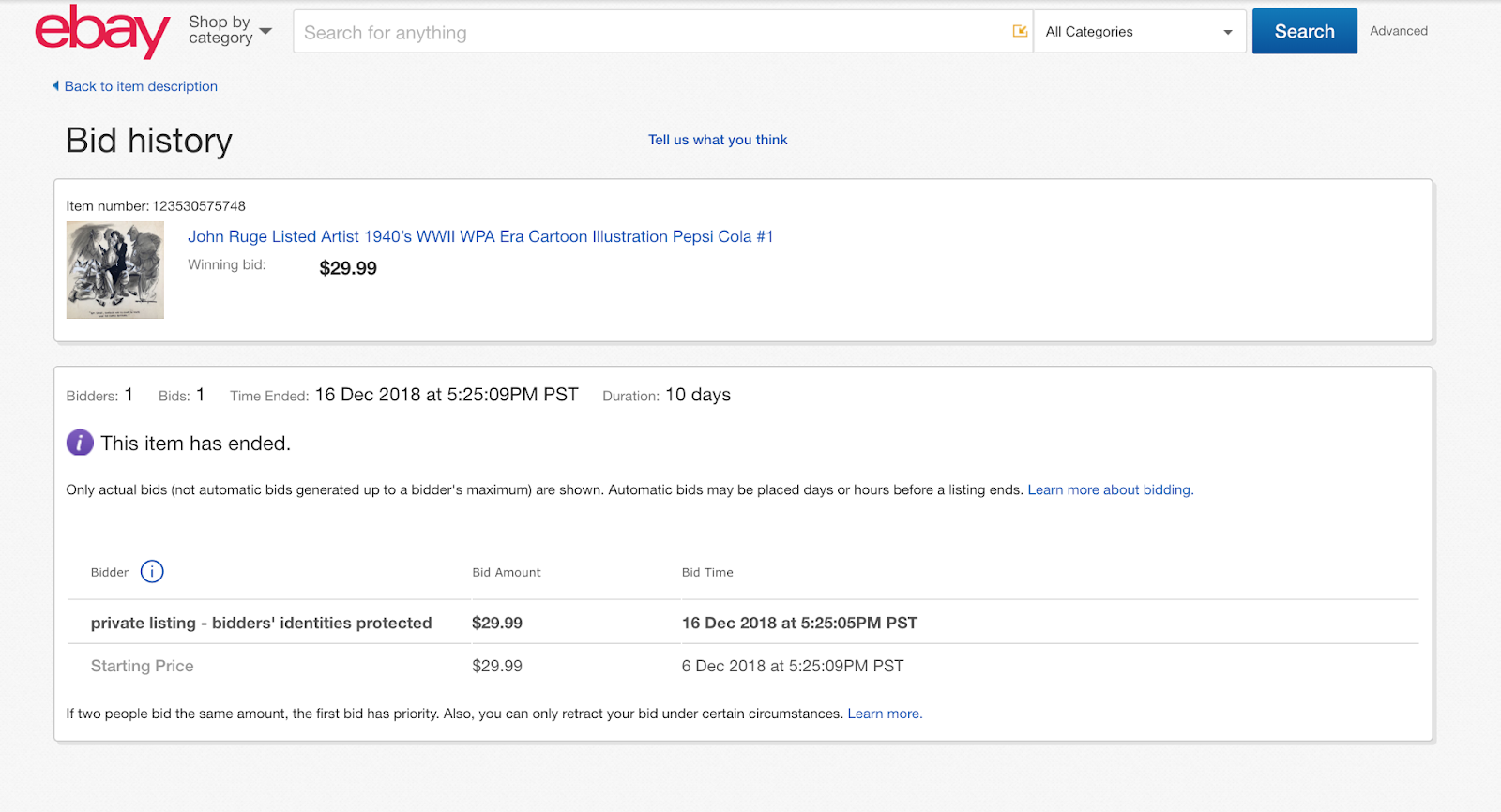
William Von Riegen eBay Listing Ended December 16, 2018
William Von Riegen eBay Bid History One bid just four seconds before the auction closes. Well done.
In summary then, only three of these four John Ruge eBay listings are actually by John Ruge:
Note: This piece apparently dates from World War II. Does anyone know the specifics of where it was published? Are there other known examples of Pepsi advertising by William Von Riegen, if that is indeed what this is?