Showing posts with label Coca-Cola. Show all posts

Saturday, August 23, 2025

Edward Sorel: A Swarm of Taxicabs

Contributor David from Manhattan writes of illustrator Edward Sorel's take on New York City taxis:


Edward Sorel's appearances in American Heritage have always been welcome. In December 1992 the editors made that clear with a spread of eight pages of drawings, each in pen & ink and watercolor with accompanying text, in addition to an eye-catching front cover, all with a New York City flavor for "Our Checkered Past."


Described as "A fond ride through the bright high noon and on into the sad twilight of the American taxicab," it begins with motorized vehicles in 1896 designed to resemble horse-drawn carriages, and ends in 1982 with the title "Onward and Downward" when the Checker Motor Corporation made its last cab. The artwork for the opening page, however, immediately drops the reader into a maelstrom of taxi traffic.


Perhaps with a photo in mind taken just before the May, 1937 unveiling of the Father Duffy statue in Times Square by Mayor LaGuardia, Sorel added taxis, rich color and a sense of humor. His well-lit vision of a Manhattan rush hour has it all: Mr. Peanut, Coca-Cola, Chevrolet, hotels, and best of all a swarm of taxicabs--circling in a frenzy of yellow, orange and red, around Father Duffy and several sidelined pedestrians.

A smaller version of this same scene was given the written title, "Duffy Square, 1937" by the artist, the drawing just as frenzied and colorful but looser in execution. 


Apparently unpublished, it was offered, matted and framed in 2014 at Swann Auction Galleries. I have no information on provenance, but any viewer examining the lot beforehand would have noted a label on the back from Jack's Art Gallery, a reliable walk-in still in business on Broadway in Harlem, and not so coincidentally just a short distance from the artist's apartment.

That said, anyone searching for this issue on eBay or elsewhere may wonder about the drawing on the front cover, which seems to exist in a dreamy world quite separate from the story inside. Titled by the magazine's editors, "Edward Sorel's Christmas Carol to the Lost American Cab," the artist added a sprig of holly to a woman with a haunting stare, which for some collectors may be faintly familiar. 


Fortunately American Heritage and Sorel, having a little holiday fun, provide the  answer at the bottom of the contents' page inside. "Edward Sorel pays homage to a golden age of both taxis and fashion: those eyes first shown from a 1919 Vogue cover by Georges Lepape." 


Lepape, Parisian-born and credited with 114 Vogue covers, would not have minded sharing the spotlight with a gifted, taxi-loving artist from the Bronx.


You can see the rest of Sorel's fabulous illustrations for the American Heritage article here.
 Tipping is not required.


Edward Sorel
Swann Galleries sale of January 23, 2014


Note:  I am exceedingly grateful to David from Manhattan for once again writing of the outstanding work of Edward Sorel. Some might call him Superpen—Sorel, that is.


If you can recognize Vice President Spiro Agnew patriiotically grasping the American flag in Sorel's 1973 drawing on the back cover, I salute you. I expect everyone can recognize the superhero referenced on the front cover. 

Incidentally, for those keeping score, this is David's seventy-first contribution to this blog. For me, that's seventy-one days off!


05041

Tuesday, July 19, 2022

Bernard Schoenbaum: The Real Thing

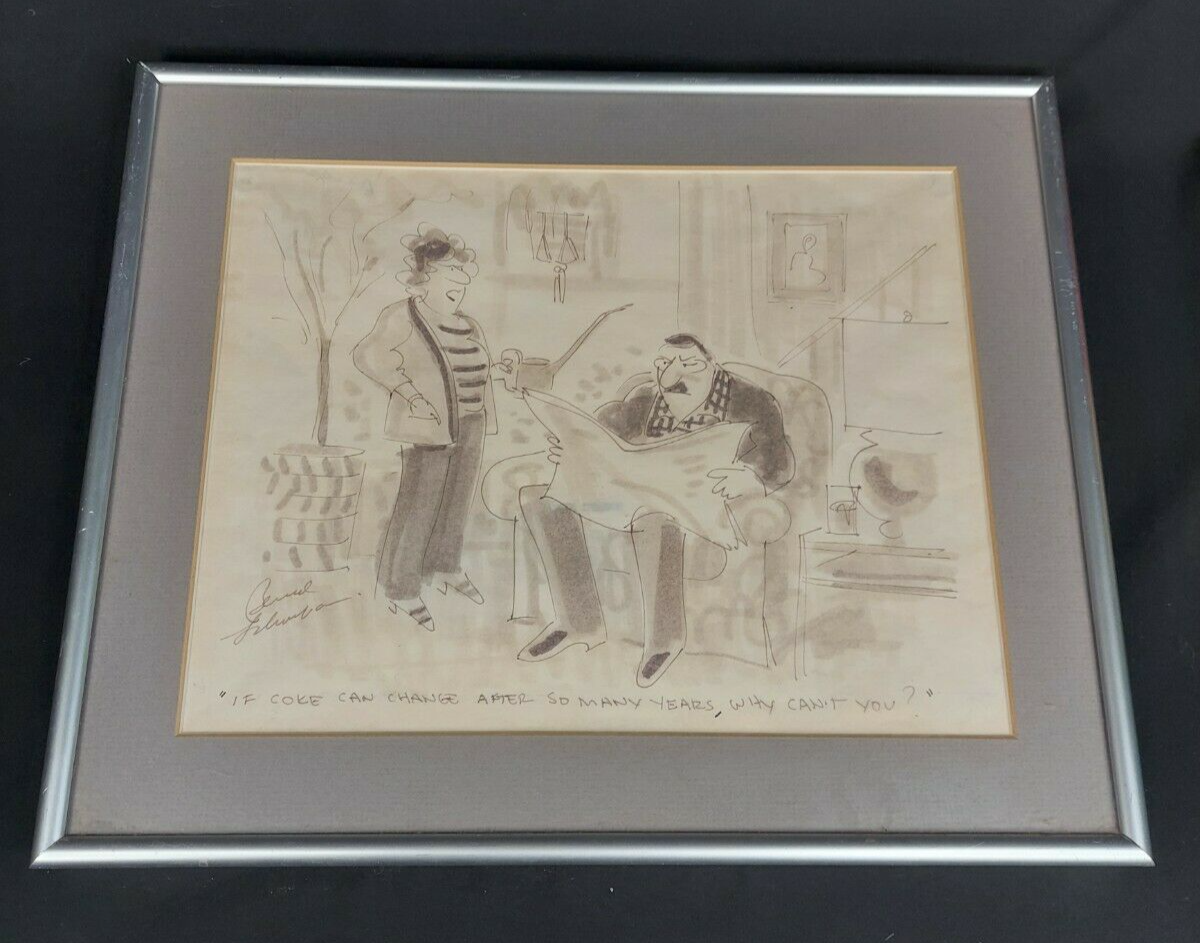
In 1985, Coca-Cola announced that its legendary formula would be retired. In its place, the company would introduce a newly formulated soft drink called New Coke. The product launch was a marketing fiasco and the original formula soon had to be reintroduced as Coca-Cola Classic. Before the extent of this marketing failure was fully understood, Bernard Schoenbaum came up with a New Yorker cartoon that played on the spirit of the moment.

"If Coke can change after so many years, why can't you?"
Bernard Schoenbaum
Original art
The New Yorker, May 13, 1985, p. 52


The original art was offered on eBay, where the seller described it incorrectly as a "vintage 1985 New Yorker artist approval proof."

"If Coke can change after so many years, why can't you?"
Bernard Schoenbaum
Original art
The New Yorker, May 13, 1985, p. 52

"If Coke can change after so many years, why can't you?"
Bernard Schoenbaum
Original art
The New Yorker, May 13, 1985, p. 52


The seller wrote, "I am unsure who the artist is." The signature belongs to New Yorker cartoonist Bernard Schoenbaum.
Left detail

Right detail


The cartoon was a timely one, and it was therefore designated for publication in the "A" Issue, the next issue of the magazine to see publication.

The extensive printer's markings seem to have thrown off the eBay seller and very likely caused him to misidentify this piece as an artist's "approval proof."


Bernard Schoenbaum
eBay listing ended June 15, 2022

Bernard Schoenbaum
eBay item description


"If Coke can change after so many years, why can't you?"
Bernard Schoenbaum
Original art
The New Yorker, May 13, 1985, p. 52


A cartoon by Bernard Schoenbaum
https://archives.newyorker.com/newyorker/1985-05-13/flipbook/052/


04020

Sunday, March 22, 2020

Peter Arno: Ringling Bros.–Barnum & Bailey Circus Magazine 1942

Visitors to the Ringling Bros. and Barnum & Bailey Circus in 1942 could purchase a 15-cent program with a color cover illustration by the New Yorker's most popular cartoonist, Peter Arno, who served as "art director" for "Circus King" John Ringling North, a fellow Yale man in the Class of 1926. That cover showed a pair of cartoon elephants standing upright and embracing playfully, not unlike many an Arno human couple. Inside the magazine, as the program was called, readers would find five full-page Arno cartoons on circus themes and some subject illustrations as well. Two of the cartoons—those featuring the bearded lady and the elephant's hindquarters—would later be collected in Peter Arno's Man in the Shower (1944). An eBay listing offers a few key interior views of the Circus Magazine, here generously supplemented by additional pages from other eBay listings as well.
Peter Arno
Ringling Bros.–Barnum & Bailey Circus Magazine 1942

 Fifteen cents—a bargain!

The contents page begins by noting five cartoons by Peter Arno. The theme of the 1942 show was "Gayety!" 
https://www.ebay.com/itm/RINGLING-BROS-BARNUM-BAILEY-CIRCUS-MAGAZINE-1942-featuring-Peter-Arno-/254197507316

A better image from another source:

Let's start with the five cartoons first, noting right off that Arno didn't always leave all that much to the imagination:

"His wife says he eats firecrackers in bed."


https://www.ebay.com/itm/RINGLING-BROS-BARNUM-BAILEY-CIRCUS-MAGAZINE-1942-featuring-Peter-Arno-/254197507316


"Now, Arthur!  No more remarks like that!"

Arno also contributed interior illustrations:
"The Human Side of the Circus" by Edwin C. Hill


"It's an Old Family Custom" by John B. Kennedy
Camel cigarettes advertisement
https://www.ebay.com/itm/RINGLING-BROS-BARNUM-BAILEY-CIRCUS-MAGAZINE-1942-featuring-Peter-Arno-/254197507316


Program of Displays, Nos. 2 and 3

"Work Refreshed"                                         Display No. 4 "Holidays
Coca-Cola 1941 advertisement                               Display No. 5 The Shyrettos
Image added September 2, 2023

Program of Displays, Nos. 7 and 8

Trio of "North Starlets"
Mary Jane de Young         Lee Wallenda         Dorothy Burt


The program also carries a lot of advertising, especially cigarette ads, so we'll start with them first. Students of design may wish to ponder what ploys are being used in the Raleigh ad to direct the reader's eye to the advertising copy. Extra credit will be given to anyone who can find both of them.
Raleigh cigarette ad


Philip Morris, as we've seen opposite Displays Nos. 2 and 3, offers some reassuring medical news without any regard for whether it's truthful:
"You see, Philip Morris superiority for the nose and throat is recognized by eminent medical authorities."


Chesterfields are advertised on the back cover with a patriotic wartime theme:

"They Rate the Best"
Chesterfield cigarettes advertisement


There are ads for beverages too:
Borden's Hemo
Not a promising name for a product


Even bacon:


And oil:
https://www.ebay.com/itm/RINGLING-BROS-BARNUM-BAILEY-CIRCUS-MAGAZINE-1942-featuring-Peter-Arno-/254197507316


Peter Arno
eBay Listing Accessed January 13, 2020


Peter Arno
eBay Item Description Accessed January 13, 2020


Note:  Did you know this blog is the home to more than 125 posts about Peter Arno? He's a fascinating and nearly inexhaustible subject. Readers are invited to contribute original art and published rarities that will help to shed more light on this giant among New Yorker cartoonists.

The particular spelling of gayety, the theme of the 1942 circus, is an odd but not unheard-of choice today and it was a particularly odd but not unheard-of choice in 1942 as well.
Gaiety vs Gayety


Quick Links to the Attempted Bloggery Archives: