Showing posts with label V-E Day. Show all posts

Thursday, September 29, 2022

Helen E. Hokinson: Radio Days

These days the news is relentless. Many of us use our televisions,  computers, and mobile phones to keep ourselves updated throughout the day.


During World War II, Americans had an urgent need to keep up with the news as well. Moving images of war were available in the cinemas through newsreels. Detailed print articles abounded in a wide variety of newspapers. But for the latest breaking news, there was nothing as immediate as radio. Commentators over the air waves like Gabriel Heatter became familiar names even before the war:

"Gabriel Heatter sounded an ominous note as I rounded a curve."
George Price
The New Yorker, July 6, 1940, p. 21


Weekly magazines like The New Yorker were an excellent source of news too. They could analyze the events of the week in great depth while providing perspective and thoughtful writing. The New Yorker in particular, with its talented stable of artists, could also take a step back and comment on how we consumed the various news media, as with the George Price drawing above.


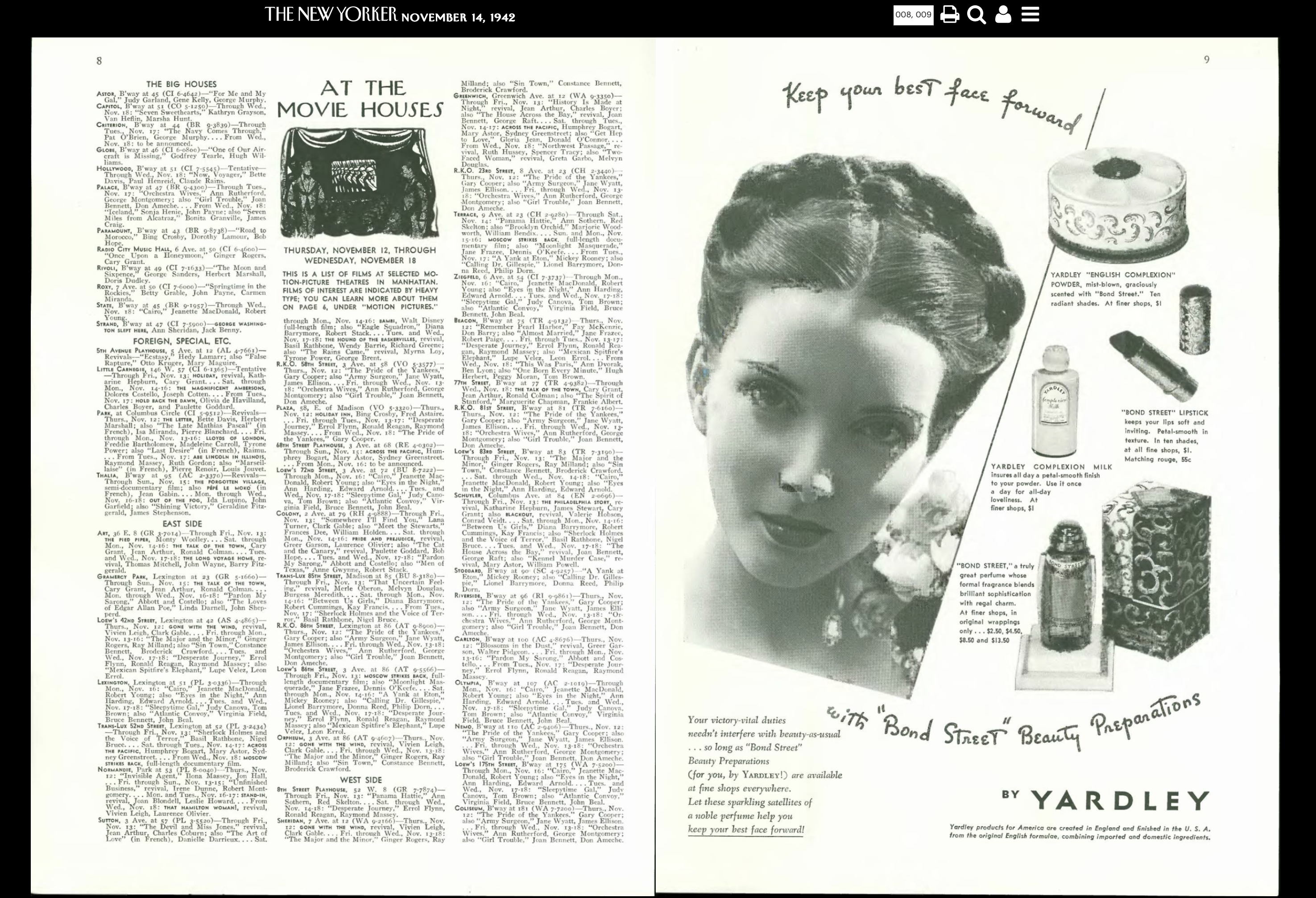
The issue of November 14, 1942, is another case in point. A spot drawing in the movie listings highlights the experience of watching newsreels:

Spot drawing
Victor de Pauw
The New Yorker, November 14, 1942, p. 8


While Saul Steinberg offers a humorous insight into newsstand behavior:

Saul Steinberg
The New Yorker, November 14, 1942, p. 11


"There's good news tonight." The familiar voice of Gabriel Heatter, again, brought news of World War II to American families sitting by the radio. Before the war, George Price may have had him sounding "an ominous note," but Heatter's wartime broadcast was known for its hope and optimism. That brought him popularity, although it brought him some jibes as well. Helen E. Hokinson's cartoon in the issue shows how her matrons related to the radio personality as if he were a personal acquaintance:

"Gabriel Heatter was every bit as surprised as I was."
Helen E. Hokinson
The New Yorker, November 14, 1942, p. 13


With V-E Day and Germany's surrender, Hokinson has occasion to return once again to the famous broadcaster. Her original cartoon art for The New Yorker was sold at auction just yesterday:

"Isn't it all wonderful! I'm so happy for Gabriel Heatter."
Helen E. Hokinson
Original art
The New Yorker, 
May 5, 1945, p. 19


The paper has significant foxing.

"Isn't it all wonderful! I'm so happy for Gabriel Heatter."
Helen E. Hokinson
Framed original art
The New Yorker, 
May 5, 1945, p. 19


Helen E. Hokinson's signature

Typed caption


Helen E. Hokinson
Hill Auction Gallery listing accessed September 27, 2022 after the first absentee bid was placed


The hammer price:


"Isn't it all wonderful! I'm so happy for Gabriel Heatter."
Helen E. Hokinson
Framed original art
The New Yorker, May 5, 1945, p. 19
A spot drawing and a cartoon by Helen E. Hokinson
V-E Day (May 8, 1945) commentary by Gabriel Heatter


An illustration by Ludwig Bemelmans and a cartoon by George Price


A spot drawing by Victor de Pauw and an advertisement for Yardley


An advertisement for B. Altman, the famous banner by Rea Irvin, and a cartoon by Saul Steinberg


A spot drawing by Susanne Suba and a cartoon by Helen E. Hokinson


Note:  It's hard for me to look at original art by Helen E. Hokinson and not want to write a little something about it. It's especially great when the art tells a story. Feel free to send images of your original Hokinson art to share, perhaps, with the world.

And, while we're at it, I don't mind original art by Ludwig Bemelmans either:


Now, about those spots...

I can't make out the signature on the twins playing piano four hands spot illustration. Can any reader make it out?


Susanne Suba's spot is an interesting example of social realism not typical of the magazine. Feel free to send examples of her original art.
Victor de Pauw is one of my favorite spot illustrators. I'd love to see more of his work too.


04092

Friday, April 18, 2014

Shore Leave: Constantin Alajálov New Yorker Cover Art

In 1945, merely a couple of weeks after Victory in Europe Day, the New Yorker published this cover art by the gifted Russian artist Constantin Alajálov. The artwork was just sold on eBay for $5,000. The seller did a very good job describing the artwork and the specific moment in history it evokes. Let's first take a look at the sale and the seller's item description:

Constantin Alajálov, Original cover artwork, The New Yorker, May 26, 1945

Constantin Alajálov, Original cover artwork, The New Yorker, May 26, 1945

Constantin Alajálov, Framed original cover artwork, The New Yorker, May 26, 1945

Constantin Alajálov's signature

Constantin Alajálov, Detail of original cover artwork, The New Yorker, May 26, 1945

Constantin Alajálov, Detail of original cover artwork, The New Yorker, May 26, 1945

http://www.ebay.com/itm/Constantin-Alajalov-1945-New-Yorker-cover-painting-Russian-artist-Zoo-NYC-/151265125601?nma=true&si=UB68sj2DvLx%252F9kdb54zXrlCgzYs%253D&orig_cvip=true&rt=nc&_trksid=p2047675.l2557


[End of eBay listing]

One thing that can be said for Alajálov's New Yorker covers is that they don't simply meet our expectations. The best ones possess an uncanny ability to surprise and delight. Imagine it was your assignment to design a magazine cover that would hit newsstands a couple of weeks after V-E Day. How would you illustrate the excitement and expectancy for a return to normal peacetime pleasures at a time when the nation was still technically mobilized for war? Would you set your cover at a military base? Somewhere in Europe? At sea? When you consider these possibilities, the simple idea of depicting numerous enlisted men and WAC's in uniform on shore leave enjoying the mundane delights of a day at the zoo is truly inspired.

Constantin Alajálov, The New Yorker, May 26, 1945


The composition could not have been an easy one to create. What could be more challenging than painting an aerial view of a crowd scene? The technical challenges have all been met splendidly, of course. Yet the image overwhelms the viewer not with its artistic bravura, but with its normalcy. This is a celebration of soldiers with nothing to do but await their return to civilian life while actually enjoying a spring day at the zoo. How sublime!

So the eBay seller is right, at least in part, in saying "The real subject is not the zoo." But the zoo is extremely important as the setting, and it is not just any zoo; it's the Central Park Zoo in New York City. The cover's view of the seal pool faces to the southwest giving the composition strong diagonals. A couple of vintage photos show the site as it was:

The seal pool, Central Park Zoo, 1940's, facing west.
The umbrellas in the background can be seen on the upper right side of the Alajálov cover.
Photo from the City of New York's Parks and Recreation Department

The seal pool in the Central Park Zoo, facing to the west, ground level.
The aviary on the left is a prominent feature of the New Yorker cover.
Photo from the Wurts Bros. Collection from The New York Public Library

The approximate view of the Central Park Zoo as seen on Google Earth today

Constantin Alajálov, The New Yorker, May 26, 1945
Constantin Alajálov, Original cover artwork, The New Yorker, May 26, 1945


Note:  Read more on Constantin Alajálov here.

Additional examples of original New Yorker cover art may be seen here.

See older posts in celebration of on National Library Week here.

Posts about Passover may be found here.

01122