A spot drawing of a typesetter by Susanne Suba was sold at Swann Auction Galleries in the Illustration Art sale of June 17, 2025. It was published in 1948 in The New Yorker. The man's attention, and ours, is focused on his hands.
Susanne Suba Swann Aucton Galleries Illustration Art sale of June 17, 2025
Spots by Suba: From The New Yorker is exactly what the title indicates. The 1944 book collects spot drawings by Susanne Suba that were originally published in the pages of The New Yorker. The signed first edition sold in November on eBay was no doubt a rarity, but that doesn't mean it was expensive.
Note: I can't get enough of interesting signed books related to The New Yorker, such as this one by Susanne Suba. If your library boasts such a volume, why not let me take a look at it. It might make for a future post.
A classic cartoon by The New Yorker'sPeter Arno was sold on eBay this past Sunday:
"I told you we should have given them something for Christmas." Peter Arno Original art The New Yorker, January 1, 1938, p. 16
True, we don't usually see manually-operated elevators these days, but they were once commonplace in New York apartment buildings. Arno extracts an awful lot of physical humor from the situation. Contrast the couple's awkwardness with the upright posture of the elevator operator.
"I told you we should have given them something for Christmas." Peter Arno Original art The New Yorker, January 1, 1938, p. 16
Each of Arno's faces adds to the comedy.
The typed caption is affixed to the art, a no-no. The word told isn't even underlined.
A copy of this issue offered on Amazon clearly shows the cartoon to be on page 14, not 16. If the photograph looks familiar, it's because the seller used a lower-resolution version of this image as the final one in the listing. This magazine listed on Amazon is no doubt one of the regional variants lacking some of the pages in the New York metropolitan edition which the magazine kept as file copies.
In addition, the cartoon was collected in Peter Arno's Cartoon Revue (New York: Simon and Schuster, 1941), Cartoon Cavalcade (New York: Simon and Schuster, 1943), The Penguin Peter Arno (Penguin, 1949, 1957), and no doubt elsewhere.
Peter Arno's Cartoon Revue (New York: Simon and Schuster, 1941)
Spot of a woman unbuttoning by a mirror Susanne Suba The New Yorker, January 1, 1938, p. 17
Note: Original cartoon art by Peter Arno comes to eBay only when it is changing hands. We can enjoy even more Arno originals here when generous collectors choose to share their art virtually here. You may take that as a hint. Thank you, and don't forget to tip your blogger.
A 1943 ad for Macy's crudely imitates The New Yorker's well-known cartoon style without employing any of its well-known cartoonists. A wife awakens to her bedside alarm which is set for six a.m. Her husband turns his head towards her and says, "Can't they open Macy's in the morning without your help?" The advertising copy informs us that Macy's opens at 9:30. The husband, we don't need to know, is named Egmont. His value-hunting wife is just "The little woman."
The New Yorker had a reputation for keeping its advertising and editorial content completely separate, and usually it did. Six years later, whether it was done knowingly or not (almost certainly it was not), cartoonist William Steig revisited the ad's scenario in his own published New Yorker cartoon. Steig demonstrated why Macy's should have hired him on the first go round.
"Macy's is closed!"
William Steig
The New Yorker, June 4, 1949, p. 22
A floral spot by Suba, a cartoon by Alan Dunn, and an advertisement from Macy's
These days the news is relentless. Many of us use our televisions, computers, and mobile phones to keep ourselves updated throughout the day.
During World War II, Americans had an urgent need to keep up with the news as well. Moving images of war were available in the cinemas through newsreels. Detailed print articles abounded in a wide variety of newspapers. But for the latest breaking news, there was nothing as immediate as radio. Commentators over the air waves like Gabriel Heatter became familiar names even before the war:
"Gabriel Heatter sounded an ominous note as I rounded a curve." George Price The New Yorker, July 6, 1940, p. 21
Weekly magazines like The New Yorker were an excellent source of news too. They could analyze the events of the week in great depth while providing perspective and thoughtful writing. The New Yorker in particular, with its talented stable of artists, could also take a step back and comment on how we consumed the various news media, as with the George Price drawing above.
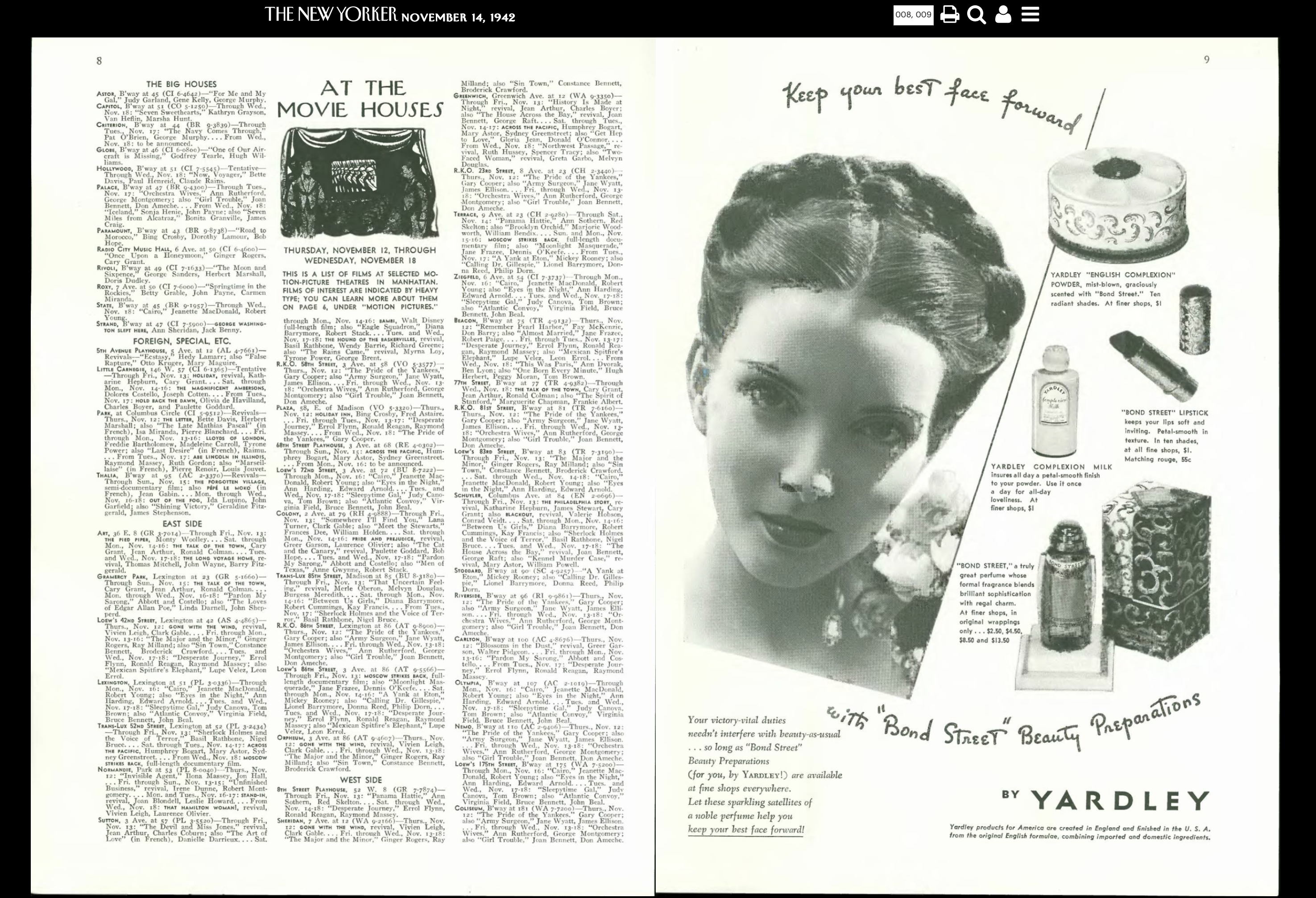
The issue of November 14, 1942, is another case in point. A spot drawing in the movie listings highlights the experience of watching newsreels:
Spot drawing Victor de Pauw The New Yorker, November 14, 1942, p. 8
While Saul Steinberg offers a humorous insight into newsstand behavior:
Saul Steinberg The New Yorker, November 14, 1942, p. 11
"There's good news tonight." The familiar voice of Gabriel Heatter, again, brought news of World War II to American families sitting by the radio. Before the war, George Price may have had him sounding "an ominous note," but Heatter's wartime broadcast was known for its hope and optimism. That brought him popularity, although it brought him some jibes as well. Helen E. Hokinson's cartoon in the issue shows how her matrons related to the radio personality as if he were a personal acquaintance:
"Gabriel Heatter was every bit as surprised as I was." Helen E. Hokinson The New Yorker, November 14, 1942, p. 13
With V-E Day and Germany's surrender, Hokinson has occasion to return once again to the famous broadcaster. Her original cartoon art for The New Yorker was sold at auction just yesterday:
"Isn't it all wonderful! I'm so happy for Gabriel Heatter." Helen E. Hokinson Original art The New Yorker, May 5, 1945, p. 19
The paper has significant foxing.
"Isn't it all wonderful! I'm so happy for Gabriel Heatter." Helen E. Hokinson Framed original art The New Yorker, May 5, 1945, p. 19
Helen E. Hokinson's signature
Typed caption
Helen E. Hokinson Hill Auction Gallery listing accessed September 27, 2022 after the first absentee bid was placed
Note: It's hard for me to look at original art by Helen E. Hokinson and not want to write a little something about it. It's especially great when the art tells a story. Feel free to send images of your original Hokinson art to share, perhaps, with the world.
And, while we're at it, I don't mind original art by Ludwig Bemelmans either:
Now, about those spots...
I can't make out the signature on the twins playing piano four hands spot illustration. Can any reader make it out?
Susanne Suba's spot is an interesting example of social realism not typical of the magazine. Feel free to send examples of her original art.
Victor de Pauw is one of my favorite spot illustrators. I'd love to see more of his work too.


.webp)
.webp)
.webp)
.webp)
.webp)
.webp)
.webp)