Showing posts with label Thomas Nast. Show all posts

Saturday, January 3, 2026

J. C. Leyendecker: Baby New Year and Prohibition Camel

Happy New Year, even if I am a little late in my self-imposed deadline!

J. C. Leyendecker's cover art for the first issue of The Saturday Evening Post to appear in the year 1920 shows a winged baby concealing a bottle of alcohol as he welcomes in the New Year. This particular year saw the onset of Prohibition, the defiance of which was in many ways to define American social life for a decade. The title Baby New Year and Prohibition Camel comes from the Post's website. It had been the cartoonist Thomas Nast who chose the camel, which drinks only water, to represent the Prohibition Party. Leyendecker put it to good use as we prepared for a bit of a dry spell.

J. C. Leyendecker
Original art
The Saturday Evening Post, January 3, 1920

J. C. Leyendecker
Framed original art
The Saturday Evening Post, January 3, 1920

Here's an illustration mystery for the ages: How on earth could this artwork, which is very specific to the New Year celebration of 1920, bear a framing label dated 1917?


The bidding was already strong some five days prior to the November 14 sale of Illustration Art at Heritage Auctions where this original art would be sold.

J. C. Leyendecker
Heritage Auctions listing accessed November 9, 2025


Sold!


Auction Action


J. C. Leyendecker
Original art
The Saturday Evening Post,
 January 3, 1920


J. C. Leyendecker
The Saturday Evening Post,
 January 3, 1920
https://commons.wikimedia.org/wiki/File:SaturdayEveningPost3Jan1920.jpg


January 7, 2026 Update:  In the comments section, John Sunday observes that the framing of this piece dates from 2017, and not 1917. I'll leave my error in place as a reminder that I have got to think fourth-dimensionally.


05171

Saturday, December 20, 2025

Thomas Nast: Christmas, 1863

Thomas Nast's spread over two pages in Harper's Weekly late in 1863 presents us with images of Christmas during the Civil War. Here is a series of vignettes which show his appeal as a storyteller. 


Christmas, 1863
Thomas Nast
Harper's Weekly, 1863, pp. 824-825

How common was it to be able to get a furlough for Christmas in 1863? Was household prosperity really all that we see here? Certainly the reality must have been harsher for many, but Nast gives his readers a story they want to believe in. And his Santa Claus creation makes an appearance as well.

The print is available form Argosy Book Store.
Thomas Nast
Argosy Book Store listing accessed May 29, 2025


05161

Friday, August 29, 2025

Thomas Nast: The Home Market Fallacy

In 1888, cartoonist Thomas Nast had a lot to say against tariffs. Theys were imposed to generate revenues and ostensibly to protect domestic producers, such as farmers, against inexpensive foreign imports. Nast asks whether Uncle Sam would be able to swallow all the farmers' surplus produce on the home market. He makes the case that "The people must be relieved, not burdened." Who knew?


Thomas Nast
Swann Auction Galleries Illustration Art sale of December 14, 2023


05047

Friday, July 18, 2025

Thomas Nast: Enter the Elephant

Among his many accomplishments, cartoonist Thomas Nast was largely responsible for establishing the elephant as the symbol of the Republican Party. He first introduced a pachyderm labeled "The Republican Vote" in a Harper's Weekly cartoon from the November 7, 1874, issue. The parable of "The Ass in the Lion's Skin" is from Aesop, not Shakespeare.

The Third-Term Panic.
"An Ass, having put on the Lion's skin, roamed about in the Forest, and amused himself by frightening all the foolish Animals he met with in his wanderings."—Shakspeare or Bacon.

Thomas Nast
Harper's Weekly, November 7, 1874, p. 912


Two weeks later, he revisited the idea, showing the hapless Republican elephant "Caught in a Trap—The Result of the Third-Term Hoax." Nast, a Republican, was reacting in both cartoons to unfounded speculation that Ulysses S. Grant would run for an unprecedented third presidential term in 1876. Argosy Book Store has a copy of the November 21 page in its inventory.

Caught in a Trap—The Result of the Third-Term Hoax.
Thomas Nast
Harpers Weekly, November 21, 1874, p. 960


05004

Saturday, June 21, 2025

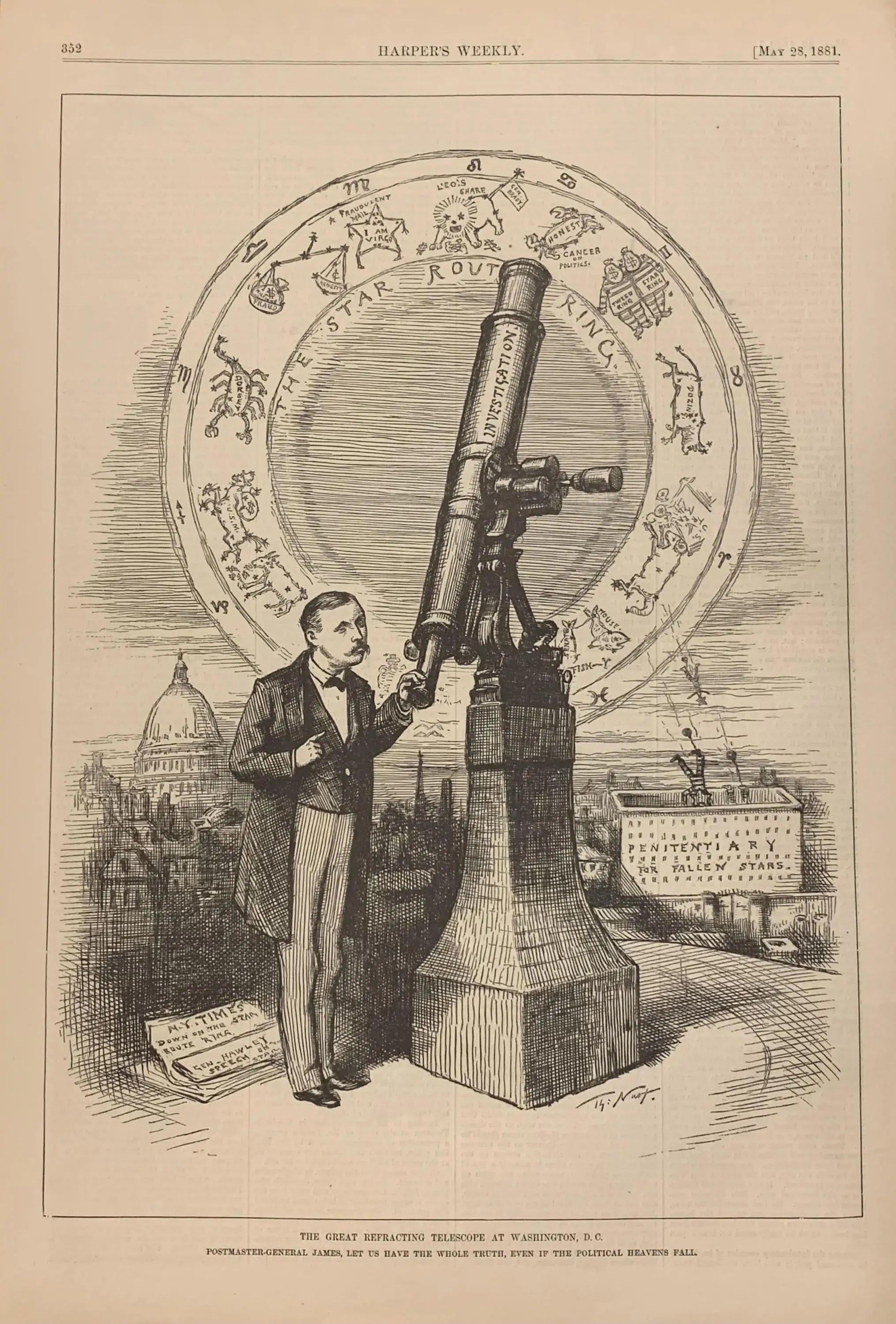
Thomas Nast: The Great Refracting Telescope at Washington, D.C.

In May of 1881, Thomas Nast took on the Star Route scandal in Harper's Weekly. Postmaster-General James is shown using the 26-inch aperture "Great Equatorial" telescope to investigate "The Star Route Ring." Nast urges him to find "the whole truth, even if the heavens fall." The cartoonist offers up an elaborate zodiac where Gemini is represented by the twins "Tweed Ring" and "Star Ring." Nast's readers, of course, would be familiar with his frequent criticism of Tammany Hall's "Boss" Tweed, so here he gets to equate the two scandals.

Thomas Nast
The Great Refracting Telescope at Washington, D.C.
Postmaster-General James, let us have the whole truth, even if the political heavens fall.
Harper's Weekly,
May 28, 1881, p. 352


The page is offered for sale by the Argosy Book Store in New York:

Thomas Nast
Argosy Book Store listing accessed June 21, 2025


Note:  For more information, follow the aqua link to Wikipedia's page on the Star Route scandal. There's also more to be learned about the 26-inch "Great Equatorial" telescope that was once located in Washington, D.C.


04978

Thursday, March 11, 2021

A Thomas Nast Signed Cabinet Card

Charles D. Fredericks (1823-1894) was a pioneering portrait photographer. In 1891, he photographed leading caricaturist Thomas Nast in his studio at 770 Broadway. Nast signed a cabinet card with his portrait in the following year.

Charles D. Fredricks
Thomas Nast, 1891
Signed "Th: Nast. 1892."

Scan by A Friend of the Blog


Note:  Thanks to A Friend of the Blog for the scan of the vintage signed photograph.


03561

Thursday, January 7, 2021

Thomas Nast: "Boss" Tweed, the "Brains" of Tammany Hall

Thomas Nast, spent his career attacking "Boss" Tweed and the corrupt Democratic politicians of New York's Tammany Hall. One of his more famous images is from Harper's Weekly and shows "The 'Brains' that achieved the Tammany victory at the Rochester Democratic Conventions." A redraw of the famous image, called more simply "The 'Brains' of Tammany Hall," is signed and dated by Nast just three days after the Harper's Weekly publication date of October 21, 1871. Accompanied by an unsigned and unremarkable sheet of sketches, it sold quickly for $2700 after being listed on AbeBooks on December 4, 2020.

Thomas Nast
Harper's Weekly, October 21, 1871


03496

Monday, February 17, 2020

David Levine: Hearing No Evil

A drawing by caricaturist David Levine gathers the personalities from the Watergate scandal in a circle. There is a lot of finger-pointing going on in a clockwise manner. The image appeared on a printed insert included in the tenth anniversary issue of the New York Review of Books in the summer of 1973. The listening devices in the drawing are unmistakeable references to the White House tapes recorded by President Nixon in the Oval Office. Caricaturist Bado points out on his blog that Levine's image is based on a Thomas Nast political cartoon of Boss Tweed and the Tammany Ring. The eight Nixon Administration caricatures were familiar figures on the nightly news then, but they are not so familiar to us today. Left to right they are (to the best of my and my friend's and family's recollections): Alexander Butterfield[?], unidentified, John Mitchell, Richard Nixon, John Ehrlichman, John Dean, unidentified, and H. R. Haldeman.
David Levine
New York Review of Books Tenth Anniversary Issue, October 18, 1973
Thomas Nast
"Who Stole the People's Money?" 'Twas Him
Harper's Weekly, 
August 19, 1871


Royal Books, which offers this print for sale as a "broadside," makes some other interesting assertions as well. To be clear, the New York Review of Books is not in any way related to the New York Times Book Review, Vice President Spiro Agnew does not appear in this print, and "passing the buck" does not fully convey the degree of moral turpitude permeating the Nixon White House.
David Levine
Royal Books Listing Accessed March 17, 2019

Thomas Nast
Two Great Questions
Harper's Weekly,
August 19, 1871


Note:  I'm afraid I've come up a bit short in my ability to recognize all the coconspirators from the Nixon Administration. My thanks to my father for being able to recognize John Dean without his, Dean's, glasses on. Political junkies are invited to help me identify the remaining unnamed figures in the Levine drawing. Avid historians are also welcome to identify the individuals in the Nast drawings standing with Boss Tweed.


Quick Links to the Attempted Bloggery Archives:

David Levine


Richard M. Nixon

Attempted Bloggery's Unpardonable Index
  
03171