Showing posts with label Nobody Loves Me. Show all posts

Thursday, January 23, 2020

Ronald Searle: Nobody Loves Me

Ronald Searle's 1974 lithograph Nobody Loves Me is surely one of his signature lithographic images. It depicts a lonely and isolated cat high up on a precarious perch. It was first collected in More Cats (1975).
Ronald Searle
Nobody Loves Me
Edition of 99, 1974


[January 17, 2022 Update:  A hand-colored épreuve d'artiste, or artist's proof, made its way onto a 1978 postcard.]
Ronald Searle
Nobody Loves Me
Postcard of hand-colored épreuve d'artiste aside from the edition of 99, 1974

Image added January 17, 2022


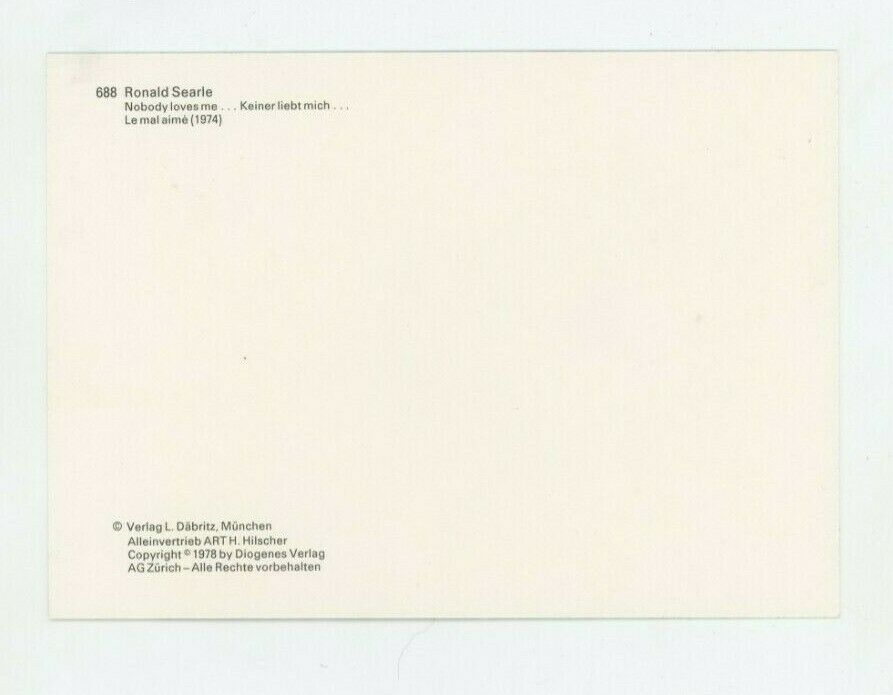
Postcard verso, 1978
Image added January 17, 2022


In 2005, Searle published The Predatory Bite of the Steel Nib in a limited edition of 296 copies. One of his sketchbook drawings reproduced there reveals something of the germination of the lithograph. In this early iteration of the image the unbalanced column is fully recognizable. The plain is not empty but filled with dogs and the cat is not cowering in solitude but delivering a fiery oration to the assembly. Searle plays with two written titles:  Top Dog and La Gloire [Glory].
Ronald Searle
Top Dog/la gloire
The Predatory Bite of the Steel Nib:  The Scrapbook Drawings of Ronald Searle

Predatory Parrot Press, 2005 


03146

Thursday, January 9, 2020

Ronald Searle: I Am Lonely

These past few blog posts could convey the false impression that it was commonplace at one time for an artist to take his published New Yorker cartoons (in the case of Lee Lorenz) or covers (in the case of Ronald Searle) and to use them to create related limited edition lithographs for sale to the public. It was not. These were rare occurrences that were not widely imitated. Why not? In the days before the founding of the Cartoon Bank, it was not easy to get prints of favorite cartoons. Wouldn't limited edition lithographs have satisfied an unmet need?

Perhaps. The lithographs in these cases were not faithful prints; they were creations artistically distinct from the published cartoons and covers. Demand would by no means have been automatic. Circle Gallery apparently misread the public demand and issued the first two Lorenz prints in editions of 300. Prices in the gallery were generally high and much of the edition may have remained unsold. Whether or not all these prints did eventually find buyers, they do not turn up very frequently on the secondary market today.

Searle's case was different. He was already issuing lithographs in editions typically of 99 on a regular—approximately monthly—basis, with considerable success. Thus a transatlantic market for his prints was already present. To occasionally adapt a popular magazine cover idea of his for the lithographic medium must have seemed a natural enough idea. Still, for the majority of his many New Yorker covers there is no corresponding lithograph, and the overwhelming majority of his lithographs have no relation whatsoever to his New Yorker work.

Searle also created at least one lithographic variation on a cover theme, as he apparently did with his New Yorker cover of January 13, 1973. The concept seems tailored very specifically to the perceived needs of the New Yorker: A business man holds a cigar contentedly, smiling from within a seashell on the beach. Searle later gave this illustration the title The Escapist in his 1978 monograph Ronald Searle. Would such an unusual image have found favor in the print market among Searle fans? He apparently thought not. Two years later he reimagined the cover as a lithograph, changing the orientation to emphasize the horizontal lines of the ocean and removing the gregarious businessman altogether. Instead Searle placed one of his popular cats inside the seashell, but here the cat stares out harrowed and discontented. Searle titled the print I Am Lonely, which would not at all correspond to the sardonically cheerful mood of The Escapist. It does, however, match the tone of other noteworthy cat lithographs, specifically Nobody Loves Me (1974) and Nobody Wants Me (1977) which are themselves graphically arresting meditations on individual isolation.
Ronald Searle
The Escapist

The New Yorker, January 13, 1973


Ronald Searle
I Am Lonely
Hors commerce aside from the edition of 99, 1975


Ronald Searle
Nobody Loves Me
Edition of 99, 1974

Ronald Searle
Nobody Wants Me
Edition of 99, 1977


Note:  I will return to the Searle lithographs Nobody Loves Me and Nobody Wants Me with more to say in future posts. I will also show a couple of additional lithographs by Lee Lorenz for good measure.

03132