Showing posts with label Janet Flanner. Show all posts

Tuesday, May 14, 2024

Polly Rowles's Copy of Paris Was Yesterday 1925-1939 by Janet Flanner

Janet Flanner's prewar "Letter from Paris" columns for The New Yorker were collected in 1972, edited many decades after the fact by Irving Drutman. The resulting volume is Paris Was Yesterday 1925-1939. Jane Grant, who established the magazine with her husband Harold Ross, the founding editor, and financial backer Raoul Fleischmann, received some of her friend Flanner's letters and recruited her to the magazine in its first year. The author, who also wrote under the pseudonym Genêt, inscribed a copy of the book in 1973 to actress Polly Rowles at Sardi's.


Janet Flanner
AbeBooks listing accessed April 20, 2024

Janet Flanner
AbeBooks item description

Polly Rowles for Hanes, 1983


04647

Thursday, July 7, 2022

The Cubical City by Janet Flanner

Janet Flanner (1892-1978) was The New Yorker's Paris correspondent. From 1925, the year of the magazine's founding, to 1975, she wrote the "Letter from Paris" column under the pseudonym Genêt. In the year 1926, she also published The Cubical City, her one and only novel. Her reputation as a writer, though, continues to rest on her work for The New Yorker.

Janet Flanner
AbeBooks listing accessed July 6, 2022


Images of a second "very handsome copy" come from—what do you know?—the same bookseller:


Janet Flanner
AbeBooks listing accessed July 6, 2022


04009

Saturday, March 27, 2021

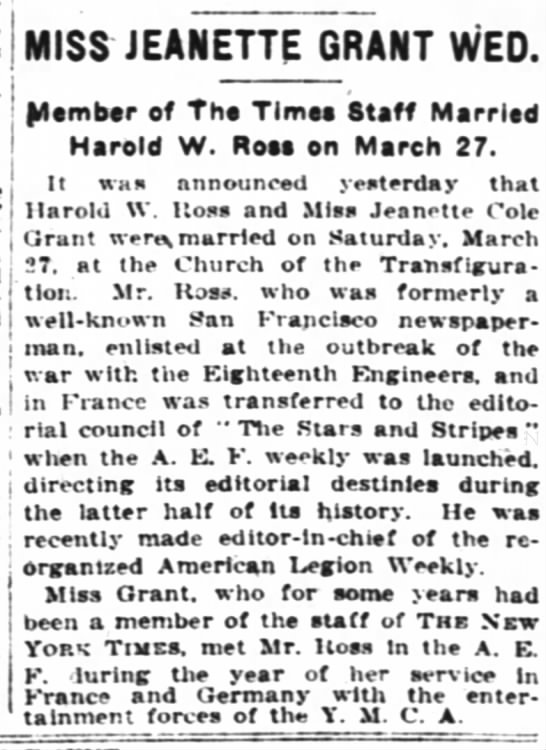
Harold Ross and Jane Grant Wed

One hundred one years ago today New York Times reporter Jane Grant and American Legion Weekly editor-in-chief Harold Ross were married. The Times dutifully covered the nuptials of its first full-fledged female reporter after the announcement was made on April 12. Ross was then known for his work during the Great War on Stars and Stripes, which he had been assigned to from its founding, eventually becoming managing editor. In France, Alexander Woollcott had introduced the couple.


Together Ross and Grant would go on to establish The New Yorker in 1925 with the financial backing of Raoul Fleischmann. Ross, of course, served as the magazine's editor while Grant worked at bringing investors and talent, notably Janet Flanner, on board. The magazine became a success but the marriage did not. The couple were divorced in 1929. Grant would publish her memoir Ross, The New Yorker and Me in 1968.


03577

Wednesday, November 28, 2018

Ross, The New Yorker and Me Signed by Jane Grant

Journalist Jane Grant was married to Harold Ross, the founding editor of the New Yorker, from 1922 to 1928. This put her at the center of activity at the time of the magazine's first publication in 1925. She was essential in getting Raoul Fleischmann to invest in the fledgling magazine, and she persuaded her friend Janet Flanner to contribute a "Letter from Paris." In 1968, Grant published Ross, The New Yorker and Me—the lack of a serial comma would be frowned upon by the magazine. Flanner contributed the book's introduction. Grant died in 1972 at her home on the White Flower Farm, which she founded with her second husband. She was 80 years old. A signed copy of her memoir was sold on eBay two years ago with a make offer option somewhere under $40.


Signed by Jane Grant


Would you include this photo in your eBay listing?


Jane Grant
eBay Listing Ended December 30, 2016

Jane Grant
eBay Item Description


December 4, 2021 Update:  Here's a different copy of the book with Jane Grant's full signature:


Note:  The University of Oregon has some interesting biographical material on Jane Grant here.


Quick Links to the Attempted Bloggery Archives:


Harold Ross

Sunday, May 11, 2014

Constantin Alajálov: Then Comes Marriage

Happy Mother's Day!

Constantin Alajálov's 1942 New Yorker cover illustration depicts a newlywed bride's sudden awareness of the new direction her life may soon take. The groom is predictably oblivious to this dramatic moment. This was published as a June wedding cover, but it seems to anticipate many Mother's Days to come.

Constantin Alajálov, The New Yorker, June 20, 1942

The artwork also served as the cover for Conversation Pieces, with text by Janet Flanner.
Constantin Alajálov, Conversation Pieces.  Text by Janet Flanner.  New York:  Studio Publications Inc., 1942.


Note:  Read more of my blog posts about the art of Constantin Alajálov.

Of course, there's also more to read about Mother's Day.

01146

Monday, April 21, 2014

Fatigue Duty: Constantin Alajálov Preliminary New Yorker Cover Art

Comparing preliminary with published versions of New Yorker cover artwork allows one to infer the kinds of changes requested by the magazine's editors. Of course, some changes might have been made independently by the artist and some could be more or less random. Constantin Alajálov's preliminary cover illustration dated January 1942 is finished and seems perfectly adequate, but it was repainted by the time of the June publication. The question is, why?

Illustration House sold this alternative version of the June 6 cover in its May 2010 sale. The lot description notes this "is evidently the first version of Alajalov's idea, the main difference being that the woman has an officer's hat." The cap is a part of the uniform and seems to belong there right alongside the gloves. Were the editors concerned that readers might take it for a man's cap, that of a visitor? That would be totally out of context here. Did the editor Harold Ross think she should have hung it on a coatrack? I doubt we'll ever know.

The gloves have definitely been improved upon in the published version. In the preliminary artwork, they are somewhat creepy, like the gnarled roots of a tree. In the final version, they are sleek and elegant, befitting a woman's hand. Unfortunately, the woman's hand holds a cigarette in both versions.

The room has been rendered less frilly and more colorful. The feminine ribbons have been removed from the wallpaper. The window curtains are less ornate. Color has been added to the vanity, the ribbon on the lampshade, and the summer dress. Were the editors concerned that a white summer dress looked too much like a wedding gown? Why on earth were the slippers removed from the floor by the vanity?

Finally, for those who look at the New Yorker of this era as a bastion of propriety and respectability, it is interesting to note one other minor change. The bathroom door has been closed just slightly.

Constantin Alajálov, Preliminary cover art, The New Yorker, June 6, 1942

Constantin Alajálov, The New Yorker, June 6, 1942

Illustration House
Lot 6, May 22, 2010

The Illustration House sale price:
http://www.findartinfo.com/search/listprices.asp?keyword=14468&name=Constantin-Alajalov


In the previous year, 2009, this lot was offered by James D. Julia Auctions. They were unable to identify it as a variant of a published New Yorker cover, although they did note Alajálov's work for that magazine and for the Saturday Evening Post. They also noted the January 1942 date written on the back as well as the title Fatigue Duty, which I have adopted. The work did not sell.
Constantin Alajálov, Framed preliminary cover art, The New Yorker, June 6, 1942


http://www.invaluable.com/auction-lot/constantin-alajalov-american,-1900-1987-prepara-2305-c-696c573d19

By November of 2009, someone identified the New Yorker connection. The work was sold for $900 and the buyer must have taken it to Illustration House for resale:

http://www.findartinfo.com/search/listprices.asp?keyword=14468&name=Constantin-Alajalov
By the way, the original artwork to the published cover is in the collection of the Sterling and Francine Clark Art Institute in Williamstown, Massachusetts. They acquired it in 1955 along with six other works by the artist. They identify it by the title Wave and Maid. (During World War II, women serving in the U.S. Navy were known as WAVES, which stood for Women Accepted for Volunteer Emergency Service.)
Constantin Alajálov, Original cover art, The New Yorker, June 6, 1942
Collection of the Sterling and Francine Clark Art Institute

Constantin Alajálov, The New Yorker, June 6, 1942

May 13, 2014 Update: An earlier sale of the preliminary art was held in 2008 by Trinity International. Interestingly they identified it as published, not preliminary or alternative, New Yorker art, and they gave it the title "The Wedding Dress." It sold for $2,000, more than twice what it fetched in 2009.


Constantin Alajálov, Preliminary cover art, The New Yorker, June 6, 1942
Constantin Alajálov, Framed preliminary cover art
The New Yorker, June 6, 1942
Constantin Alajálov's signature


http://www.liveauctioneers.com/item/4710980


Note:  Alternate versions of published New Yorker art are often quite interesting. If you have access to any, please contact me to share your variations on a theme right here on Attempted Bloggery. Fame can be yours, but most collectors prefer anonymity.

More of my blog posts about the New Yorker art of Constantin Alajálov may be seen here.

I have just a few additional posts with preliminary versions of published New Yorker cover art and they may be seen here.

My previous posts about Earth Day are here and they're 100% organic.

01125