Comic art and illustration specialist Murray A. Harris of California often annotated the back, or verso, of works in his collection, adding his personal stamp and signature. Here's an example of his markings on the back of a Reamer Keller drawing selected from the blog archives. It is stamped twice indicating two different Harris addresses, signed once, and date stamped, either indicating a date of publication or of acquisition:
Many collectors must be familiar with Harris because of such documentary practices. It is gratifying to know something about the provenance of a drawing, particularly if it once resided in a well-regarded collection.
A work on paper from the Zipriani Auction House of Lima raises some questions in this area. It was listed this past March as "Saul Steinberg Drawing on Paper (In The Style Of)." In auction speak, that's tantamount to an admission that it is not an original drawing by Saul Steinberg, or that its authorship cannot be proved, but to my eye it is still fairly impressive. The original $1,200 asking price is a bit of a head-scratcher; too low for a true Steinberg original of this quality but too high for a mere copy.
Adding to the puzzle, the drawing has a Harris collection stamp on the verso. It is poorly inked unlike the Keller example above, and there is no corresponding Harris signature or other marking. Could this doubtful Steinberg have resided in Harris's collection? Or is the stamp itself a fake, meant to suggest provenance and thus authenticity to the knowing collector when in fact there is neither? Harris's name was in bold text on the verso of the Keller drawing; here it is clearly a different stamp with the same text.
At any rate, the lot did not find a buyer. The price was soon reduced to an opening bid of $400, and later to $100—not true Steinberg territory.
In the style of Saul Steinberg Zipriani Auction House listing accessed March 7, 2023
The version of Steinberg's New Yorker drawing from the issue of February 3, 1945 is distinct from that published in his later 1945 collection All In Line. In fact, his New Yorker and his All In Line drawings differ in a great many ways (see, for example, the head at the lower left, left-facing in one and right-facing in the other), something one might readily expect from a series of freehand variations on a theme this complex.
Saul Steinberg The New Yorker, February 3, 1945, p. 22
The Zipriani drawing is close to the better-known All In Line version, but it is by no means identical. So the question is, would Steinberg do such a slavish redrawing of his own work, certainly not his usual practice, or is it a reasonable good copy by someone else perhaps made with a light box? Then again, could Steinberg himself be closely copying over his own work to try to get everything just right for the book version?
In the style of Saul Steinberg
The final nail in the coffin, I believe, of the Zipriani drawing's authenticity is the company it keeps. Most every piece in the March sale was also described as "in the style of . . . "
Something fishy is apparently going on down in Peru. A comic panel by R. Crumb from HUP #3 (1989) features a noted real estate developer. The variety of hatching, cross-hatching, line quality, and lettering present a challenge to a potential copyist quite distinct from the clean lines of the Steinberg.
A drawing currently for sale on eBay is listed as "Robert Crumb Drawing on paper (Handmade) signed and stamped mixed media vtg art." It is not at all convincing as a Crumb original, particularly when compared with the published HUP panel, and the original is probably a full comic page anyway. The $115 or best offer price should be seen as a tacit acknowledgment of this. The seller, probably not coincidentally, is located in Lima.
The verso is telling as well for the presence of no fewer than five collectors' stamps! Honestly, if one stamp is good, are five better? At the bottom left is yet a third Harris stamp, not the one on the Keller or the Zipriani Auction piece. If that's not convincing enough, there's a Museum of Modern Art stamp at the lower right. Talk about your jaw-dropping provenances!
Peru then may very well have a workshop churning out copies of drawings, some better than others, and decorating the versos with copies of collectors' stamps including Harris's. As always, caveat emptor.
Note: I wish to thank cartoonist Michael Maslin and writer Steve Stoliar for helping me to decipher the Zipriani Auction piece. It's taken me the better part of a year to come to my present understanding of it.
Writer Steve Stoliar brightens my new year with news of his most recent acquisition:
It's a 1923 book called Actorviews, written by noted Chicago theatre critic Ashton Stevens.(Orson Welles said he based Jed Leland on Stevens, who was also George Stevens's uncle.) It was issued in a signed/limited edition of 210 and is also inscribed by Stevens. The book is signed to Florence Nash, a theatrical actress and poetess who is mentioned in Stevens's interview with Nora Bayes. In addition to Stevens's inscription, there is a fairly accurate caricature of Stevens drawn by Gene Markey, who did the illustrations for the book. Since you blogged about Markey's drawing of Benchley and Woollcott, I knew you'd know who he is. He also did a famous caricature of a young Ben Hecht—and he was married to Joan Bennett, Hedy Lamarr, and Myrna Loy, though not at the same time.
For me, Chicago in the '20s has the same sort of romantic image as New York in the '20s: Gangsters, speakeasies, Hecht, Lardner, Dreiser, all those newspapers, etc. This particular copy evokes so much of that time.
Picked it up for $25.
Actorviews Title page
Limitation page No. 89/210
"For Florence Nash, My friend since she was a baby poet, my admiration ever. Hers faithfully, The Author" and "The Venerable Critic on a quiet night in what he has nick-named 'The Windy City.' To Flo-Flo— GM"
So did Stevens truly "nick-name" Chicago "The Windy City," as Markey suggests? It wasn't his coinage. Steve writes back, "I also checked earlier and saw that Stevens didn't invent 'The Windy City' but, to my surprise, he was well-known for having popularized the term." Aha!
Steve also provides some helpful Wikipedia links for those of us who aren't quite so up-to-date on 1923 Chicago-based literary celebrities:
Note: I'm so grateful to Steve Stoliar for sharing this find here on Attempted Bloggery. I had no idea such a book was out there. This is Steve's eighth contribution to the blog if I'm counting correctly and his thirty-seventh if I'm not. Steve is the author of Raised Eyebrows: My Years Inside Groucho's House. If you don't have a nightstand, buy one and place this book on it.
Throughout these dozen years or so of attempted blogging, I have benefited from the support of a bevy of generous contributors, advisors, and occasional nitpickers. I owe a great debt to each of the individuals listed below for offering much-appreciated help and inspiration to me over these past twelve months. To any others I may have neglected to include this go round, please accept my thanks despite my inexcusable laxity.
Note: The limited edition Thank You print by Roz Chast is new to me. Is it recent? I'm curious as to which Bloomsbury Press title this print is associated with.
A curious six-panel original drawing by New Yorker cartoonist George Booth looks very much like a cartoon published in the issue of June 30, 1975. Indeed, a notation on the verso in the artist's hand cites this issue as if the work were actually published there, although it gets the page numbers wrong (if only by one). But there are no publisher's markings on the art and it deviates slightly but significantly from the published cartoon. This is clearly a finished drawing, not a rough. It is executed in felt tip pen, now a bit faded, over pencil. Apparently, then, it must be a redraw created by Booth for someone who wished to have the original art but for one reason or another was not able to obtain it.
Note: My thanks go to Steve Stoliar for first bringing this auction to my attention. Steve is the author of Raised Eyebrows: My Years Inside Groucho's House, which I highly recommend.
Thanks too to Michael Maslin for discussing this complicated piece with Steve and me. Michael is a New Yorker cartoonist and the author of the world's first and only biography of Peter Arno. Do I really need to say I highly recommend Peter Arno: The Mad, Mad World of The New Yorker's Greatest Cartoonist too?
Before you get to the reading assignments, I could use some new content for the old blog. Redraws and other variations on original New Yorker cartoon art by George Booth and others are sought after here as the potential subject matter of future posts.
Throughout these eleven years of blogging, I have benefited from the support of a number of generous contributors. Some send me submissions, some send me alerts, and some send me corrections. Some function more as behind-the-scenes advisors. Whatever the case, I owe a great debt to each of the individuals listed here for offering much-appreciated assistance to me over these past twelve months. Friends, I thank you all:
An original illustration by cartoonist Charles Addams was sold last week by Heritage Auctions. It is framed above a printed sheet declaring it an original Addams Family illustration, but it is not quite the Addams Family we're all familiar with. Who exactly are these characters and why on earth are they all writing, or attempting to write?
I didn't recognize the illustration when author Steve Stoliar first brought it to my attention. My first thought was that it might be an advertising piece, but that was just a guess. I decided to consult with some Addams specialists.
Charles Addams's biographer Linda H. Davis writes, "I have not seen it before. Since it’s not clear what they’re signing, I suspect that he did indeed do it for an advertising gig. He did quite a lot for advertising. And most of the characters are recycled from cartoons. The funny thing to me is the Fester-nosed bird, which resembles some self portraits he did for Tee, in which he portrayed himself as a bird, dropping a Valentine outside the sliding door of her 'bird room,' etc."
Ms. Davis continues, "One of my favorites of the two-headed crowd is in my book, p. 126: 'Everything happens to me.'"
"Everything happens to me." Charles Addams Homebodies, 1965
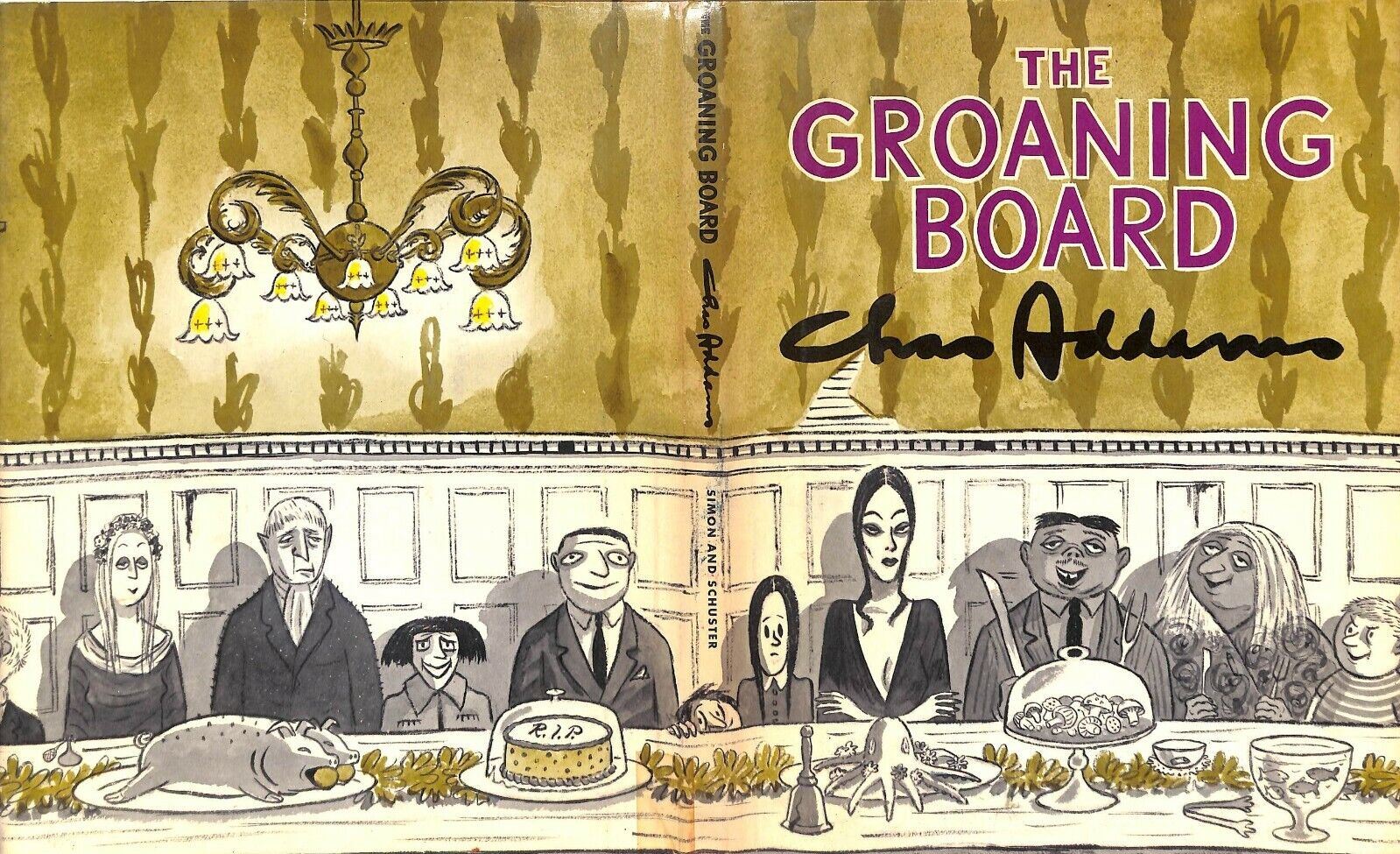
Addams merchandise maven Joel Jacobus has his own insights into the characters. He writes, "Well that's quite interesting. I have not seen it before. The female is definitely the character who would eventually become Morticia's sister Ophelia. She appears in a number of Addams' drawings, including the dust jacket and title page of The Groaning Board.
Thing? Yes, Thing. A word of explanation might be in order here. In an earlier communication, Joel wrote, "Kevin Miserocchi [director of the Tee & Charles Addams Foundation] identifies the character peeking out from under the drapes [in the Addams Family scarf] as The Thing. Our modern concept of The Thing as a disembodied hand wasn’t solidified until the 1964 TV show. Prior to that, with the exception of one drawing showing hands coming out of a record player and changing a record, The Thing tended to peer down from balconies, from behind drapes, or out from under seats. There's no real evidence that Mr. Addams thought of this character as 'The Thing' (which was only mentioned once in an early cartoon that shows a sign on the mansion’s wrought iron fence that reads, 'Beware of the Thing') but the idea that 'something' was creeping around the mansion was pretty powerful and since this character creeps around the house, it’s not unreasonable to think the two are one and the same."
Okay, back to the illustration's characters. Joel continues, "But the others are all new to me. Although Addams did like to draw two-headed boys now and then, this one doesn't look like any of the others that I recall.
"I am inclined to think this was for an industrial advertisement rather than for The New Yorker. There seems to be a quite a few of Addams's industrial ads out in the world..."
Finally, I contacted H. Kevin Miserocchi of the Addams Foundation. He was aware of the drawing only because it had been sold earlier this year at Doyle. He suspects this is a magazine illustration or perhaps advertising art, but he has no record of it.
Doyle, formerly the William Doyle Galleries, did indeed sell this piece in March. The auction house speculated that the piece was created for an advertisement and came as close as one can to identifying Ophelia without actually doing so. Doyle called this "a group of Addams Family relatives," which is excellent salesmanship, who are "apparently suffering from writer's block." Could be.
So it seems the previous owner purchased this at Doyle and then framed it to indicate the characters were from the Addams Family. As Ophelia is Morticia's sister, this may even have some truth to it. The Doyle sale price in March of $11,970, including the buyer's premium, is a considerable investment. The bidding at Heritage started at $7,500, with an ultimate sale price of $45,000, again including premium, would seem to indicate a remarkably successful and quick turnover, particularly for a subject on the periphery of the Addams Family. (I wouldn't try this at home.)
Charles Addams Heritage Auctions listing ended October 7, 2022
Note: My thanks to Steve Stoliar, author of Raised Eyebrows: My Years Inside Groucho's House, who originally brought this intriguing Addams drawing to my attention. I strongly recommend his book but I think the audiobook, which Steve himself narrates, is terrific too.
Thanks also to Linda H. Davis, author of Charles Addams: A Cartoonist's Life. Ms. Davis has been very generous in her responses to all my Addams queries. Her biography should be essential reading for everyone who likes to visit this blog.
I am indebted as well to Joel Jacobus, tireless cataloguer of Addams merchandise and memorabilia. When I need to tell Granny Frump from Grandmama, I go to Joel.
Thanks as well to H. Kevin Miserocchi of the Tee & Charles Addams Foundation. He is an executive producer of "Wednesday," premiering on Netflix November 23. It seems to have a great look and a talented cast:
"Wednesday" Trailer
My thanks also to to New Yorker cartoonist and Ink Spill blogger Michael Maslin, who came along with me for this whole adventure.
Needless to say, any reader who chanced to see this Charles Addams illustration in print should get in touch and provide the details.