Showing posts with label Karl Haendel. Show all posts

Wednesday, August 23, 2023

Karl Haendel: Depressed? and New Yorker Cartoon Drawing #20

I've written several times about the appropriation art of Karl Haendel, who came to my attention because his subject matter is, at least occasionally, New Yorker cartoons. His selection of these cartoons baffles me—and then it doesn't. I do, after all, understand why an appropriation artist would want to appropriate something extraordinary and few things are more extraordinary to me than New Yorker cartoons. But what of his selection? Are they simply random, contemporary examples of cartoons, as they frequently seem to be? Is there some esthetic or perhaps autobiographic reason for his choices? And how does he decide which works to group together and when?


The untitled 2001 work which starts with the word Depressed? does little to answer these questions. It certainly doesn't appear to arise out of an esthetic imperative. The unadorned typography looks mind-numbing to have to replicate with a pencil. The size, at least, gives the drawing the presence of a statement piece. 


The work was offered at auction earlier this month by Wright in Chicago, although it did not travel to the auction house from Los Angeles. It was given a presale estimate of $2,000 to $3,000, with bidding opening at $1,600. It did not find a buyer.
Karl Haendel
Wright Editions & Works on Paper auction accessed before the August 8, 2023 sale


Chances are you are not familiar with the work of New Yorker cartoonist David Stein. I certainly wasn't. His only cartoon may be found way at the back of the issue of April 19 and 26, 2004, the Spring Humor Issue. Ask yourself then why Haendel might choose to appropriate the work of Stein, thus:

New Yorker Cartoon Drawing #20
Karl Haendel


Perhaps we can get another hint from the grouping of four Haendel works of which this is a part: Depressed Nude #3, Wasserlack #3 (Ghost Version), New Yorker Cartoon Drawing #20, and 11th Question Mark. (Wasserlack is German for water-based paint. It is the brand name of water-based varnish pencils depicted here as a photographic negative or "ghost.")

To oversimplify a bit, the themes of this set may be depression, the chaotic artistic process, psychotherapy, and uncertainty. The Stein cartoon might have been chosen for its clever use of the psychiatrist and patient trope rather than for anything to do with this obscure New Yorker artist or the esthetics of the cartoon. The caption in this context possibly suggests some similarity between the painstaking slowness of the psychiatric process and of the artistic process, but I don't want to read more into this than is actually there. The set of four drawings is still available for sale.
https://www.art.salon/artist/karl-haendel


So, once again, Karl Haendel's choice of New Yorker cartoon may not originate from any particular appreciation of the art form. Rather, he simply may be making a connection between depression and psychotherapy, just as his Depressed? drawing did.

"Are we there yet?"
David Stein
The New Yorker, April 19 & 26, 2004, p. 194

New Yorker Cartoon Drawing #20
Karl Haendel

A cartoon by David Stein


Note:  Would you like to know what a New Yorker cartoonist really thinks of having his work appropriated by Karl Haendel? Then you'll want to read "Stop, Thief! My Work Gets Appropriated" by David Sipress here. Yes, the title kind of gives it away.


04420

Friday, September 23, 2022

Karl Haendel: New Yorker Cartoon Drawing #16 and #5

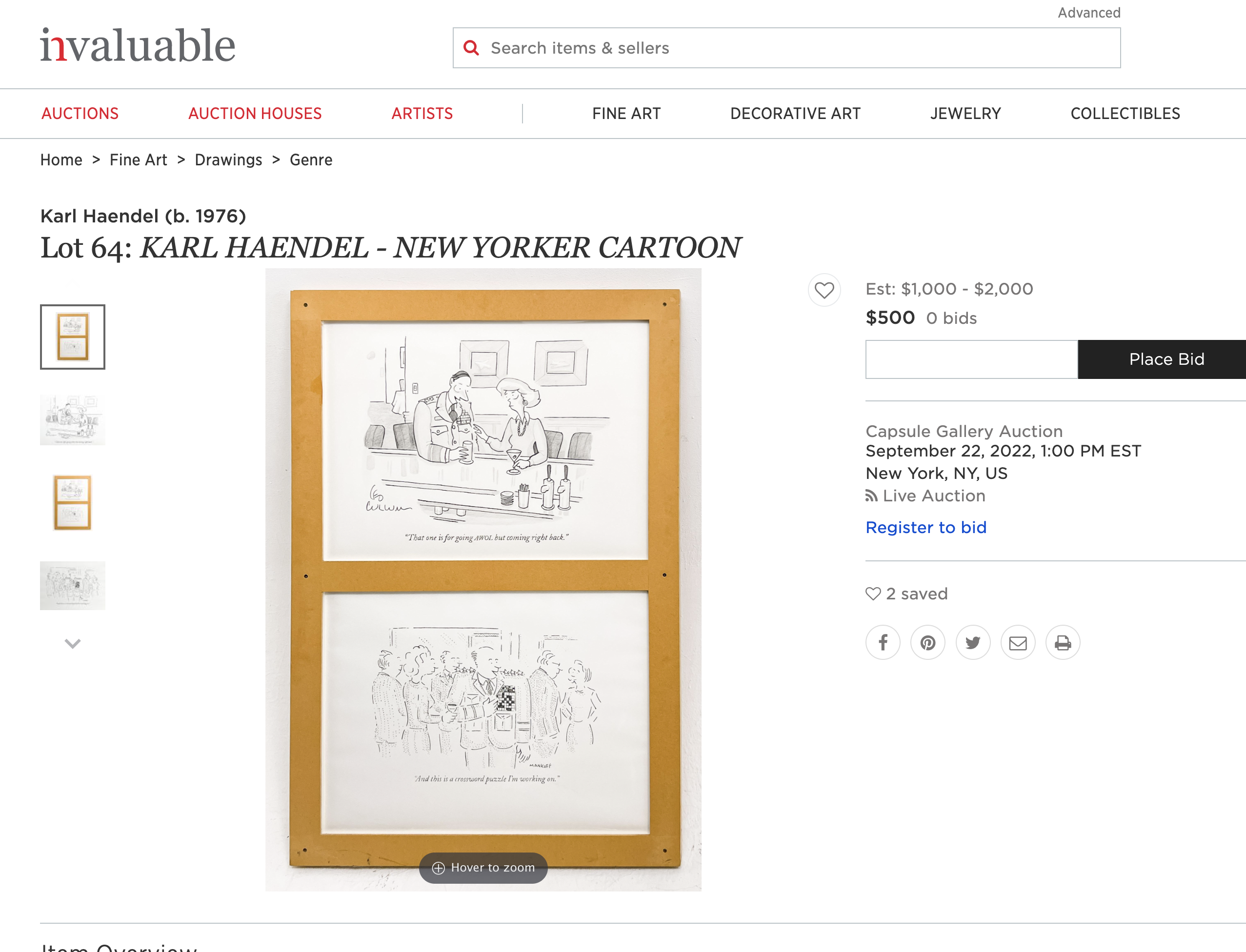
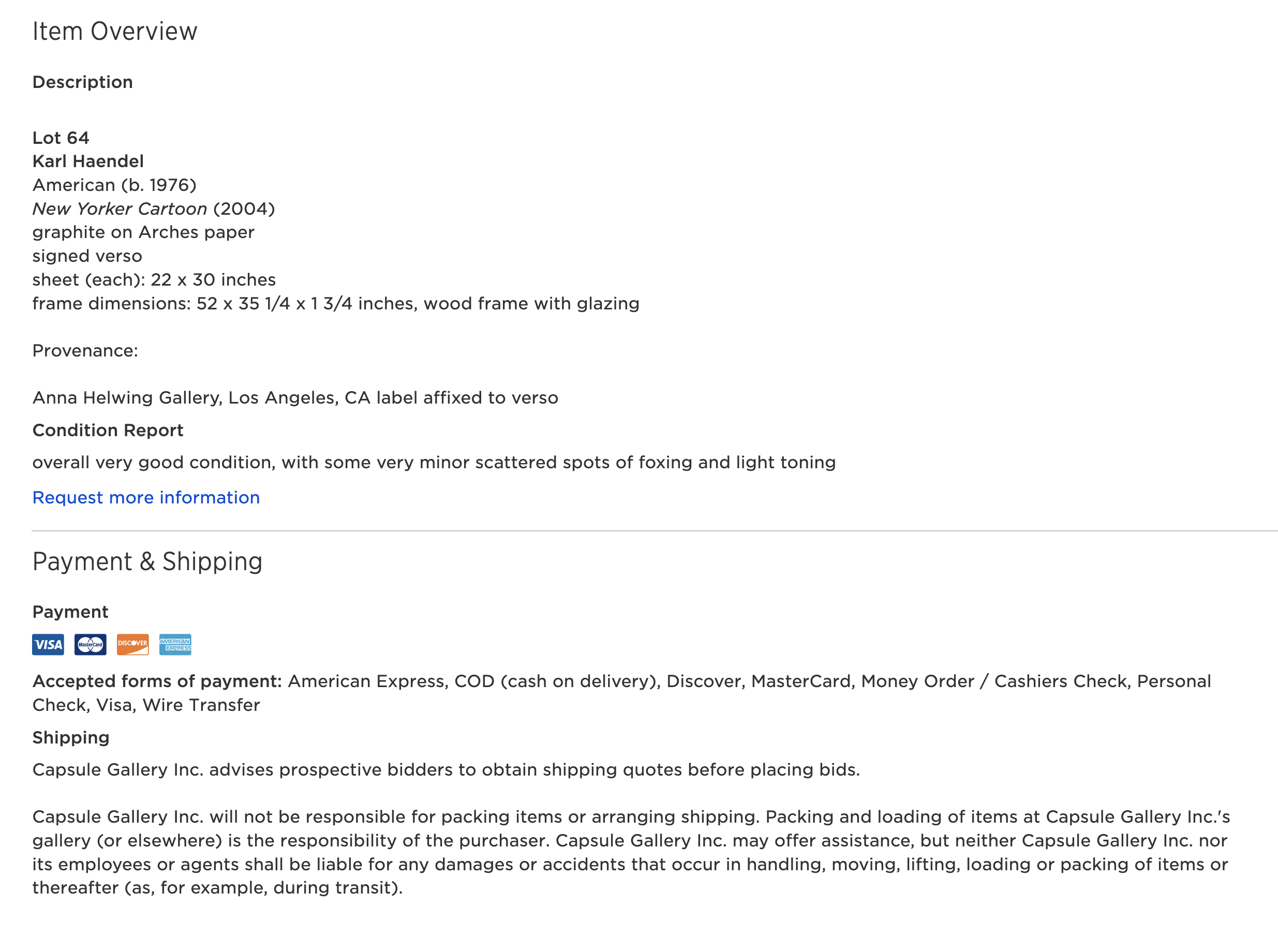
Some of the cultural artifacts appropriated by artist Karl Haendel are published New Yorker cartoons, enlarged and redrawn in graphite by the artist from the magazine page. Sometimes Handel groups these works with other drawings, creating an installation of appropriated works that are related thematically in ways that may or may not be fully apparent. In the case of New Yorker Cartoon #16 and #5, the two works are framed together, one above the other, for a reason that seems transparently obvious: both drawings are appropriations of New Yorker cartoons on the subject of military medals. The top drawing, #16, is appropriated from a published cartoon by Leo Cullum, while the bottom drawing, #5, is taken from a cartoon by Bob Mankoff. Both cartoons were published by The New Yorker in 2004 and appropriated by Haendel in that year. The framed pair went to auction yesterday with a presale estimate of $1,000 to $2,000.


Karl Haendel
Capsule Gallery Auction listing accessed September 19, 2022


The lot was passed with the bidding, I believe, at $800:


In chronological order:
Bob Mankoff

Karl Haendel after Bob Mankoff

Cartoon by Bob Mankoff


Leo Cullum
Karl Haendel after Leo Cullum

Cartoon by Leo Cullum


Note:  How does it feel to have one's cartoon appropriated? David Sipress weighs in on his experience with "Stop, Thief! My Cartoon Gets Appropriated." 


04086

Saturday, December 21, 2019

Karl Haendel: New Yorker Cartoon Drawing #27

In 2007 artist Karl Haendel appropriated his twenty-seventh New Yorker cartoon, mining the work of cartoonist David Sipress for at least the second time. A 2004 work, New Yorker Cartoon Drawing #9, appropriated Sipress's "Bad dog" drawing. As with other drawings in the series, Haendel makes large graphite renderings of published New Yorker cartoon images. His process may or may not involve a light box or a projector; these renderings do not appear to be done freehand.


This drawing is one of five framed pieces that make up the Mazel Tov group. The phrase is Yiddish meaning good luck or congratulations. The Jewish theme suggested by the title may also apply to the inclusion of the lyrics to Bob Dylan's "Jokerman." The grouping was offered for sale at Sotheby's in 2013 where it apparently did not find a buyer:
Karl Haendel
Mazel Tov Group (2006-2007)
Sotheby's 2013

The work currently resides at the Henry Art Gallery of the University of Washington, Seattle.  The artist's installation view from a 2019 exhibition is notable for placing the New Yorker drawing and the Dylan lyrics well below eye level.
Karl Haendel
Mazel Tov Group (2006-2007)
Installation View, Henry Art Gallery, University of Washington


Joe Milutis's commentary on the grouping articulates the "multiple themes" to be discovered here:
https://henryart.org/exhibitions/karl-haendel-mazel-tov-group#page-navigation-overview


The museum's commentary doesn't even mention cartoonist David Sipress; it speaks only of "a Jewish-American themed cartoon from The New Yorker." That's odd because Haendel does nothing to hide the identify of the cartoonist; the signature is copied directly from his source material. The cartoon was first published in December of 2006 so Handel no doubt selected it when it was quite fresh.
David Sipress
The New Yorker, December 4, 2006, page 68
Karl Haendel
New Yorker Cartoon Drawing #27 (2007)

Cartoon by David Sipress
Could there be some autobiographical element to Haendel's appropriation of this cartoon mixing the Jewish and Christian holiday traditions? Haendel didn't meet Emily Mast until 2009, which was two years after he completed the Mazel Tov Group. His wedding ceremony in 2011 was performed by a friend of the bride in "a ceremony that included Jewish traditions."
https://www.nytimes.com/2011/09/25/fashion/weddings/emily-mast-karl-haendel-weddings.html


Karl Haendel
Sotheby's New York Contemporary Art, March 7, 2013
https://www.sothebys.com/en/auctions/ecatalogue/2013/contemporary-art-n08967/lot.140.html


Bob Dylan
"Jokerman"
From Infidels (1983)


February 5, 2020 Update:  David Sipress writes of this piece for NewYorker.com's Culture Desk in a piece called "Stop, Thief! My Cartoon Gets Appropriated." His essay was posted yesterday and it marks the first time this blog is mentioned on the New Yorker's website—it's literally parenthetical: "(According to the cartoon-related Web site Attempted Bloggery, to date Haendel has appropriated at least twenty-seven New Yorker cartoons.)" Let's just hope I've been fact checked on this.


03113

Sunday, September 8, 2019

Karl Haendel: New Yorker Cartoon Drawing #9

Artists who appropriate other artist's images don't just copy them. They transform the images in a meaningful way. There are any number of ways in which this may be achieved and many decisions to make along the way. The artist first must choose an image to appropriate. Karl Haendel, for his series of New Yorker Cartoon Drawings, has a wealth of images to choose from. For his New Yorker Cartoon Drawing #9, he chose one by cartoonist David Sipress.
Karl Haendel
New Yorker Cartoon Drawing #9 (2004)

The Sipress cartoon was published in the same year as Haendel made his drawing. 
"Bad dog."
David Sipress
The New Yorker, April 19, 2004, page 169


The carefully-rendered caption makes it clear that Haendel's subject matter is the cartoon as it appears in print on the page of the New Yorker. Haendel's drawing differs from the published Sipress cartoon in at least three fundamental ways: it is reproduced by hand, it is much larger, and the medium is graphite. In this way it is decontextualized from the magazine page and is presented as an art object on the wall. It is an irony of this process that when Haendel's work is reproduced in a printed catalogue or onscreen, it becomes more like the mass-produced magazine cartoon that served as its original source.

https://www.phillips.com/detail/karl-haendel/NY010610/348

https://archives.newyorker.com/?i=2004-04-19#folio=168


Quick Links to the Attempted Bloggery 
Archives:


Appropriation Art


David Sipress

The New Yorker


September 11


Attempted Bloggery's Never-Appropriate Index


03029

Saturday, September 7, 2019

Karl Haendel: New Yorker Cartoon Drawing #6

We begin with a classic full page New Yorker cartoon by Warren Miller that was published in the magazine in 1974:
"Sam, it's the most sensitive thing you've ever done!"
Warren Miller
The New Yorker, June 17, 1974, page 29


American artist Karl Haendel was born two years after this cartoon was first published. In 2004 he appropriated the cartoon for his New Yorker Cartoon Drawing #6. That's right, #6:
New Yorker Cartoon Drawing #6 (2004)
Karl Haendel


The title acknowledges the source material for the drawing, which would be obvious in this case even if it didn't.  The drawing is quite large, 70" x 51", much larger than the printed page from which this drawing was appropriated and surely much larger than Miller's original cartoon. The medium is graphite which has a far different feel from the washes used by Miller. Haendel has copied the printed caption verbatim but he has not included a page number. Perhaps the image's source was not the original magazine but a book of collected cartoons.

Haendel may alter the images he appropriates in deliberate ways for satiric or artistic purposes. For the most part, this drawing seems to be faithful to its source. The meticulous use of graphite gives Haendel's work a very crisp and clean look compared with the darker wash tones of the original published cartoon. Miller's signature seems to have been rendered as MiVer, which leaves one wondering if Haendel knew the actual name of the cartoonist.

In its 2009 sale of this work, Christie's New York estimated the value at $6,000 to $8000. The hammer price was $5,250. This realized price is most likely higher than what Miller's original cartoon might fetch at auction, but again the present work is a much larger piece.
Karl Haendel
Christie's New York
Sale 2150, March 11, 2009

First Open Post-War and Contemporary Art
Lot 17


Quick Links to the Attempted Bloggery 
Archives:


Appropriation Art

Warren Miller

The New Yorker


September 11


Attempted Bloggery's Sensitive Index


03028