Showing posts with label Arthur Getz. Show all posts

Friday, October 11, 2024

Robert Day: What Would Cagney Do?

An original New Yorker drawing by cartoonist Robert Day (1900-1985) was presented by the artist to actor James Cagney (1899-1986), for whom it must have held special significance. It was given as a Christmas gift, probably in 1956, which was the year of the cartoon's publication. Day and his wife, "Rob & Buffie," were evidently on a first name basis with Cagney, whose surname alone back then would have identified him to much of the world. The artwork was sold by Doyle in 2000 at the Cagney Auction.

"I just asked myself what Cagney would have done if he were in my place, and here I am."
Robert Day
Original art
The New Yorker, December 8, 1956, p. 50

"I just asked myself what Cagney would have done if he were in my place, and here I am."
Robert Day
The New Yorker, December 8, 1956, p. 50


"I just asked myself what Cagney would have done if he were in my place, and here I am."
Robert Day
Original art
The New Yorker, December 8, 1956, p. 50


With a cartoon by Robert Day and a spot drawing by Arthur Getz


Mail call!
Arthur Getz
Spot drawing

The New Yorker, December 8, 1956, p. 51


04767

Tuesday, August 8, 2023

Arthur Getz: Musicians

It's unusual to see the most published New Yorker cover artist of all time, Arthur Getz (1913-1996), working in the medium of ceramic relief. His three-panel work Musicians is unsigned and undated, so far as we can see in its frame. One musician occupies each panel. The piece was offered at auction in New York on Sunday with a presale estimate of $400 to $600 and a buyer's premium of 25%. It sold for $225.


Arthur Getz
New York City Estate Auction accessed June 18, 2023

Arthur Getz
New York City Estate Auction item description

Arthur Getz
New York City Estate Auction
accessed June 18, 2023


Sold!


04405 

Wednesday, June 21, 2023

Jazz Musicians: Arthur Getz Original New Yorker Cover Art

Arthur Getz's New Yorker cover of January 4, 1958 depicts a trio of jazz musicians performing. The original art was sold at auction on Sunday in New York. The presale estimate was $2,000 to $4,000. It sold for $4,000, the high estimate.

Arthur Getz
Framed original cover art
The New Yorker,
 January 4, 1958

Arthur Getz's signature

Detail of the bassist

Detail of the pianist


Detail of the drummer


Hammer Galleries inventory stamp

ALS from Arthur Getz to the work's buyer

Hammer Galleries paid receipt of September 20, 1966


Arthur Getz
Auctions at Showplace sale of June 18, 2023


Arthur Getz
Framed original cover art
The New Yorker,
 January 4, 1958

Arthur Getz
The New Yorker, January 4, 1958


The previous sale, then, occurred on September 20, 1966 at the Hammer Galleries in New York. The price was $650 plus tax. The price today, without the premium is $4,000. This leads to the obvious question: Was this artwork a good investment? Let's look at the numbers.


Six-hundred fifty 1966 U.S. dollars is the equivalent of $6101 today, representing a cumulative inflation rate of 837%. A good financial investment has to return more than the rate of inflation, so this artwork technically fails the good investment test. On the other hand, an investment in the S&P 500 placed in September of 1966 would have returned 5,287% which beats the rate of inflation several times over. With dividends reinvested, though, the same investment returns 26,426%, hands down the winner.

https://www.usinflationcalculator.com/


https://dqydj.com/sp-500-return-calculator/

Clearly, in this instance, an investment in the stock market greatly outperforms the rate of inflation and creates wealth, while an investment in this particular work of art does not. To be fair, there were no index funds in 1966 that could mimic the performance of the S&P 500, but that's not really the point.

The point is that art is not an investment that can be relied on to appreciate in value year after year. Some art appreciates significantly over time and some, perhaps most, doesn't. 

You are not likely to be able to predict what artists your grandchildren's generation will value. The lesson is not to avoid buying art. The lesson is to buy art that you love. The original purchaser of this Getz art admired it enough to contact the artist and he responded with an invitation to visit him in his studio. Some family's life was enriched by this art for some fifty-seven years. Who can put a price on that?


04357

Tuesday, January 17, 2023

Campaign Stop: Arthur Getz Preliminary New Yorker Cover Art

Arthur Getz's preliminary cover art for The New Yorker issue of October 1, 1960 depicts the height of the campaign season during a presidential election year. The candidate at the top of the boarding stairs is indistinct, but he doesn't especially resemble either Nixon or Kennedy, the Republican and Democratic nominees, respectively, for the presidency. The actual published cover zooms in on the candidate but his features remain blurry; the colors are more muted and the activity on the ground largely eliminated. For some, therefore, the bold preliminary art offered at auction in Atlanta on January 14 may be more visually satisfying than the actual published cover.


The title noted on an information sheet accompanying the work, Hail to the Chief, seems out of place. Eisenhower was still finishing up his second term as president, and he was the only person this anthem would have been appropriate for. The auction house's notion that the aircraft depicted is Air Force One seems questionable for the same reason. Both Nixon and Kennedy campaigned by air in 1960 as did numerous candidates for lower office, no doubt.

Arthur Getz
Preliminary cover art
The New Yorker, October 1, 1960


Arthur Getz's signature

Arthur Getz
Preliminary cover art
The New Yorker, October 1, 1960


Before the sale, the painting was given an auction house estimate of $3,000 to $5,000, with online bidding set to start at $1,500.
Arthur Getz
AbeBooks listing accessed January 7, 2022


The hammer price was $2,000—or $2,500 with the buyer's premium.


Arthur Getz
Preliminary cover art
The New Yorker, October 1, 1960

Arthur Getz
The New Yorker, October 1, 1960


Note:  Arthur Getz often made any number of preliminary versions of his New Yorker covers. I would like to hear from anyone in possession of other Getz variations on this cover theme. 


04202

Sunday, November 20, 2022

Richard Taylor: A Revised Statuary of Morse

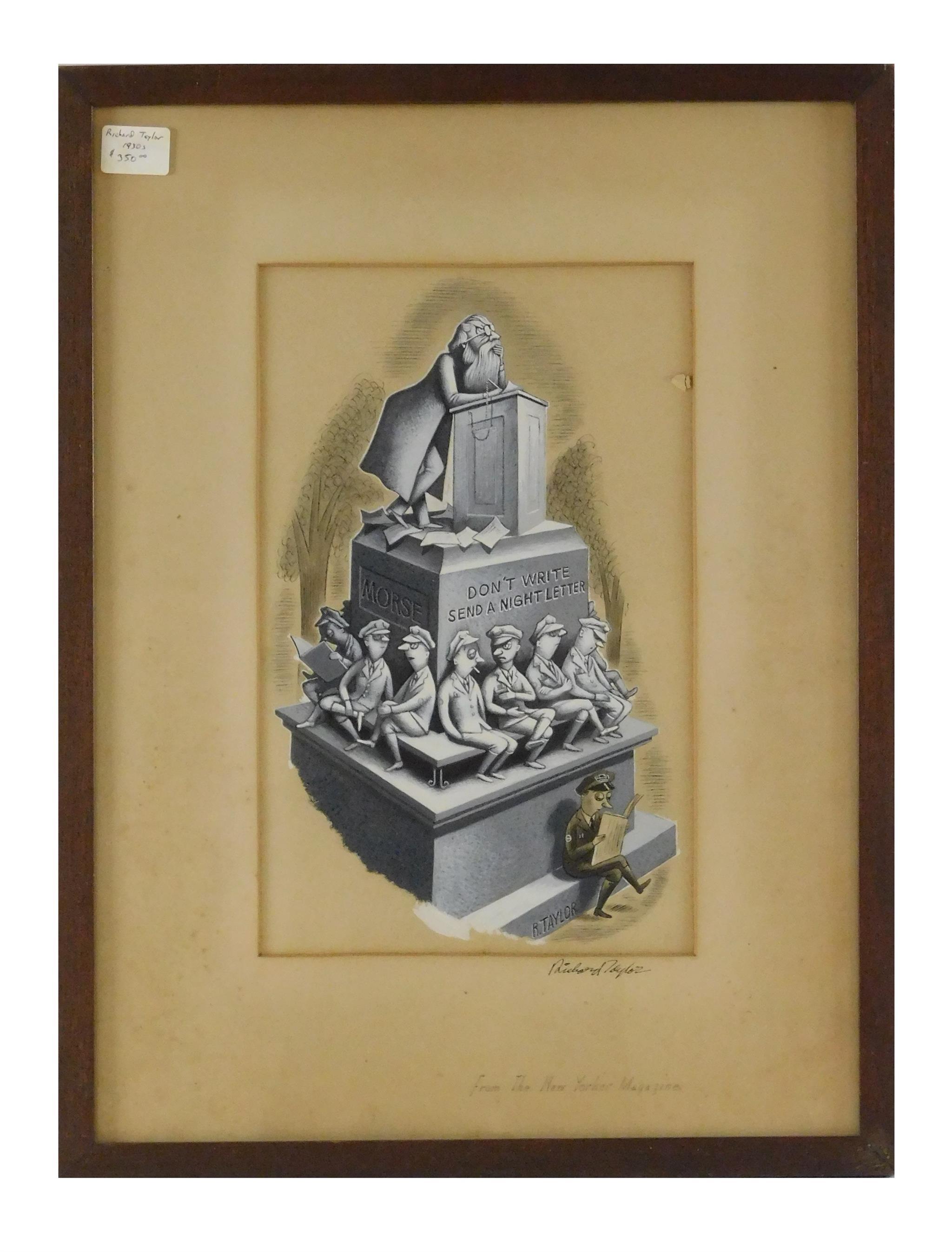
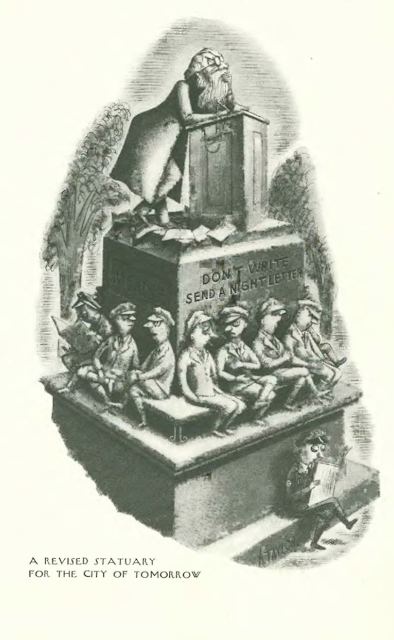
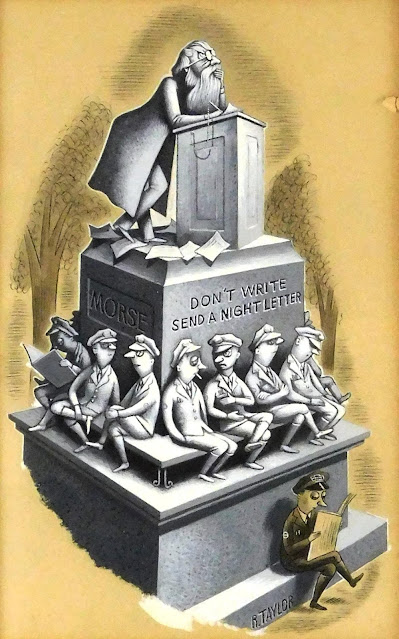
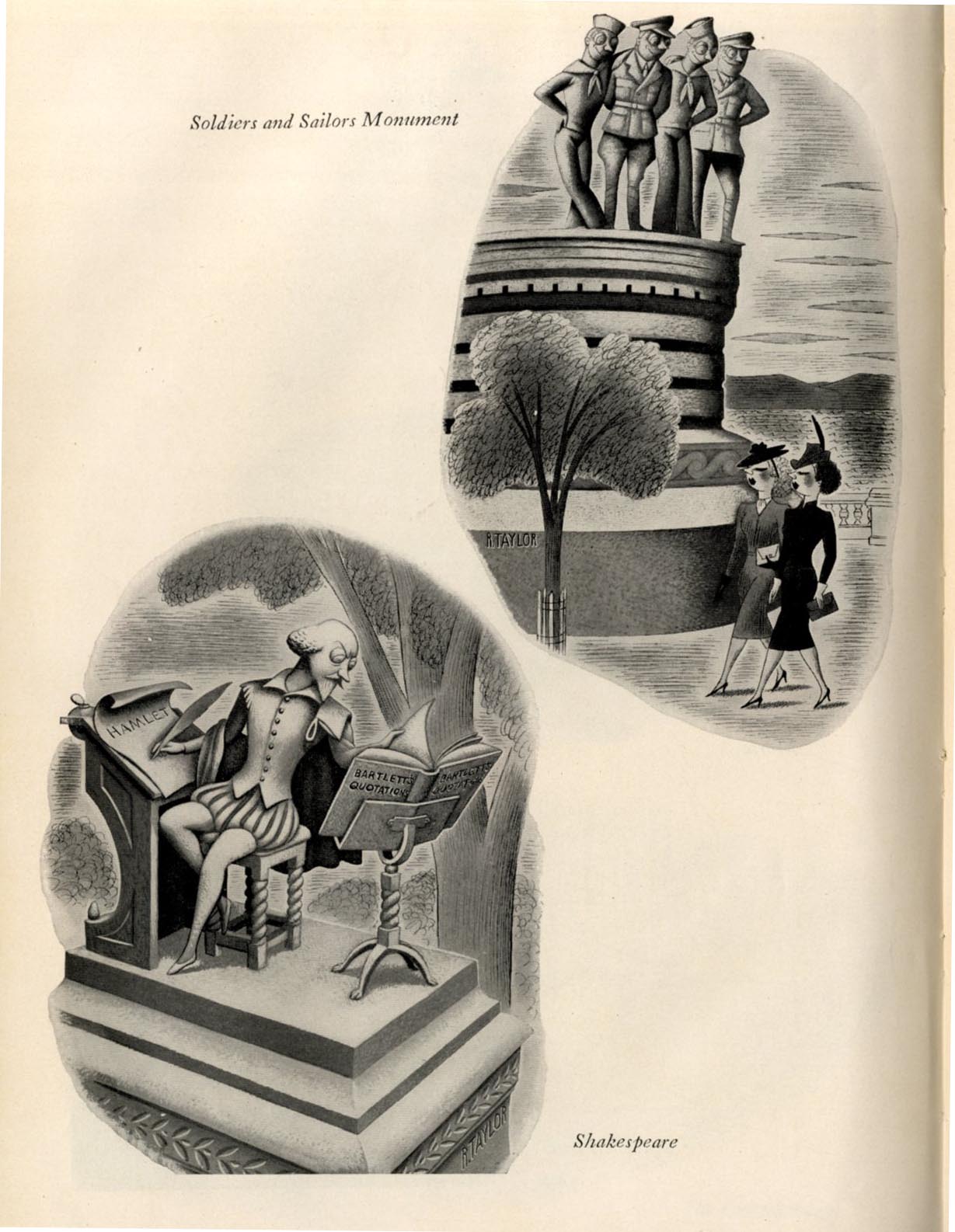
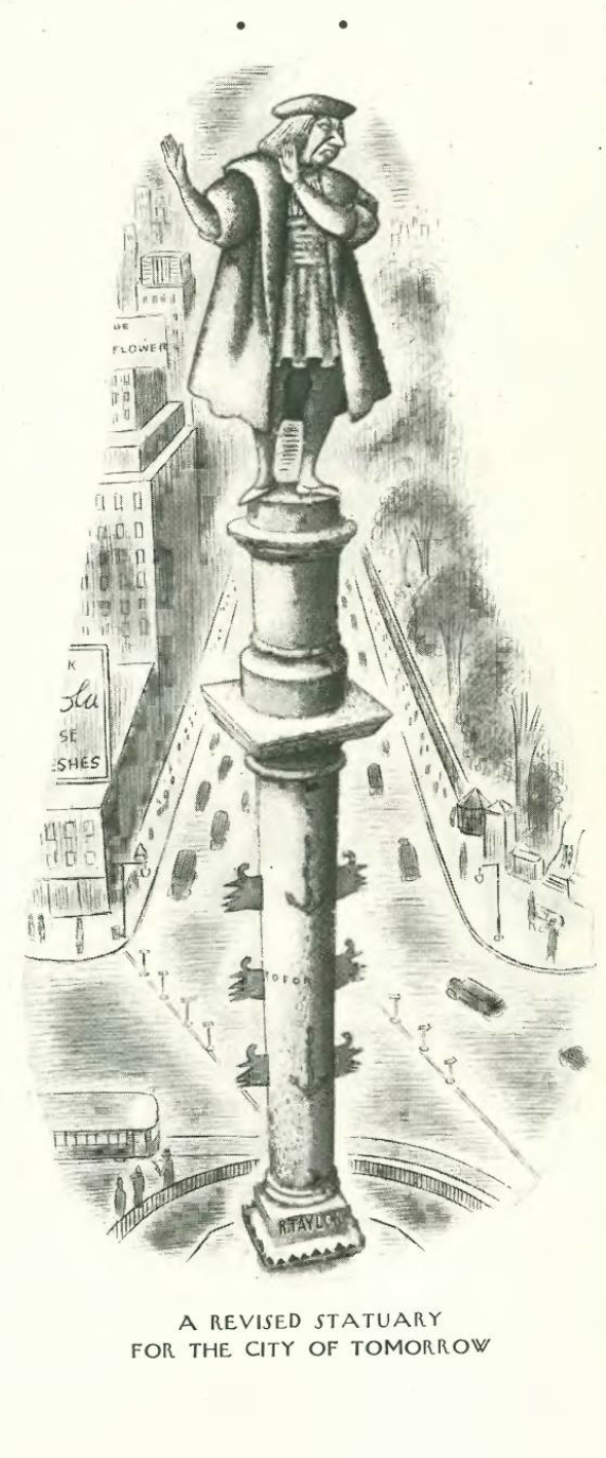
In 1938 and 1939, readers of The New Yorker were treated to a series of satirical statue designs by cartoonist Richard Taylor. Presented singly in the magazine, they went under the shared title A Revised Statuary for the City of Tomorrow. One of the originals from the set, Morse, was sold this past summer at Winter Associates, Inc., of Plainville, Connecticut. The frame has a price sticker of $350, and the work was given a presale estimate of $200 to $400. It is correctly dated to the 1930s.
A Revised Statuary for the City of Tomorrow: Morse
Richard Taylor
Framed original art
The New Yorker, August 27, 1945, p. 20


Some explanation might be in order today. Morse, the main figure of the public sculpture who is seen standing at his writing desk, is Samuel F. B. Morse, the painter and also the inventor of Morse Code. The monument's inscription Don't Write, Send a Night Letter refers to reduced rate telegrams sent overnight and delivered the following morning. These night letters had been popular, necessitating the many sculpted telegram messengers sitting on the statue's wraparound bench, but they were well in decline by the late 1930s; thus the lone living telegram messenger seen in the drawing. The telephone was making the telegram obsolete.
A Revised Statuary for the City of Tomorrow: Morse
Richard Taylor
Original art
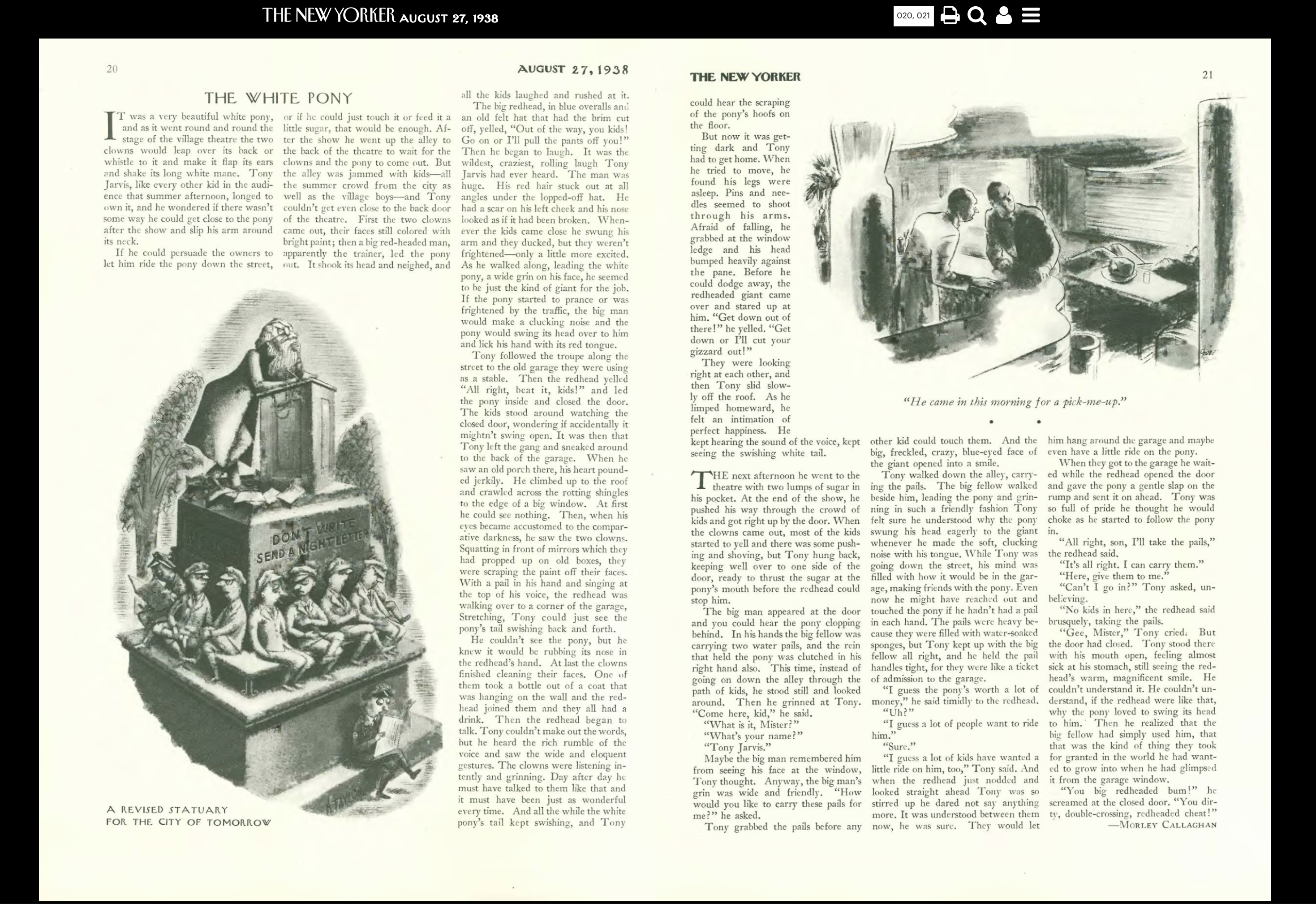
The New Yorker, August 27, 1938, p. 20


Taylor drew his signature onto the base as if it were incised in the stone, but he signed the matte loosely with his full first name. Now the signed matte is aging faster than the artwork it is meant to protect, and the new owner may have to make a decision about whether it should be removed and replaced.


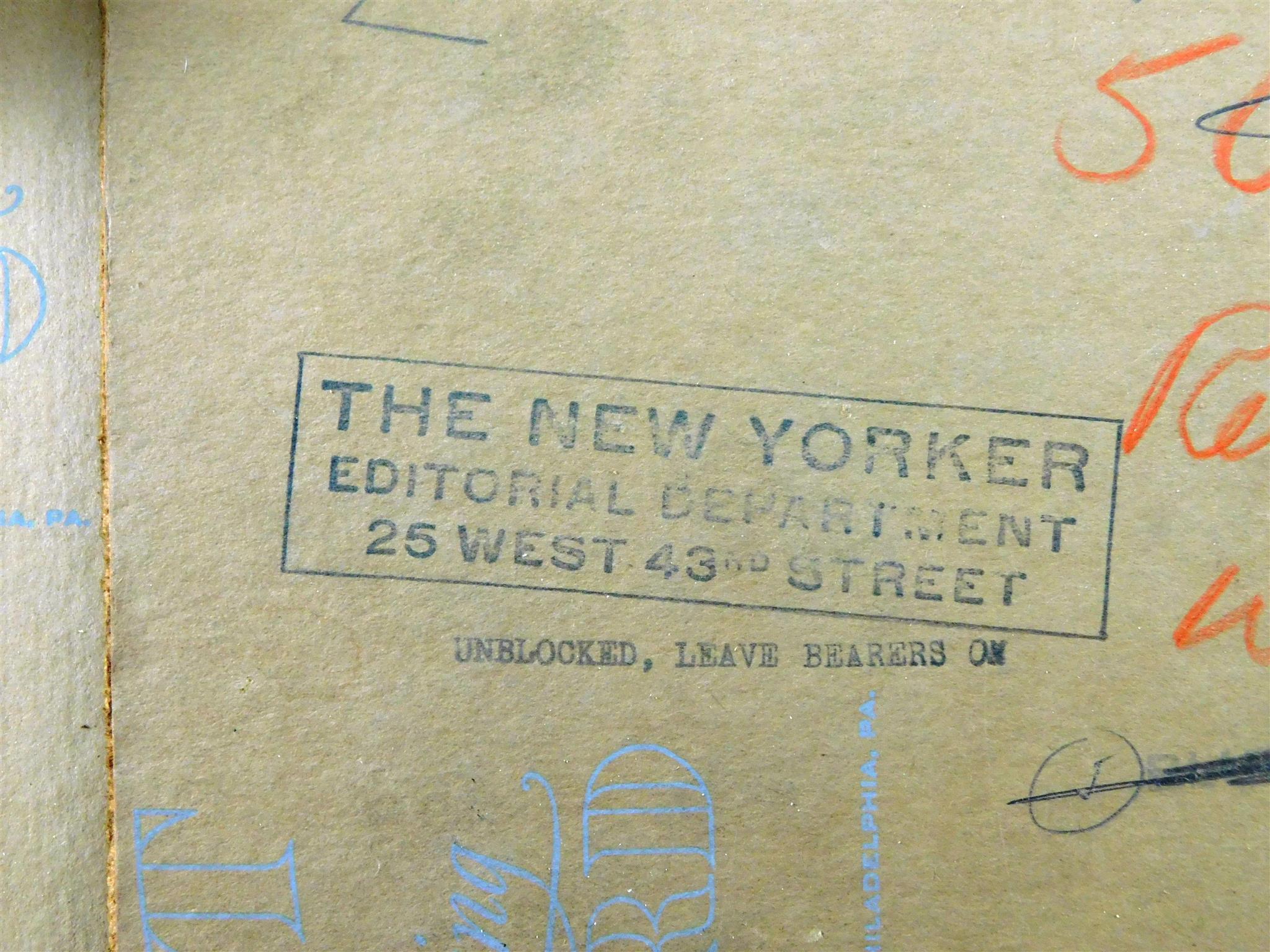
Verso


Richard Taylor
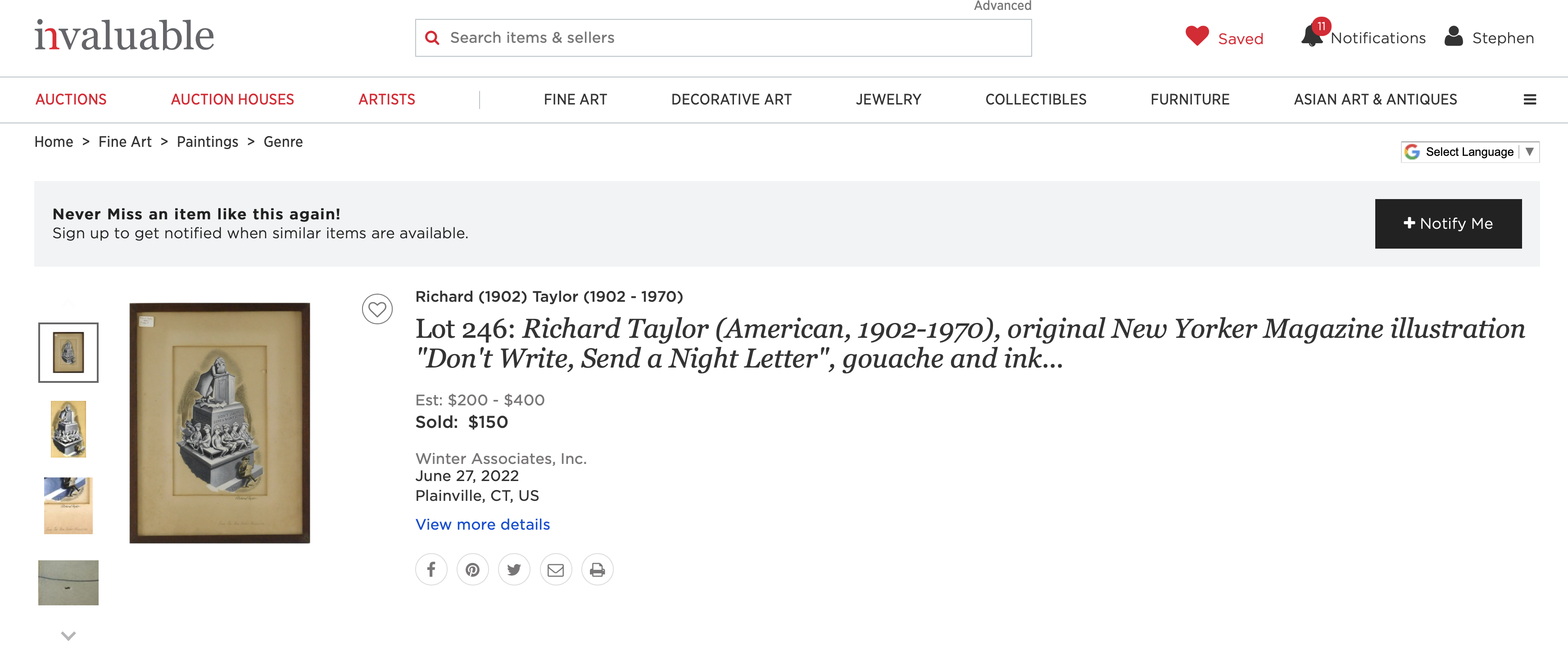
Winter Associates, Inc., June 27, 2022 sale


The $150 sale price does seem inexpensive for such a beautiful drawing, but then the gag itself may not have aged all that well for the modern reader who communicates by email and text message.


A Revised Statuary for the City of Tomorrow: Morse
Richard Taylor
Original art
The New Yorker, August 27, 1938, p. 20


Cartoons by Richard Taylor and Garrett Price


Most of the published Revised Statuary drawings, including Morse, were collected in The Better Taylors (1944).


https://www.fulltable.com/VTS/n/y/tt/b.htm


Then there are two others statues familiar to those who frequent Columbus Circle and Central Park:
A Revised Statuary for the City of Tomorrow: Columbus
Richard Taylor
The New Yorker, August 13, 1938, p. 21


A Revised Statuary for the City of Tomorrow: Cleopatra's Needle
Richard Taylor
The New Yorker, January 14, 1939, p. 27


A spot drawing by an unidentified artist [Tito?] and a cartoon by Richard Taylor


A spot drawing by Arthur Getz and a cartoon by Richard Taylor


Note: Having mentioned the book, I find it hard not to share a few images from a fine copy of The Better Taylors (1945 reprint edition from the World Publishing Company) currently listed on AbeBooks for $250, which is more, I'll just note, than the cost of the Taylor original seen above:


https://www.abebooks.com/servlet/BookDetailsPL?bi=30891484001&searchurl=an%3Dtaylor%2Brichard%26sortby%3D17%26tn%3Dbetter%2Btaylors%2Balbum%2Bcartoons&cm_sp=snippet-_-srp1-_-title2


And, finally, here are a few of the other images from The New Yorker's pages. Can anyone identify this spot artist possibly named Tito?
Spot drawing
Artist Unidentified [Tito?]


Spot drawing
Arthur Getz


04144